
Clearing Clutter: Creating Room to Grow
We are deep into Autumn, the season of letting go. Trees are losing their last leaves, the fruits have fallen from the branches and we can see through the bareness of the limbs.
We can mirror this season in our own lives by clearing the clutter – letting go of old, dead, useless things and thoughts, to make room for new growth and blooming.
Clutter isn’t just piles of papers and stacks of unsorted bills. Clutter can be anything you no longer use: trinkets you used to collect, clothes you no longer wear, wedding gifts from a previous marriage.
Not only do these things take up space in our homes, they keep us attached to a version of ourselves that we no longer are.
And until we let them go, we cannot move into the authentic person we truly are.
For several years I created artworks from found and recycled materials. I had full drawers and boxes, neatly organized and arranged with all kinds of objects and doodads for my creations.
Sometimes a friend would call, asking for some odd item and, sure enough, I had it.
But after two years of not making art, it occurred to me that, not only were all of these things taking up precious space, but they were making me feel bad that I wasn’t creating anything.
I kept the things for “just in case” I needed something, but realized that, I can always find them again if I do. (And finding them was part of the fun of it, after all.) The bottom line was, I was no longer that kind of artist and so I didn’t need to hold on to all of those things.
There was such freedom in the revelation.
I spent an entire weekend sorting through all of my stuff. I filled 4 boxes for Goodwill, 2 bags for trash and even made a pile of some real treasures to give to an artist friend. And yes, I kept a few special items that were just too wonderful to part with.
It was a great feeling to open up empty drawers, to feel the space I had created. Not just the physical space in the drawers, but that new space in my identity. I loved being able to stretch into the new questions: Who did I want to be now? How did I want to express myself creatively now?
It’s impossible to move into this place of transformation if we are living in a space filled with old things, old beliefs, old habits.
The first step toward any change is really examining what no longer serves us. From there we can find the courage and the desire to let those things go, to make space for new growth, new questions, new possibilities.
So what things, beliefs, habits are cluttering your life and keeping you from being able to ask new questions?
As we move into this season of letting go, what are you ready to let go of that is no longer serving who you want to be in your life?
Please share your thought by clicking on the Comments!
[ssba]The Whole of the Heart

As you know, I’m spending the month of November getting reacquainted with my creative heart. It is great fun to hang out in the studio, tearing images from magazines and calendars, playing with patterns and colors and composition. I’ve also been shaping flying birds out of newspaper and sketching sculptures that I imagine building with found pieces of metal.
And I’ve been pretty easily able to stay focused on the play and process and not worry about producing product for the upcoming Arts Festival.
But what I didn’t expect was how emotional I’ve been, especially about missing Laddy.
Being a Mac workaholic seems to have kept a lot of this tender grief at bay since Laddy died in September. Now, with more time and attention spotlighting my heart, of course I’m going to FEEL other things more. Good stuff, fun stuff AND sad stuff.
Because the creative heart is not a separate place. The whole of the heart feels everything.
In fact, it’s probably BECAUSE of this deep grief that my heart begs to be more creative, more expressive. Because it’s a way for me to touch the sadness, lean into the feelings, move through the sorrow to some peace and healing and sharing.
This past weekend Marika, Mabel and I drove up north to spread some of Laddy’s ashes where we’ve spent many happy weekends camping. We parked in the day use area on the top of Mingus Mountain and walked the graveled road into the campground. The sky was big and blue and clear and, with the campground closed for the season, it was incredibly quiet. The only sounds were the birds and Mabel’s jingling collar and the breeze through the tall pines.
We sat on the picnic table in our favorite camp site and Marika told the story about the night it stormed and the thunder cracked right over our heads and the rain pelted the RV roof and Laddy was so scared that he climbed into the shower.
We walked along the road beyond the campground and crossed the cattle guard that Laddy got stuck in, and turned off onto the dirt trail to the pond, where he liked to swim. The water must have been cold because Mabel only went in up to her knees.
At each place I released a few finger fulls of Laddy’s ashes from the ziploc bag, the white chunks falling onto the dry brown grass and the finer particles blowing back onto me and leaving a layer of salty white dust on my hands. And each time I cried, feeling the enormity of his presence and his absence at the same time.
We had our lunch at a picnic table in the sun, then drove further up the mountain to the spot where hang gliders take off. We sat on big boulders and looked out over the expansive Verde Valley, to the red rocks of Sedona in the distance, pointing out familiar places in the terrain below.
We drove back down the winding mountain road, through Jerome and into the Verde Valley where we stayed overnight at the pet-friendly Little Daisy Motel. It was the first time Marika, Mabel and I had ever stayed in a motel together.
In the morning we headed to Dead Horse State Park, another favorite winter campground. We drove through the park, remembering the early morning pooper walks, and how Laddy would walk ahead of me on his leash, pulling me up the steep inclines.
We walked along the banks of the lagoons where people were fishing and we reminisced how there used to only be one lagoon and the rest was just a big open field where Laddy would dig for gophers. And how one time, we followed the trail really far, and found the dead flicker when we were walking with Zasu and Saffron, even more years ago.
I sat down on one of the benches, imagining how Laddy would sniff around for a while, then find a comfortable lying down spot, preferably in the shade. And I shared with Marika how this loss is so different than any other.
When I am missing my mom, I can hear her voice, even have a conversation with her. But Laddy and I had a more physical connection and I don’t know how to connect with his spirit. I can remember us doing things together but I cannot feel his presence now. And this makes me miss him even more.
We cried for a bit together, then headed down toward the river. We followed a trail to a small cove along a bank of turning cottonwood trees where Laddy loved to chase sticks into the water. His legs were so long and the water isn’t very deep so he mostly just stood in the water up to his belly. But then he would walk out to the very center where the water was deep enough and he could actually swim.
I stood at the edge of the water, remembering and crying and I spread some of his ashes in a circle around me. The water was so clear that I could see the streaming of green grasses underwater. I tossed the remaining ashes into the moving water. As they hit the water, they lit up like sparkles.
I’d love to hear your stories…. Click on the Comments below.
[ssba]Doing What You Love: How to Begin (Again)
We all have something we love to do. But for whatever reason, we aren’t making the time. Other things seem more important. We neglect to schedule it in. We put it off until someday.
But if we want to do this thing that fills our heart, we have to make the time.
It has to be a habit, a routine, a regular part of our daily life.
Routines become mundane. Often, the word habit has a negative connotation. We tend to break habits, think of bad habits.
So why not, instead, create an habitual ritual.
A ritual is sacred. Important. Meaningful.
Like walking the dogs. Feeding the birds. Drinking your morning cup of coffee. An habitual ritual happens at a set time every day. Not every other day. Or once a week. But every day. Even if something else seems more important.
Nothing is more important.
You’ve learned this by NOT showing up. By talking yourself into other things, out of THIS thing. But then, you feel a hole in your heart, and food can’t fill it. Sleep can’t fill it. Not even dog kisses can fill it.
Only doing what you truly love can fill it.
It could be painting. Or exercising. Or learning a new language.
For me, it is writing.
How words miraculously appear on blank paper, flowing out from the end of my hand as if by magic. Sometimes they are boring, simple, repeating rhymes that any five year old could write.
But when I stay with it, a sentence forms, an image appears and a story unfolds like a fancy napkin in my lap and I just watch it, breathe it, follow it. Without censoring, without spell check, just allowing the words to lead and flow and color the page and I realize that it’s not a hole in my heart at all, but a filling, an overfilling, an overflowing and THIS is what I have been missing. This is what I have been aching for. THIS is why I write.
And so, even on the days when all I can write are silly rhymes and simple descriptions of tall trees and a sky that is only blue, I must make it a habitual ritual to show up. Because I want to write.
How do you create an habitual ritual?
You show up. At the same time everyday. Every Day. And you remember how much you want it. You come back to the WHY of doing this thing in the first place.
You honor the time, you honor yourself. You honor this thing you are setting out to do.
You pick up your paint brush, or put on your running shoes, or poise your finger pads over the grooves of the keyboard and you begin.
And the next day you begin again.
Create the ritual.
Become the ritual.
Because it’s the only way to your heart.
I’d love to hear your comments. Please share them with me and my readers by clicking on the Comments.
[ssba]
Let Your Heart Be Drawn

by the stronger pull of what you really love.”
~ Rumi
My biggest take away from Patti Digh’s camp last month was the deep connection to creativity, both in others and in myself. Being around people who make art and music and love to write is rich fuel for my own creative soul.
I was deeply inspired by the poets who stood up and spoke strong words, by the songwriters who sang their own lyrics, by the painters and jewelers and art makers who displayed their works on simple black tablecloths, all claiming, “Yes, this is my voice, this is my work.”
I have been dreaming of getting back into a studio, to make things out of recycled materials, to focus on more creative writing, to follow the surges of great ideas and see what happens.
But studio space is expensive and hard to find in Morro Bay and I had no vision of what I’d do with the stuff I made.
Years ago, when I lived with Marika, I spent hours out in the garage making art and writing fiction. My art supplies were neatly arranged, I had clean work surfaces and an easy balance between Mac clients and studio time. I sold my art at festivals and art shows and even did commission work.
These days I’m a Mac workaholic, with no defined creative time or space.
But since we returned from our Southern vacation, I’ve been feeling the pull to honor my creativity. I’ve been spending time in the garage, touching surfaces, finding fun items that I had boxed up, remembering how much I loved being in the space and creating.
And I heard my heart– Why not stay with Marika another month and play in the studio?
WOW! I could so easily do that.
Sure, I miss the ocean and my daily beach walks, and yes, the dryness of the desert is a challenge to my skin and nose. But I bought nasal spray and eye drops and it’s not like I’m never going back.
The weather is Phoenix has finally cooled down. The studio is right there, ready for me. And Marika is just as excited for me as I am and she is delighted that I’m going to be here longer.
Since she got laid off last month, she’s been relaxed and present, cooking, birding and getting together with friends. We have been so enjoying the time together. And I love playing football with Mabel.
And so I am staying through November, with the intention to spend the majority of the working day out in the studio, playing with my writing craft and making some great art pieces.
And since I work well with deadlines and structure, I’ll be selling this new work at the upcoming Community Art Festival at Desert Song Yoga and Massage in Phoenix on November 23.
It is what I have dreamed of doing for years. I just never expected it to be here, in Phoenix, at Marika’s house, in the same space I used to call my creative home.
Oh, what happens when we let go and listen to our heart.
Comments? Questions? Please post by clicking on the Comments below.
[ssba]A Southern Travelogue
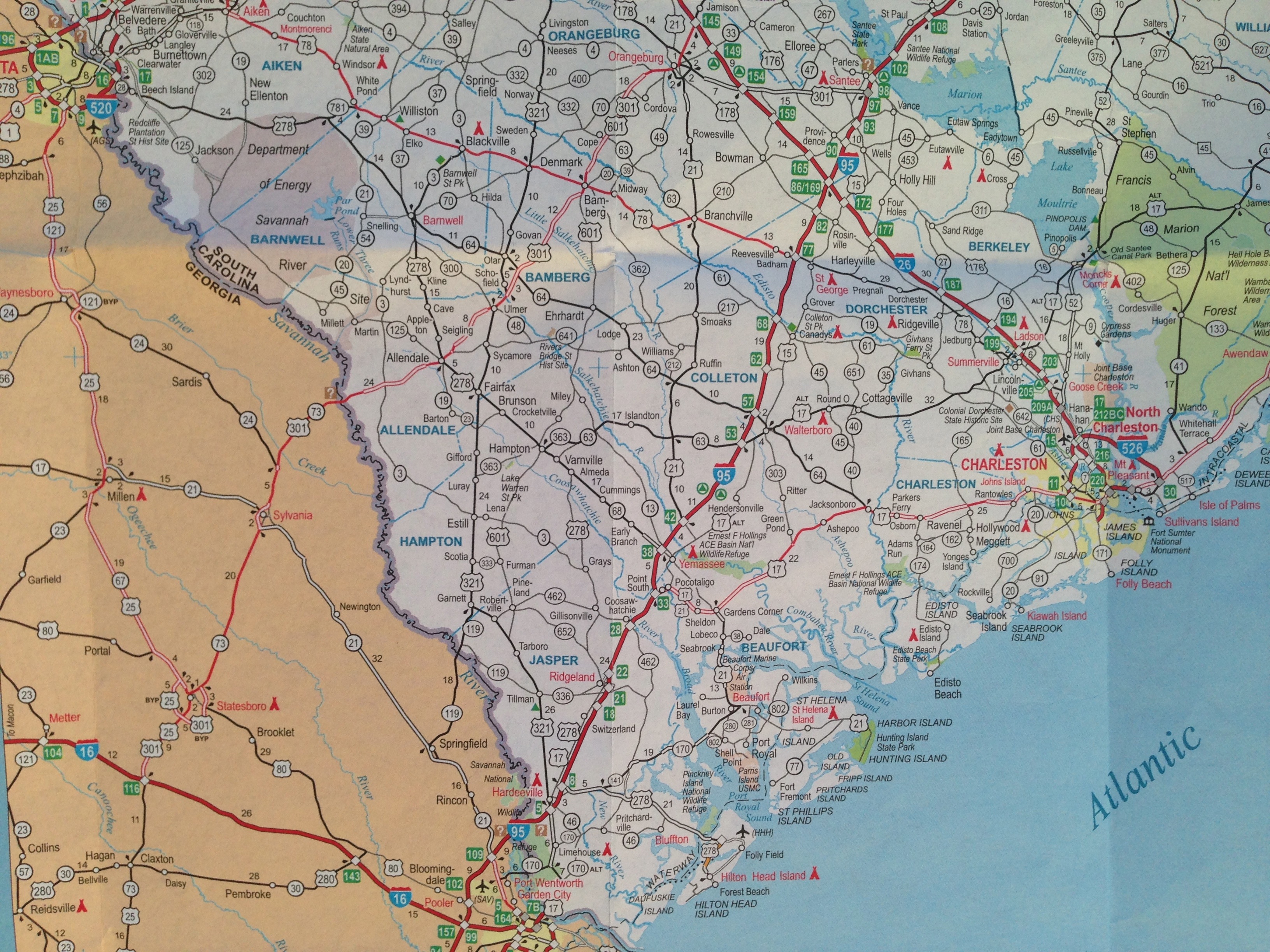
Marika and I had a great vacation exploring Georgia and South Carolina. The pace is slow, the trees are tall and the people really are friendly, y’all. Here is my travel journal from our trip:
Sunday:
A dear friend gave me a ride from camp to our rental condo in downtown Atlanta, where I dropped off my luggage, then took the MARTA train to the airport to surprise Marika. What a delight to see her smiling face when I met her at the baggage claim so that she wouldn’t have to pick up the rental car alone.
The condo was on the third floor of a twenty four story building, just a few short blocks to the aquarium. It started to drizzle as we made our way to the closest restaurant for dinner. We walked home in a downpour of warm, wet rain.
Monday:
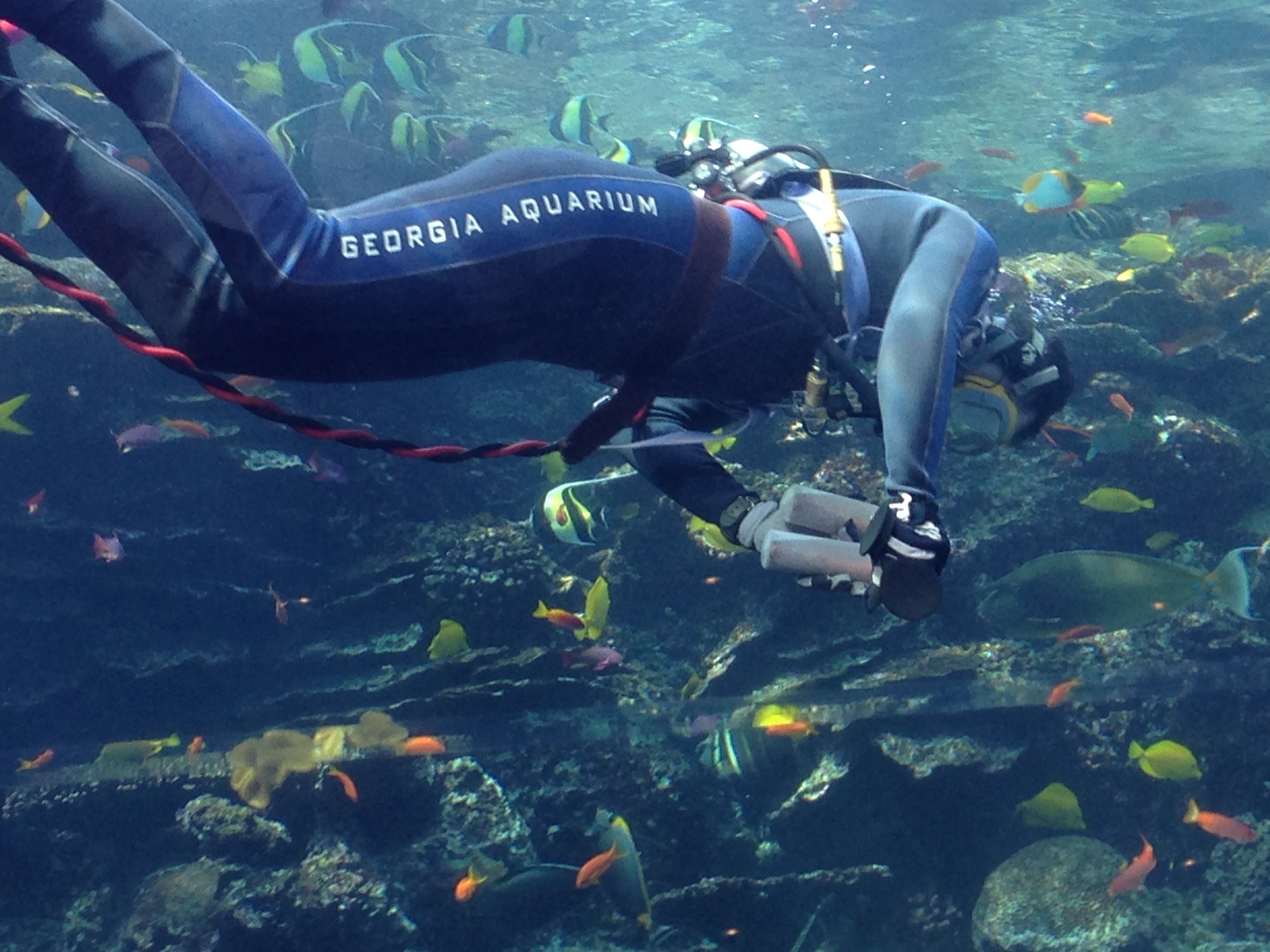 We spent the entire day at the Georgia Aquarium. We got there just as they opened on a relatively un-busy day so it was easy to see everything. Our favorites were the Beluga Whales, the dragon seahorses from Asia that look just like their name, the vivid rainbow of colors in the tropical coral reefs while divers squirted food from plastic condiment bottles.
In the Ocean Voyager exhibit, we walked though the famous glass tunnel, where fish swam above and around us as we glided on a moving walkway into the room with the 15-foot tall windows of the world’s largest aquarium tank. We learned that the whale shark is really a fish, the largest fish, growing up to 32 feet. I was mesmerized by the giant manta rays that somersaulted through the diver’s bubbles. Marika’s favorite was the spotted eagle ray, with a beak-like mouth, that flapped through the water like a flying bird.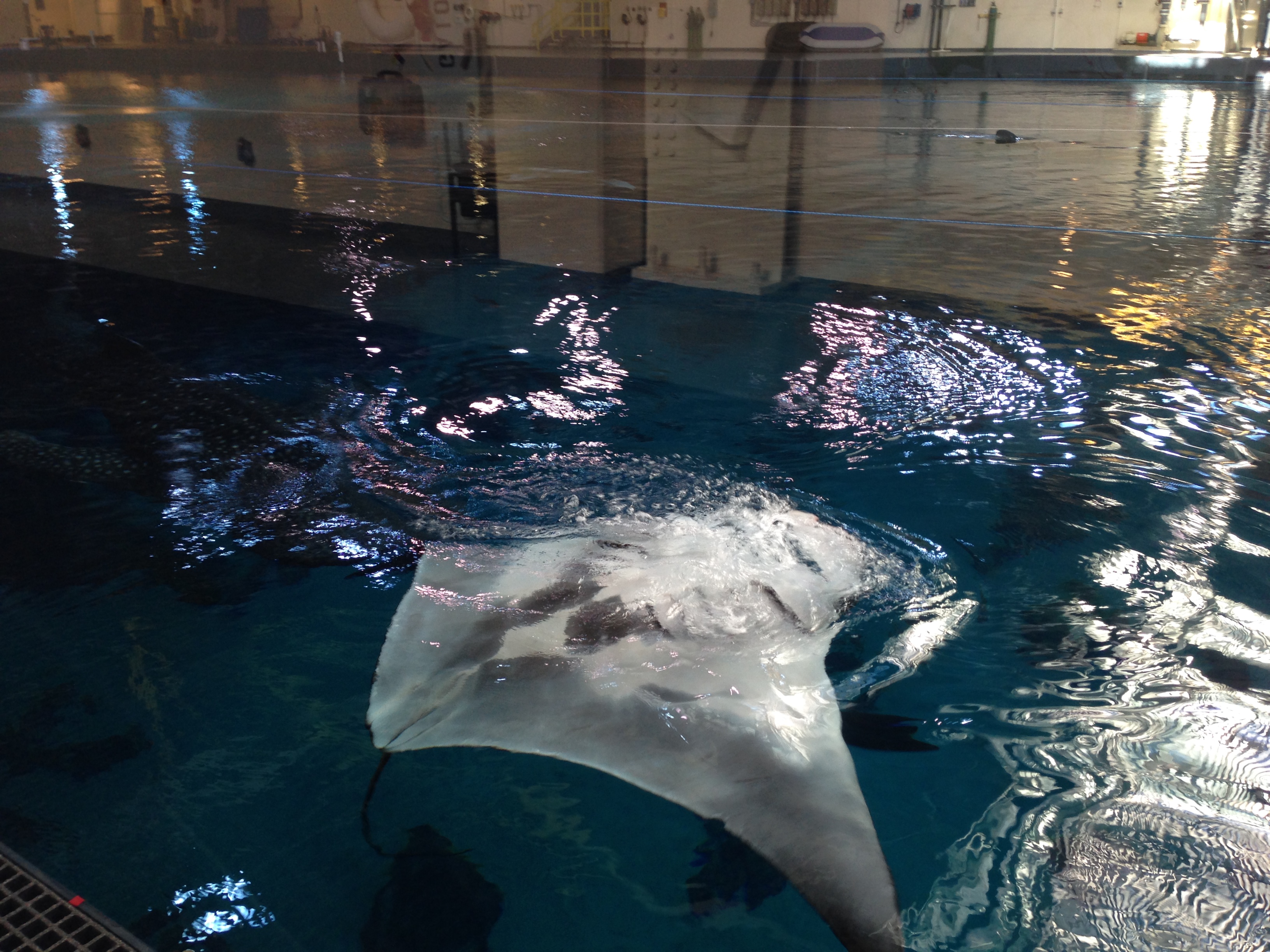
In the past I would have been bored and antsy halfway through the day, and so the biggest joy for me was seeing how I’ve grown, embracing the present moment 98% of the time.
After we had seen EVERYTHING, I asked Marika if there was something she wanted to see again. She chose the Beluga Whales and we saw the same tour guide for the third time, chatted more with her, then talked with another woman who happened to be in charge of guest programming, who took us on an impromptu behind the scenes tour of the Ocean Voyager tank. WOW!!! It looked exactly like the tour guide had described-the length of a football field without the end zones. What she hadn’t told us, was that the sides are not straight, but hourglass shaped, to give the fish more exercise and mental stimulation.
Our behind the scenes guide explained that, when they were designing the aquarium, the team visited aquariums around the world, asking what worked, what would they change, and then incorporated all of the information as they built the Georgia Aquarium.

On our walk back to our condo, we picked up Chinese food to go, and ate dinner on our screened in balcony as the sun went down and the city lit up.
Tuesday:
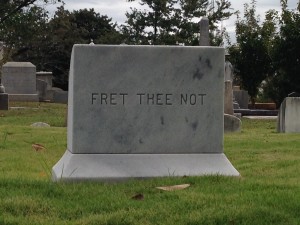
We spent several hours exploring the Oakland Cemetery in Atlanta as our history tour of the city. Headstones dated back to the early 1800’s. We downloaded an audio tour of the African American section and walked on cobblestones under giant magnolia trees, through designated Jewish and Civil War sections, many epitaphs so old they were unreadable.
We had our late lunch/early dinner at Six Feet Under, a pub and fishery across the street from the cemetery: fried catfish, hush puppies, coleslaw and corn for me, fried oysters and hush puppies with a dinner salad for Marika. So good and so much food that I took half home!
Wednesday, a traveling day:
The highways in the south are tall-tree lined, two lanes going in both directions with minimal signage. Taller than the trees billboards appear on the westbound side of the road when we approach larger towns.
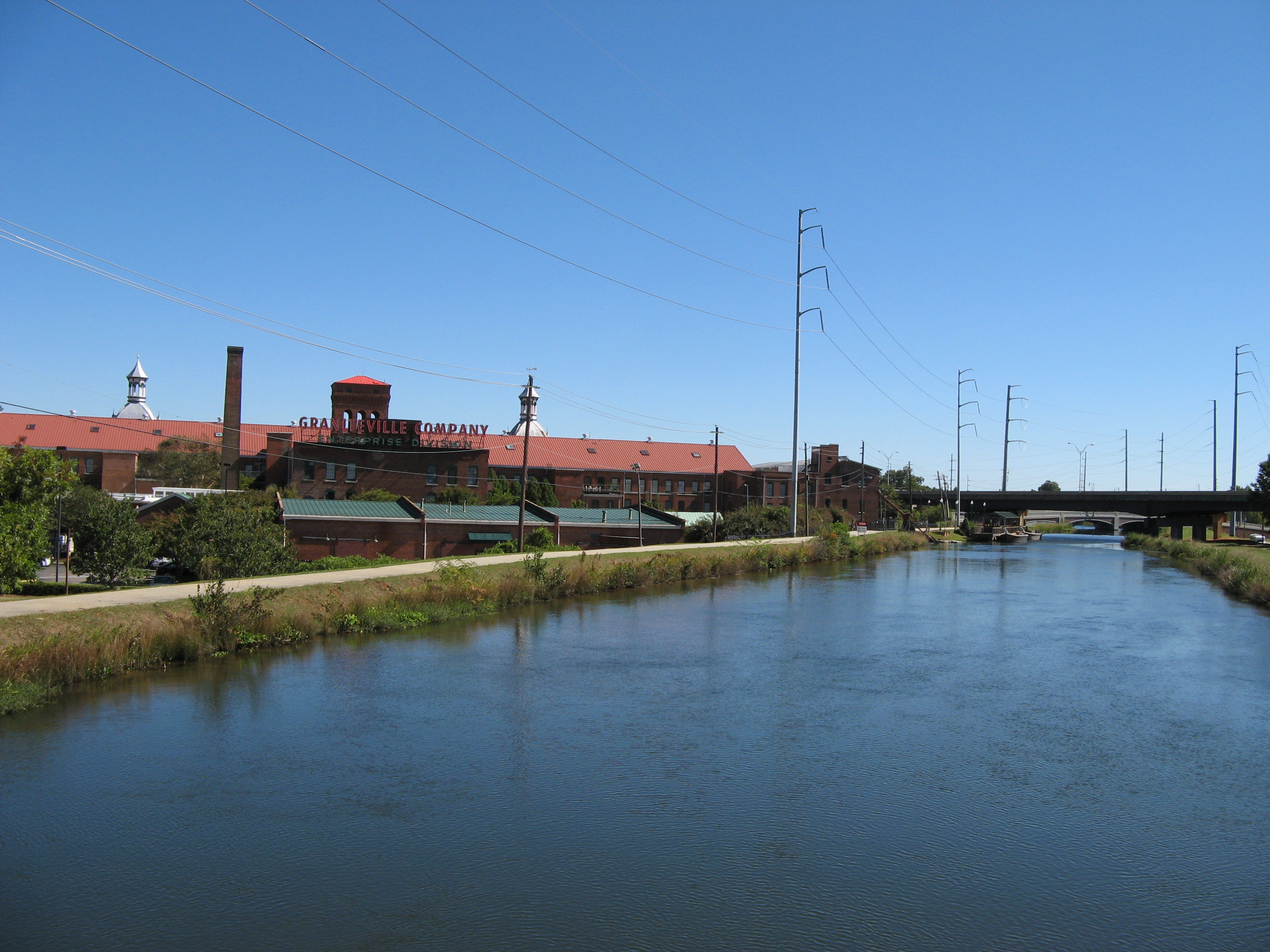 Our original plan for the day was to drive the three hours directly to our motel in Bishopville, South Carolina and visit Pearl Fryar’s Topiary Gardens. But Marika found a fabulous Civil War history boat tour along the Augusta Canal. She said, “So what if we got to our hotel in the dark?” I cried with surprise at my flexibility. And it was amazing! We even went to The Phinizy Swamp Nature Area to walk and bird.
And when Bob, our GPS, led us to the Bishopville Landfill instead of the EconoLodge, we both laughed in the dark, then called the motel for better directions.
As we drove, we listened to k.d. lang, Phoebe Snow and Joni Mitchell and I shared stories from camp, about cupcake Laurie, Canada crush Barbara and zip-lining Lisa–the adjectives helped Marika keep everyone clear in her head. It was like reliving the weekend in technicolor.
 On the surface, camp was about speakers and poets and writing. But deeper, there were lots of soft edges where vulnerability offered opportunities to say “Yes, and” instead of “Yes, but.”
I showed up so clear that I was there to be present, open, with no expectations. I took very few photos. I didn’t rush back to my room to hibernate. I didn’t even bring extra business cards. And I loved observing how I kept saying yes.
Even when I said no, I was saying yes to something else. And most deeply important to me, the people I connected with I REALLY connected with. For the first time at a large event, it wasn’t about filling a punch card to meet as many people as possible, but really seeing and hearing and discovering something about the people I did meet.
I gave my first personal story speech to a hundred and fifty compassionate listeners and I loved the experience so much that I am sure this is part of my new work.
Thursday:
It was another full day, doing more than we had originally planned. We had breakfast at the famous Waffle House across from the EconoLodge and met the Fryars.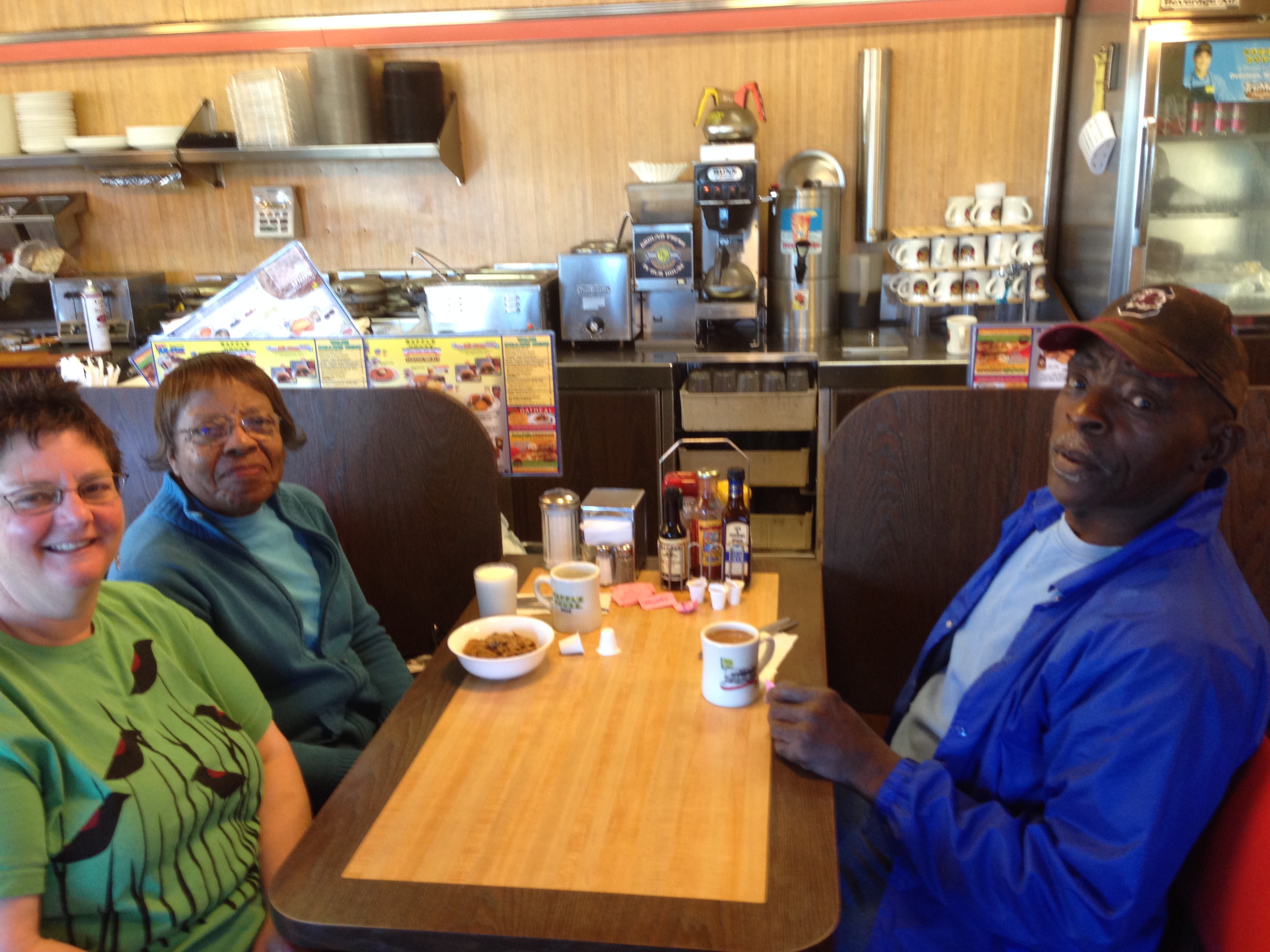
Ever since I watched the documentary “A Man Named Pearl,” I have dreamed of visiting his gardens. No one taught him how to bend trees, to turn a round tree into a square, to carve bushes into sailing ships. For 40 years he worked at a canning company, first in New York and then he was transferred to Bishopville, South Carolina to help open up a new factory. He received the same salary and so, with the extra money, he cleared a corn field, built a house and started experimenting with throwaway plants and trees.
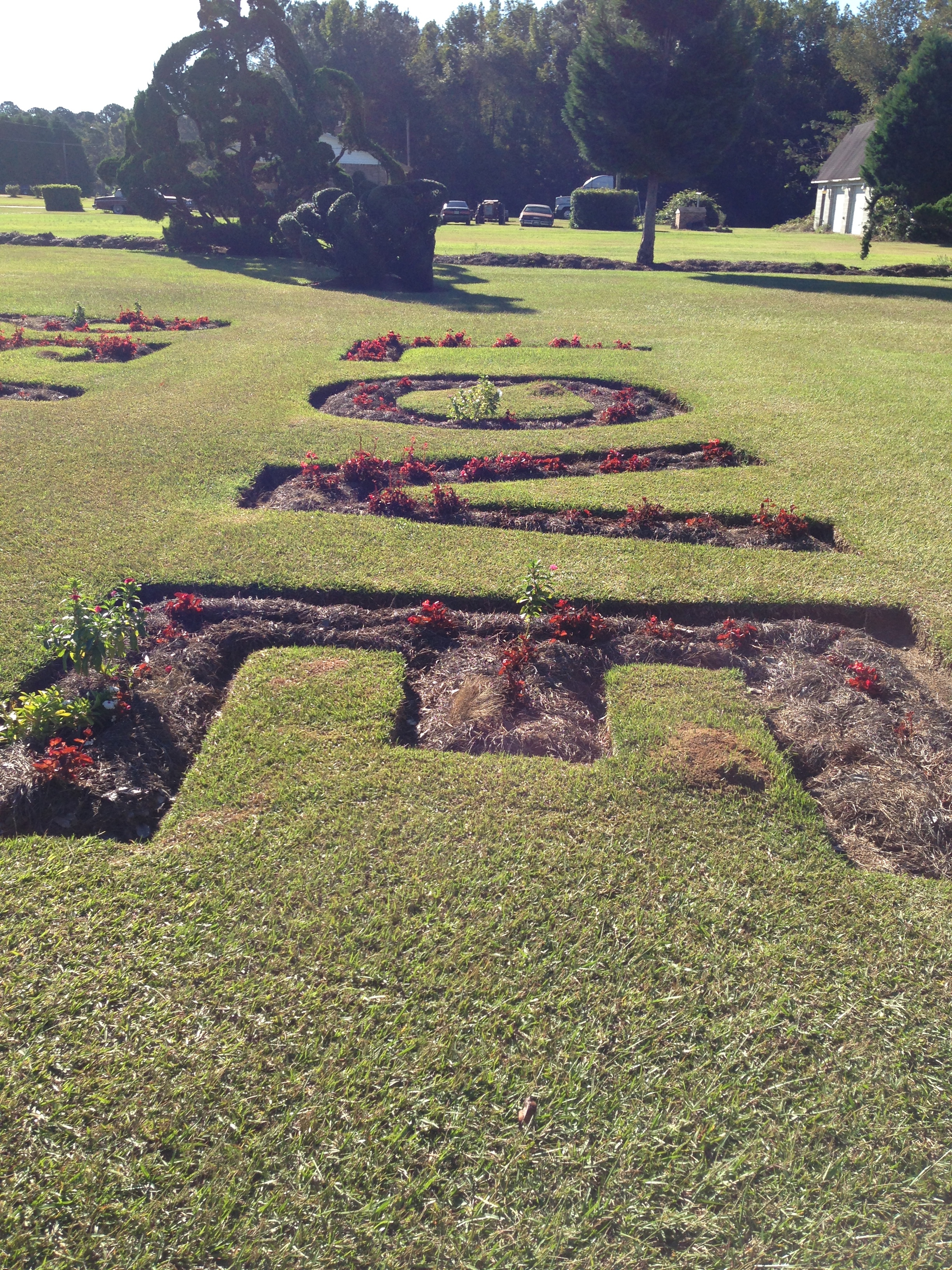 Pearl Fryar’s garden now has over 300 plants, trees and shrubs, and people from all over the world come to visit. And planted in the middle of many of his green sculptures are fountains and artwork made from recycled gears and wrought iron and discarded household objects.
As we walked through the expansive lawns, he rode up on his John Deere tractor, recognized us from breakfast and talked about his biggest passion: education. “Success takes work, passion and marketing” he said.
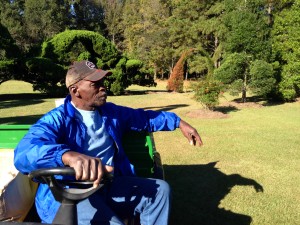
He tours the country, speaking to students of all ages, encouraging them to get an education, a trade. He thinks high schools should add on two more years, so that kids leave school with a trade, a vocation. And he has created a scholarship fund so that low-income kids can go to community college.
After the gardens, we visited The Button King’s Museum. Housed in an aluminum semi-circle of a storage building, the museum is a collection of cars, clothing and musical instruments, all covered in buttons. Dalton Stevens, aka The Button King, is now in his 80’s but he took up the hobby forty years ago because he had insomnia and didn’t want to make noise and disturb his wife’s sleep.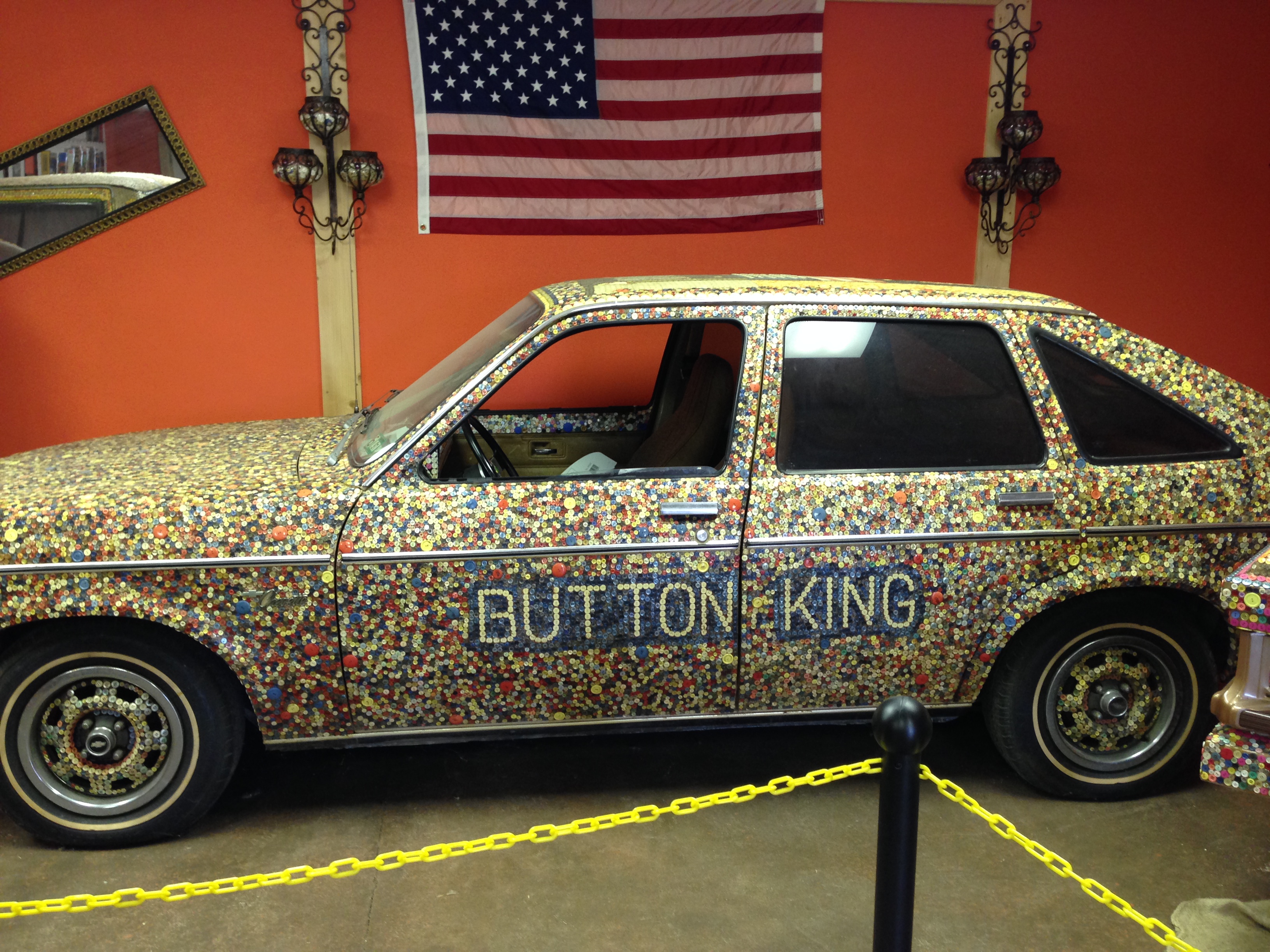
We followed another South Carolina back road to The Broom Place, so named because it was easy for the owner to spell. Susan Simpson has been hand making brooms and whisks out of broom corn for more than 45 years.
Her workspace is in a building built in the 1770’s. There is a small back room where she stores her supplies and a large front room, about 40’ x 15’, where she stands in front of an ancient broom tying machine that she bought from an elderly man in Asheville, NC. He promised to teach her how to use the equipment when she bought it, but she ended up teaching herself. She studied different brooms, how the thin strands of broom corn attach to the wooden handle, then learned how the old pulley system held the wire taut so she could wrap the strands.
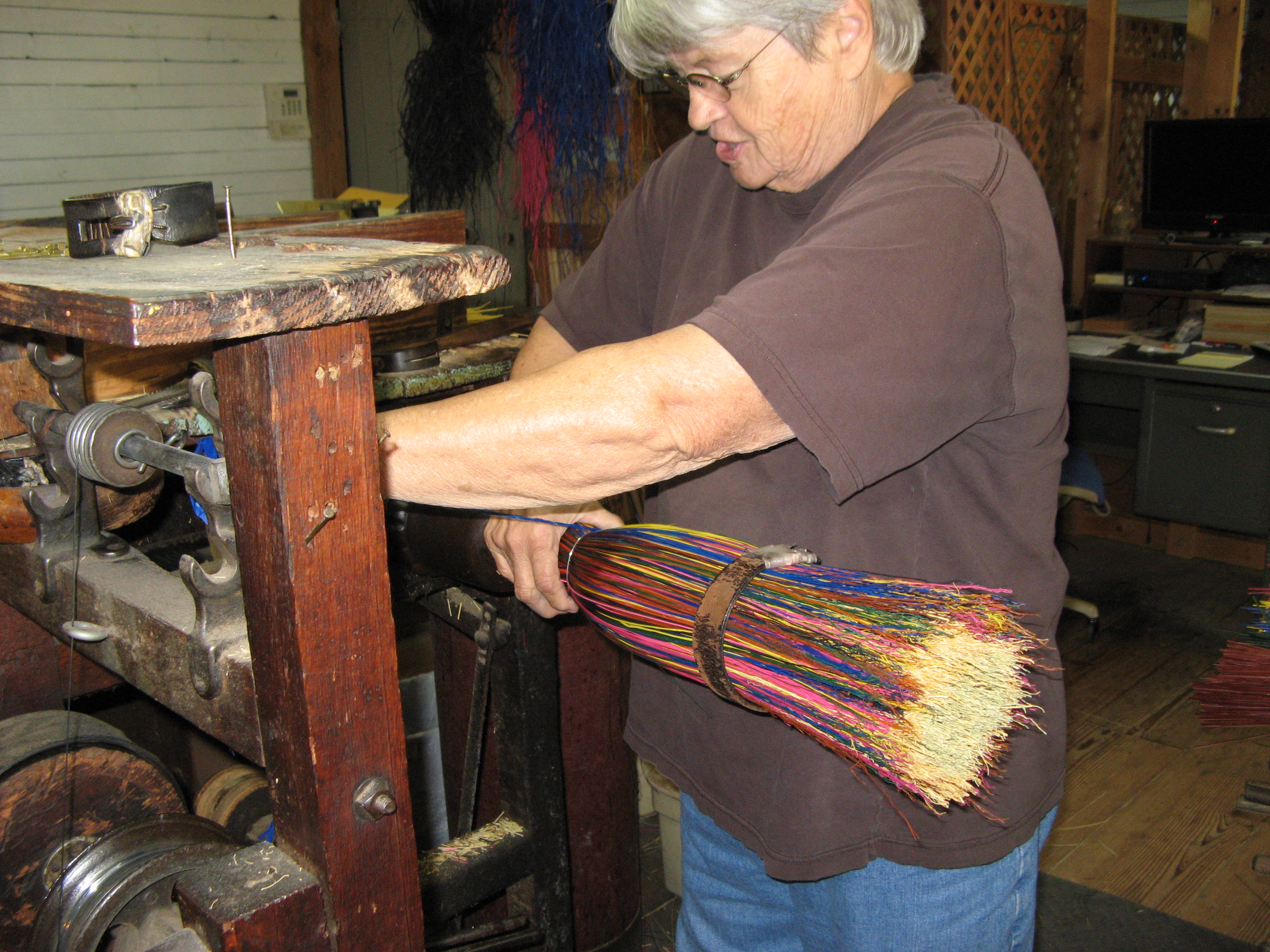 Susan is in her 70’s, stocky, strong, dressed in a t-shirt, jeans and brown boat loafers. Her silver gray hair is short, with bangs. Marika asked if her feet hurt from standing all day and she said “No, not at all, I’ve been doing it for more than 40 years.” She speaks with a slow, melodic Southern drawl, like an invitation to sit a while on a muggy summer day.
I asked her if she has an apprentice to learn the art and she said, “I had a woman write me to say she was interested in learning. I wrote to her but I never did hear back. She’s five years older than me, so who knows if she’s even alive anymore.”
When I asked about hiring someone to help with the business she said that OSHA won’t let her hire anyone because she might be tempted to teach them about the machines and they were not up to any kind of code, being so old and all.
The shop is open six days a week but she has no brooms in the store to sell. They are all custom-orders, backlogged about a year. And they are so inexpensive considering the time and quality and hand laboring, that Marika and I both dropped our jaws at the $20-$60. prices. Still, she makes about 3500 brooms a year and is happy.
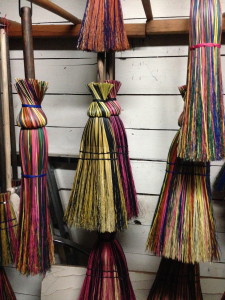 As if the whole broom making process wasn’t interesting enough, she also told stories about the Boykins, the family she rents the space from and who the town is named after. She said they’d had plantations on the land since the 1700’s and that they were all related to each other. I asked how old the last married cousins were, expecting her to say “in their sixties,” but she said, “They’re in their thirties, now. Two sons and a daughter. And they’re all a little slow, but I guess that’s what happens.”
We talked about stray cats and how her husband, 6’5” and 260 pounds, once unknowingly laid in bed, on top of their miniature dachshund and the dog slept through the whole thing. She told us about the famous last Civil War battle in town where they killed the last Union commander, and how the movie “Glory” moved the battle to Charleston because it was more glamorous.
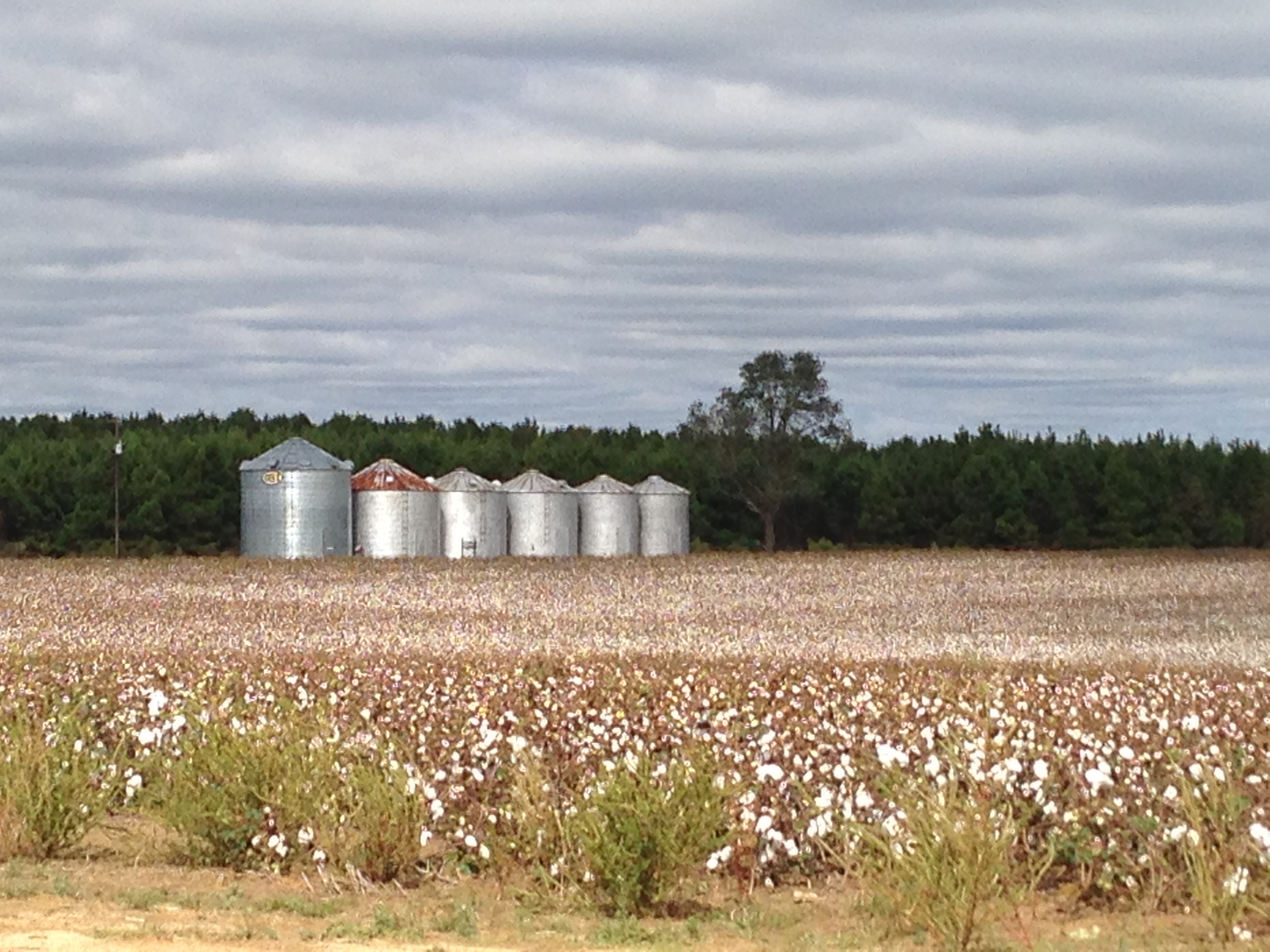 We left Boykin and drove along the thinnest black line on the South Carolina map, past soybean fields and blooming cotton and tall stalks of dried corn. We stopped for dinner at the Summerton Diner and had not very good Southern food, one meat and three sides. We got gas in a small town with a single block Main Street and a train depot before reaching I-95, the highway that connects Florida to New York City.
We made our way through Savannah’s five o’clock traffic, over the bridges and finally arrived at Fiddler’s Creek, our rental cottage for the next five days on Tybee Island. Before we even checked the rooms in the house, we walked out onto the covered dock that reaches into the tall grasses of the salt marsh.
It was low tide and the reedy grasses were as high as half a person. The setting sunlight tipped the trees in gold as a wave of cicadas screamed their evening rhapsody, sharp and steady, like a car alarm, getting louder as they landed in the surrounding trees. We had Vicks VapoRub on to ward off the mosquitos but it wasn’t working.
Friday:
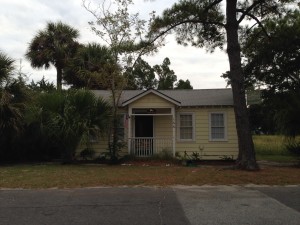
Our one bedroom cottage was built in the 1930’s and the wood floors now slope at a very noticeable angle toward the marsh. The rooms are large with lots of windows but we spend most of our time on the screened porch out back just a few feet from the marsh. There is also a covered dock with a ten foot long farm table and several chairs and chaise lounges, but there are also sand gnats and other biting bugs.
We slept in and now it is after eight, and the sun is already above the trees across the marsh. Marika is out on the dock with her coffee and binoculars, scanning the reeds and the trees to find the source of the chittering. I am having my coffee on the screened porch where the gnats can’t bite me. The neighbor kitty, who I have named Chuckles, is enjoying a Marika-scratching.
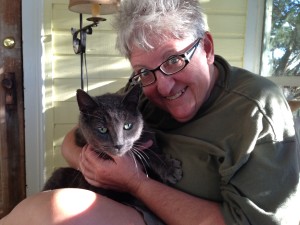 We’re both moving slower than we have all week, but we still have a day of adventures: touring the Tybee Light Station, finding the beach and making plans for a private birding/dolphin boat tour, all while avoiding as much of the weekend Pirate Festival as possible.
It is now mid-afternoon and the tide has come in, the water is at least three feet higher than this morning. A motored boat is winding its way through the tall salt marsh grasses toward the open ocean.
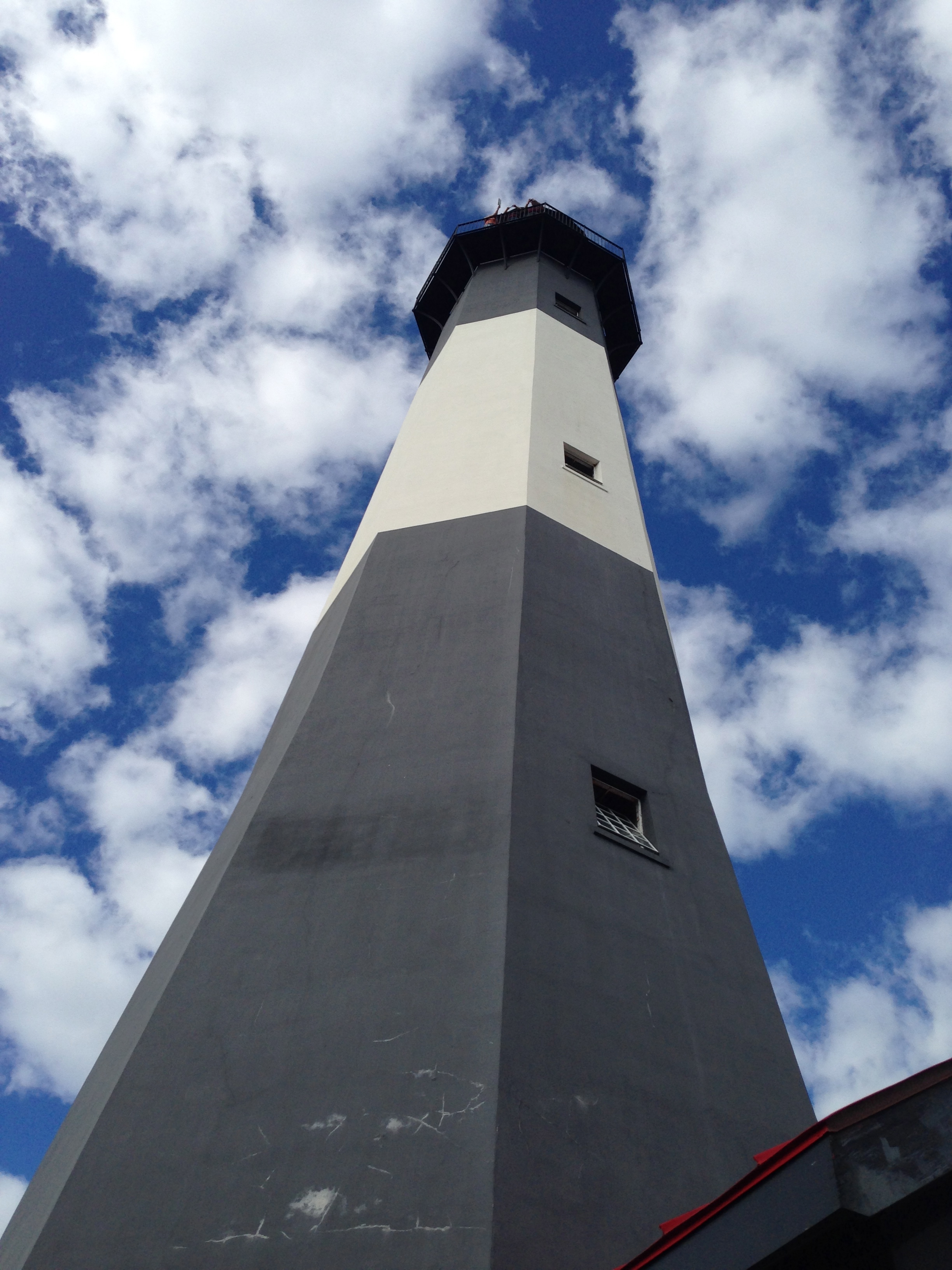 We climbed the 178 steps of the Tybee Light Station and took panorama photos of the ocean, the channels and the Savannah River. I enjoyed the Tybee Museum too, especially the photos of summering folks in the 30’s, the exhibit of Girl Scout stuff and an orange amusement park helicopter ride that brought me right back to Happyland from my childhood.
After our Light Station touring and a delicious lunch at the Sundae Cafe, we stopped at the local IGA and now have real bug spray so we can sit out on the dock and enjoy the rest of this sweet afternoon.
Sunset on the dock: dragonflies, warblers, clicking crabs, water-spouting oysters, kingfisher, great egret, green heron, gulls, a flying duck, jumping fish and cicadas that are not nearly as loud as last night–they must have been welcoming us!
Saturday:
Marika left before the sun came up, headed to the beach to bird. But she set up the coffee for me, sweet thing. It is quiet on the salt marsh, the sun is just now rising over the trees, crows are announcing the day. Chuckles, the short haired gray neighbor cat, meowed until I opened the back porch screen door and is now standing at the back door, waiting to be let in.
It was a relaxing morning, with an early lunch at AJ’s Dockside where we watched a family of four load into a sit-on-top kayak and paddle into the bright sun. It is too warm and sunny for this gal to kayak so instead, we took a three hour private boat tour around Little Tybee Island, just the two of us with our guide, René, and Bennett, our skipper.
We breezed along the waterways that cut through the tall marsh grass, sometimes going as fast as 35 mph, sometimes with the motor off, just watching and listening.
We saw so many birds: brown pelicans, kingfishers, several kinds of terns, cormorants, all kinds of shorebirds, greater egrets, lesser egrets, great blue herons, green herons, black capped night herons, even a group of WOOD STORKS!!! ( a first for us!), clapper rails–often heard, rarely seen!!, bald eagles, osprey, and an alligator!
And we saw DOLPHINS, up close, hugging the edges of the grass as they fed, then diving and resurfacing with their sleek and easy rolling motions right in front of our boat!
It was amazing to be out on the water, moving between the the tall grass, no sounds except birds flapping and dolphins breathing through blowholes! WOW! WOW! WOW!!!!
We ate dinner at the cottage on the screened porch: big salads with hard boiled eggs and tuna. Chuckles the cat, came by and enjoyed some tuna with us.
Sunday morning:
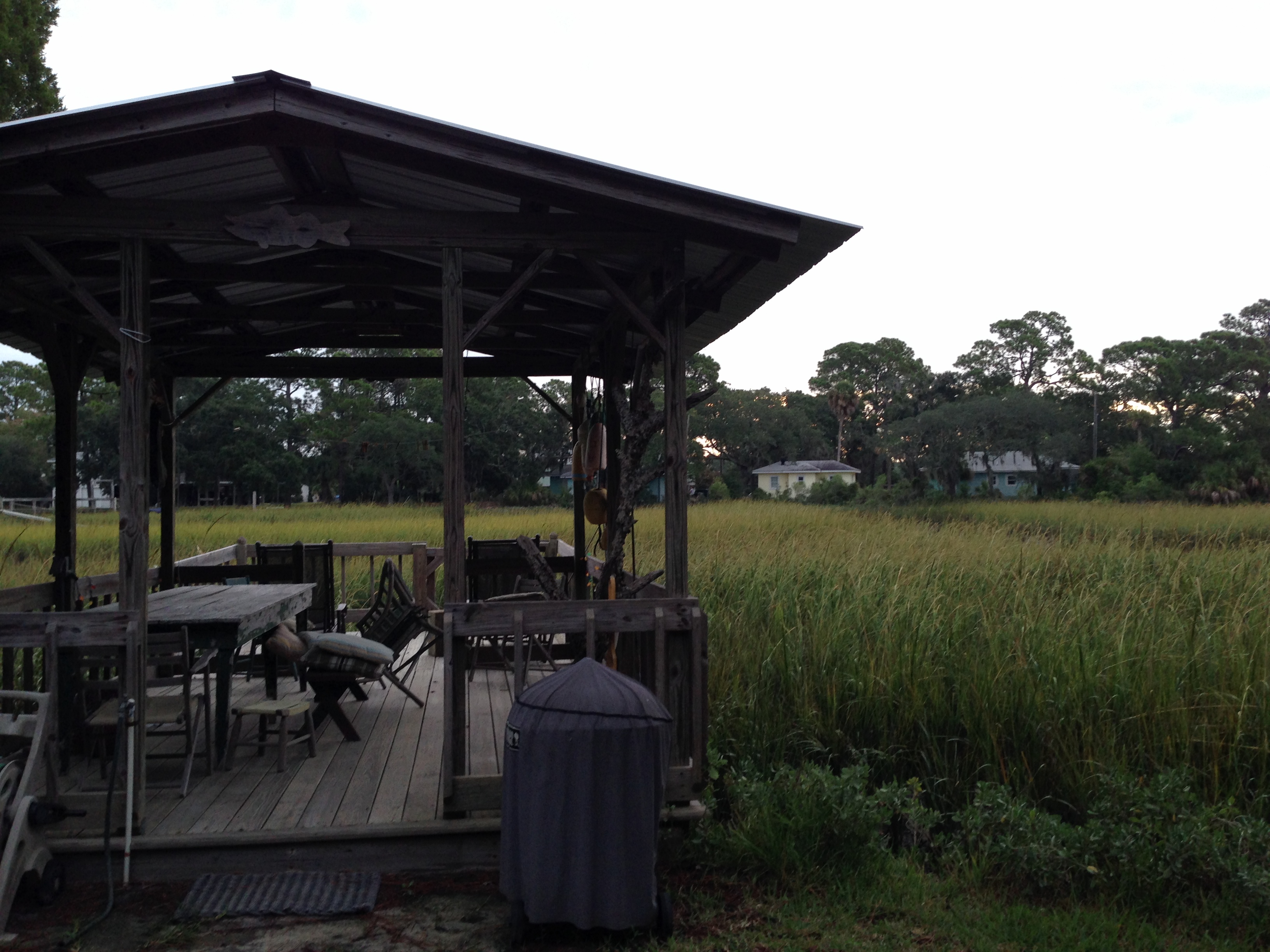 It’s overcast and a bit muggy but there is a slight breeze. Marika is off birding again, I am on the dock, listening to the fast- flapping of great egrets over the marsh grass and popping shellfish and squirting oysters in the low tide mud. Two-inch long fiddler crabs crawl across the weathered plank floor and Chuckles has arrived, hoping for a second helping of tuna.
Vacationing keeps us so busy and in some ways, removed from “real life.” This morning I had a flash of, “When I go home to Cayucos, I will feel Laddy’s absence all through me” and I cried….
I rented a bike this morning. It was my first time on a beach cruiser and my belly didn’t get in the way! I rode the bike trail, past houses, down to the lighthouse, through the park, and stopped at a garage sale. I was glad I had a basket for my fab purchase: a Royal manual typewriter, inspired by Maya Rachel Stein’s Type Rider Project and her writing workshop at camp.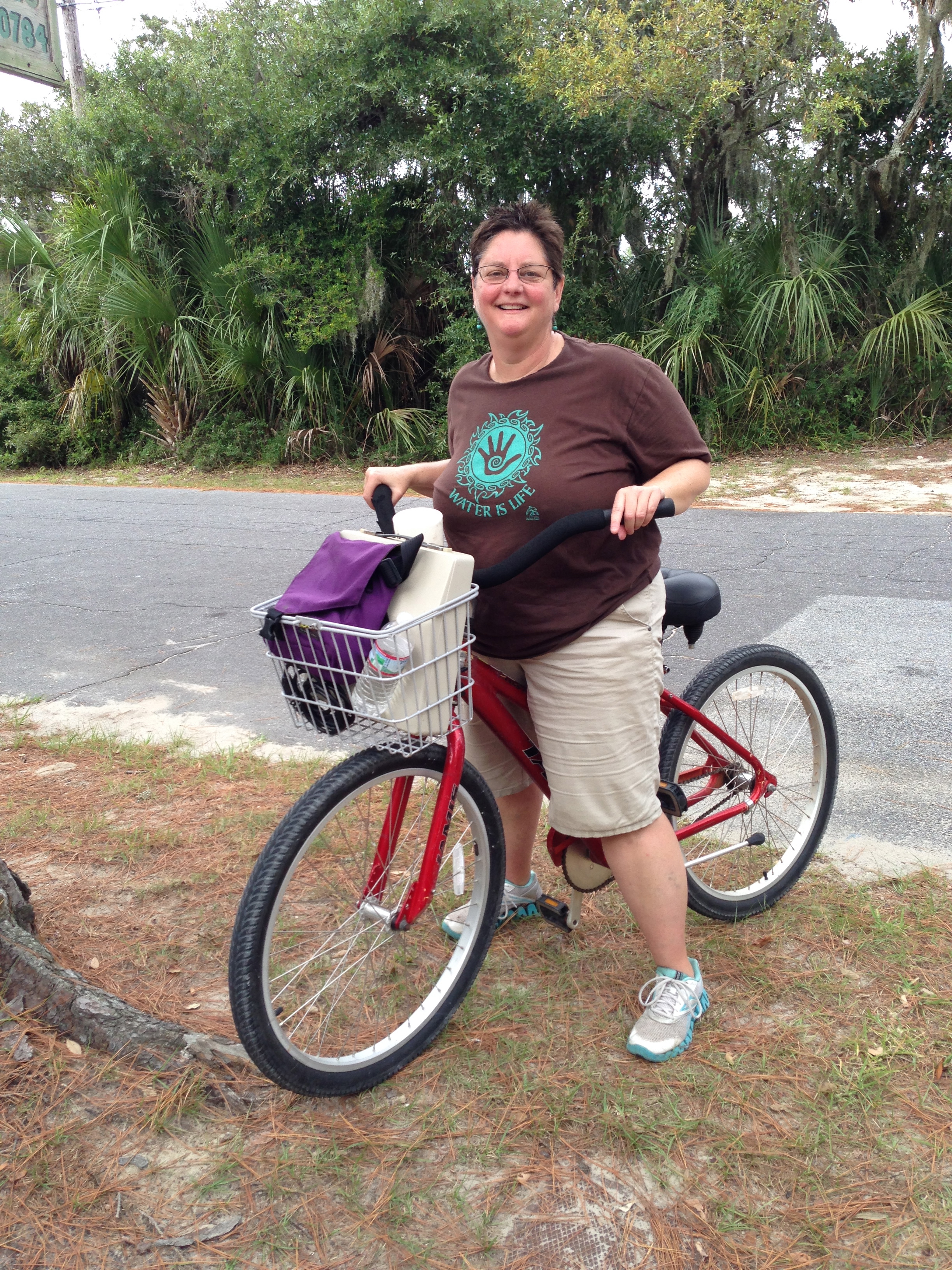
In the workshop, she handed out 4×6 index cards. By keeping the page small, she suggested, you can jot down four simple memories, or only write enough to fill one side of the card. And then you can read it and mine for something you might want to write a piece about.
This idea of writing in such a small container excited me. It’s not intimating, it’s not about a finished product, it’s more about honing the craft. This idea of small and simple appealed to my writer’s heart.
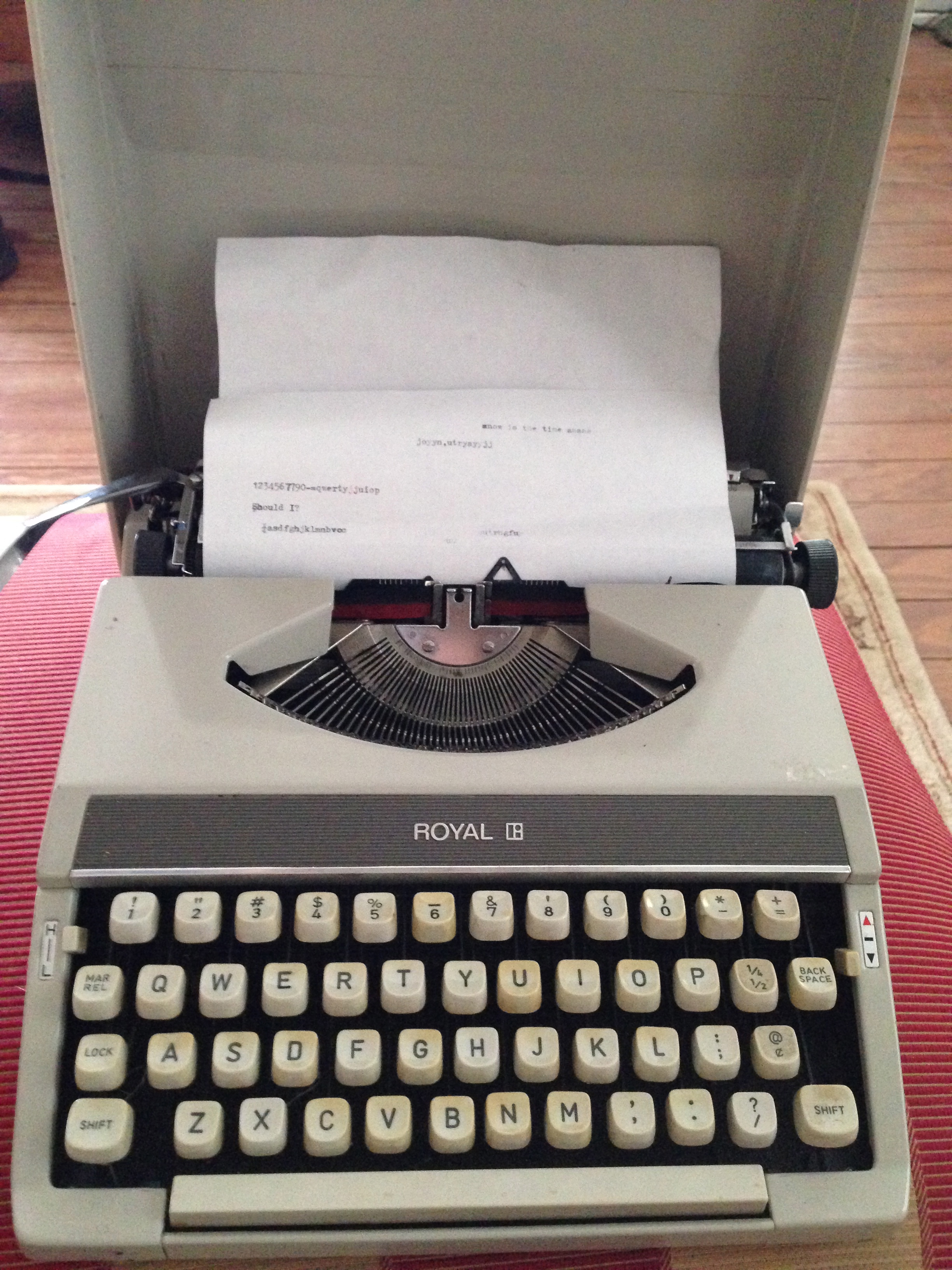
And so today, on my bike ride, when I saw this small portable typewriter for sale, WITH a typing course book for only $30.00, I knew I wanted to take it home. With all of the blogging and Mac newsletters I write, I feel I have no space for creative writing. But with index cards and this new medium, I’m excited to play with words and see what appears.
We are sitting on the dock under an overcast sky. Three kayakers paddle into the channel with the rising afternoon tide. Marika is scanning the grass and trees, the only sounds are the chirps and cicadas and the click clack of the typewriter keys. I smile every time the bell rings when I get to the end of the line.
Monday:
Our low tide shorebird boating tour with the Georgia Ornithological Society was cancelled this morning due to a high wind advisory. So instead, we drove into Savannah and enjoyed the Historic Trolley Tour, through the historic section, past Victorian homes, around several park squares and along the original cobblestone road that led down to the Savannah River.
We learned lots of interesting facts:
• the original Georgia colony had four prohibitions: practicing Catholicism (because they were afraid people would be sympathetic with the Spanish invaders), alcohol, slavery and lawyers
• they rated cotton on a scale from fair to middlin’
• the large trees are called live oaks because they don’t lose their leaves and the Spanish moss hanging from them is an air plant that the original settlers tried to use as pillow stuffings but discovered they are home to chiggers
• the Historic Savannah Foundation was started by seven women in 1955 and is responsible for saving, preserving and restoring most of the homes and buildings in the city. They even rent out many of the homes to generate funding to continue their restorations.
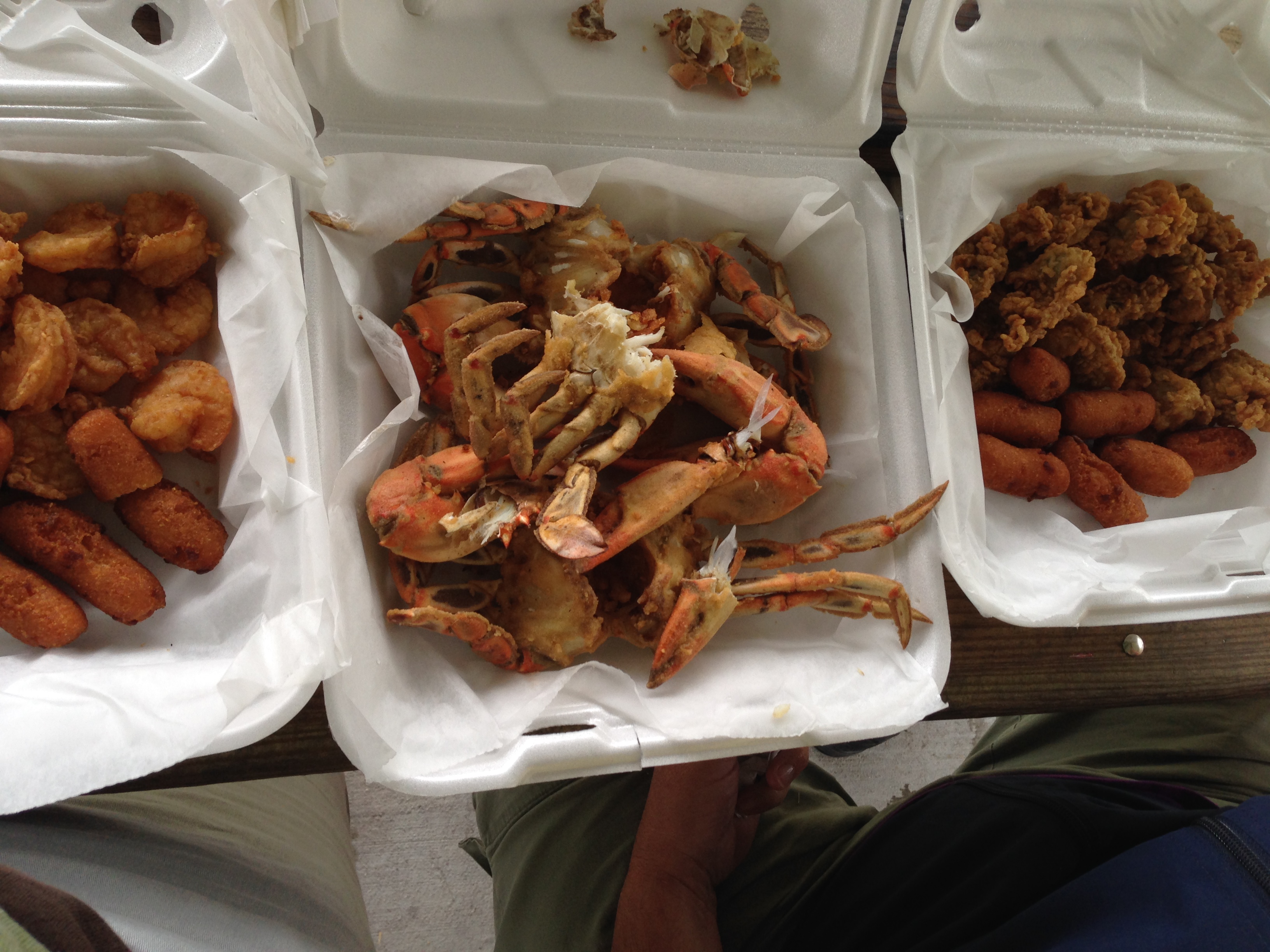 On the way back to Tybee Island, we stopped at the Seafoodelicious Fish Market for some local, fried-to-order shrimp, oysters and crab, with hush puppies. We enjoyed our feast at a nearby park and watched fallen brown leaves skitter in the cool breeze.
We are back at the cottage, our last afternoon here. The sky is a weathery gray and it is wonderfully cool, almost chilly enough for a sweatshirt, but not quite. The grasses are blowing, the tide is rising and the birds are chirping and scrawking. Marika is drinking a cup of coffee, binoculars at the ready, hoping to catch a last look at the palm warbler, the small bird with a yellow rump, white eyebrow and drab body that has been perching on the tops of the grasses all week long.
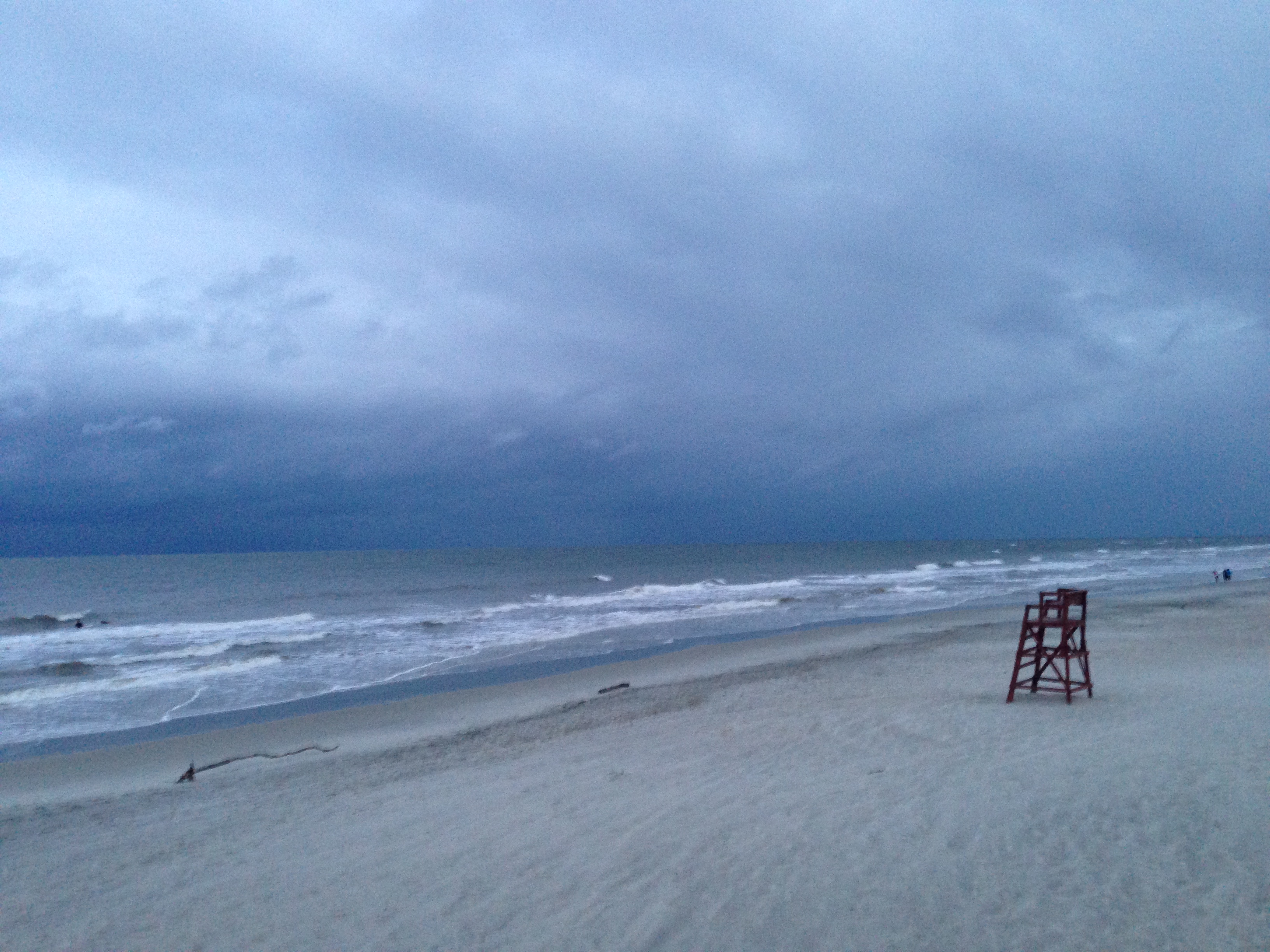 We took a sunset walk on the beach tonight. The sky was full of clouds and if there were colors, we didn’t see them since the sun sets on the other side of the island. The sand was soft and fine, like baby powder. As we reached the water line, the ground turned hard and dense, so dense that I barely made a mark when I dragged my shoe across it.
We walked the length of the pier as the light faded and we stood at the end and watched groups of brown pelicans skim across the dark water, flying north. Low waves rolled and it was breezy but warm, and there was no moisture on my arms or glasses like when I am at the beach at home.
Tuesday:
It’s our last morning on Tybee Island..high tide, grasses blowing, clouds rolling, birds singing. We’d love to stay longer but we’re looking forward to Mabel kisses later this evening! It’s been an amazing ten days of fun and discovery and I’m so glad you joined us on the journey!
[ssba]
What To Do When Nothing Is Working

It happens to all of us.
We get a great idea. We’re motivated. We take the first step toward what we want and we’re cruising.
We feel excited. Rejuvenated. Like this thing could really happen!
And then something doesn’t turn out the way we had hoped or expected.
And we land in a pile of doubt.
Sound familiar?
Did you start the year thinking this would be the year of the Big Change?
Maybe you’re ready to find a new career or to pursue that dream you’ve always said “someday” about.
You made your list of everything you wanted, opened your heart to the universe and said, “Bring it on!”
Maybe you even found a great job to apply for. You revamped your resumé and aced the interview. But you didn’t get the job.
You feel defeated and so full of doubt that you wonder if you are ever going to live the life of your dreams.
If you are standing in that space of ready, and unknown, it can be very uncomfortable.
What do you do now?
What do you do next?
Is this even going to work?
Change is not linear. And big changes don’t usually unfold the way we envision them.
Often, when we are in the midst of big changes, it seems like nothing is happening. It seems like the OPPOSITE of what we want is happening.
And so the real question is, how do you move through these challenging times, when it seems that nothing is working the way you want?
Some people feel defeat. Others see it as a challenge from the universe.
This can be a time to pause.
And breathe.
We can use these times as an opportunity to re-connected to our heart, to our truest, highest visions for ourselves. To continue to say “YES!, this is really what I want, this is really who I want to be.”
And to ask, “What do I need right now to get me though this challenging time?”
-
Talk with your biggest cheerleader about your doubts and your dreams. (Make sure this person is not a nay-sayer who says you should just be content with the life you have.)
-
Hire a coach to help you regain your clarity and intention and motivation.
-
Have patience with yourself, with the universe.
-
Continue to be grateful for what IS.
Finding a Hole in the Fence
I was talking with a client about her dream to create a dog sanctuary. She envisions a many acred facility that rescues dogs, finds them homes and, for those unadoptable ones, provides great care and companionship.
She clearly sees a loving staff working with her, organizing successful fund raising events, and the joy that this work brings her.
I invited her to make a list of the steps she can take now to keep this vision alive. While she came up with a wonderful list of self-care actions, I was surprised that there was nothing on her list that had to do with dogs.
When I asked her about it, she said, “When I think about volunteering at a local rescue place, I know I would just want to take all of the dogs home with me. And I can’t do that. So I can’t volunteer.”
She had created a black and white, all or nothing situation in her mind and it was keeping her from doing the work she loves.
I asked my client if she could imagine herself being with the dogs at a local shelter, giving them love and attention. I asked her if she could imagine being a part of an organization where she was learning how such an organization worked. I asked her if this would outweigh the fact that she couldn’t take them home.
She tilted her head to the side and laughed. “I suppose I could do that.” And then she laughed again, this time at herself, for letting that all or nothing thinking stop her from doing what she loves.
Often, when we have a resistance to something, we hear our reactive thoughts and stop. But what if we approached the resistance with curiosity, with a question, why is this holding me back?
We can also explore this with a visualization.
Imagine you are walking on a path and, in the distance you see a fence. From far away the fence seems to be blocking your way.
What is the fence made of?
How tall is it?
What it on the other side?
As you get closer to the fence you see that it isn’t impassable. Maybe you see that it is flimsy, or fallen down in places. Maybe there is an opening in the fence that you can easily climb through.
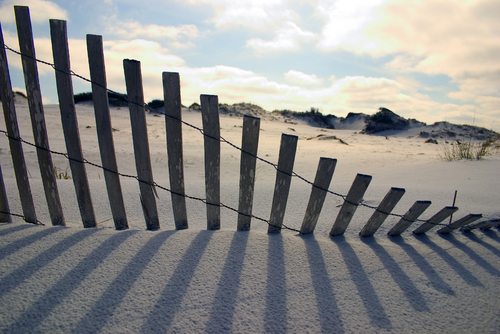
We don’t have to tear a fence down to get past it. And we don’t have to let it stop us, either. What if, instead, we explored it, looking for a way around it. What if we could find a hole in the fence to go through?
My friend didn’t suddenly stop wanting to rescue every dog, but she no longer let this stop her from helping a hundred more.
So when you think about your dream life, where is your biggest resistance?
What is the fence that is holding you back?
What is on the other side?
What does the fence look like?
Are you willing to explore it, have a dialog with it?
Can you find a hole in the fence?
Please share your story with me and my readers by clicking on the comments below.
[ssba]Inspirations From a Keyboard: Control-Alt-Delete

One of the most valuable tools I offer my clients is to practice paying attention. To slow down enough to notice the details around us. To be still long enough to hear the quieter, stronger voice inside.
Often, we are so distracted by the noise and activity of our daily lives that we are oblivious to the beauty, the wisdom, the inspiration of what is right in front of us.
The other day I saw this image online and immediately thought, WOW, Great questions!
What am I trying to CONTROL?
What do I need to ALTER in my life?
What am I ready to DELETE?
Inspiration is everywhere, all around us.
Too often, we just aren’t paying attention and so life goes on, same as it ever was. And we go on, same as we ever will be, stuck in the patterns of our days, far removed from what we might really be dreaming we could be and do in our lives.
But if we pause and ask ourselves these kinds of hard questions, we honor that deep desire inside us for something better, more exciting, more joy-full.
By simply recognizing what isn’t working in our lives, we open up to the possibility of creating more of what we DO want.
But we have to be willing to ask.
I invite you to find a quiet place with a blank piece of paper and ask yourself these powerful questions:
What are you trying to Control in your life?
How might things be different if you let go of that control?
What do you need to Alter in your life?
If you changed just one thing, what would that open up for you?
What are you ready to Delete?
What thought or relationship or activity or habit does not support who you are and the work you want to do in this world?
I’d love to hear your answers. Please share them by clicking on the comments below.
[ssba]Celebrating Hearts
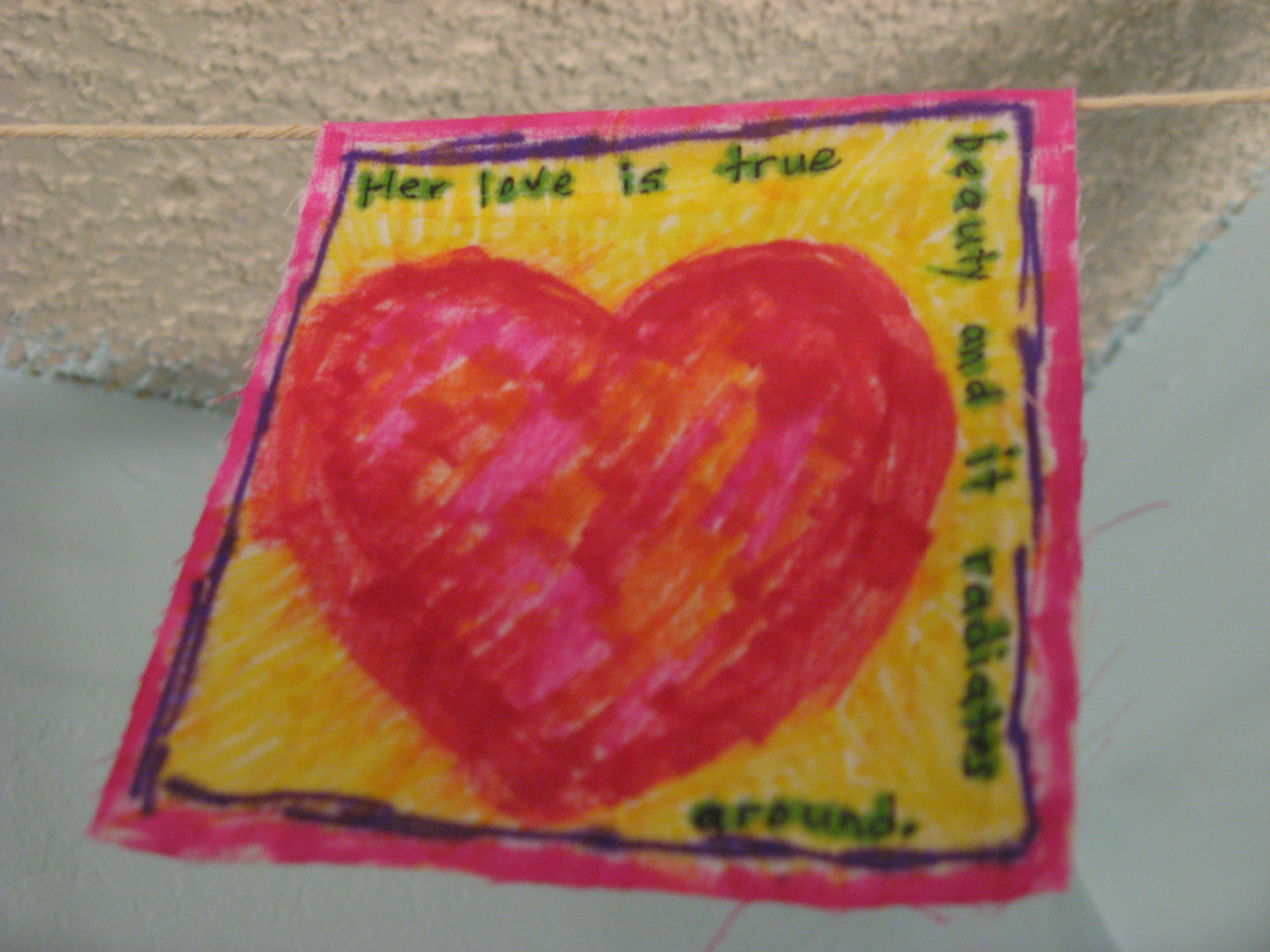
“Broken hearted often leads to broken open. And broken open is the perfect environment for finding out who you are and why you’re here. Break and grow.”
– Michele Woodward
Six years ago, on September 16, 2007, emergency open heart surgery saved my life.
I didn’t have clogged arteries or heart disease or a heart attack. I had a myxoma, a very rare benign tumor that was almost completely blocking the blood flow through my left atrium.
They discovered it after I had an episode of angina, that sharp ice pick stabbing in the back and chest and the inability to breathe. And yes, jaw pain and arm pain too. But I didn’t go to the ER or call 911. I breathed through it and kept myself calm and then went to Urgent Care the next afternoon. That’s where they saw an abnormality in my blood work, indicative of a clot, and sent me to the Heart Hospital down the street for further tests.
A client recently asked me if I experienced a white light epiphany during the surgery, if that was when I decided to change how I lived my life.
The answer is no.
It was everything that happened after the surgery that got me started on the path of this new way of being.
When you are recovering from open heart surgery, you can’t busy yourself with too much doing or distract yourself with a lot of meaningless activities or mindless chatter.
When you are recovering, at first, all you can do is sit. And breathe. And even THAT is so painful. Maybe it was that painfulness that made me so aware of my breathing. It kept me in the present moment.
I wasn’t interested in TV. I didn’t have the concentration to read or watch a movie. Everything in my world slowed down. And I rejoiced in the simplest of things, like being able to open the refrigerator, walk a full circle around the pool, reach the shower massage so that I could take a shower by myself.
Friends called and came to visit. My parents brought me my favorite foods. I was so utterly aware of the love and support in my life.
And, while I never thought I would die in the surgery, it suddenly struck me that I could have died any number of times in the days and weeks and months before because the tumor could have easily broken off and caused a major stroke.
And so, in the weeks and months that followed, as I regained my physical strength, I began to take a close look at how I was living my life. I started asking myself what did I really want to do, what did I want most in my life, and how could I best give back.
I had no answers. Only questions.
Slowing down to notice and appreciate these kinds of things is what brings us back to what matters, what’s important.
Slowing down creates the space for us to begin to ask the deeper questions.
This is what I teach and share in the groups that I lead. This is how I am living my life – listening, opening, following the energy of my heart.
We have to learn how to listen inside, to appreciate the simpler things, to trust ourselves enough to ask the bigger questions.
Only then can we be ready to hear the answers.
How do you slow down and listen to your heart? Please share by clicking on the comments below.
[ssba]Love in the Present Moment
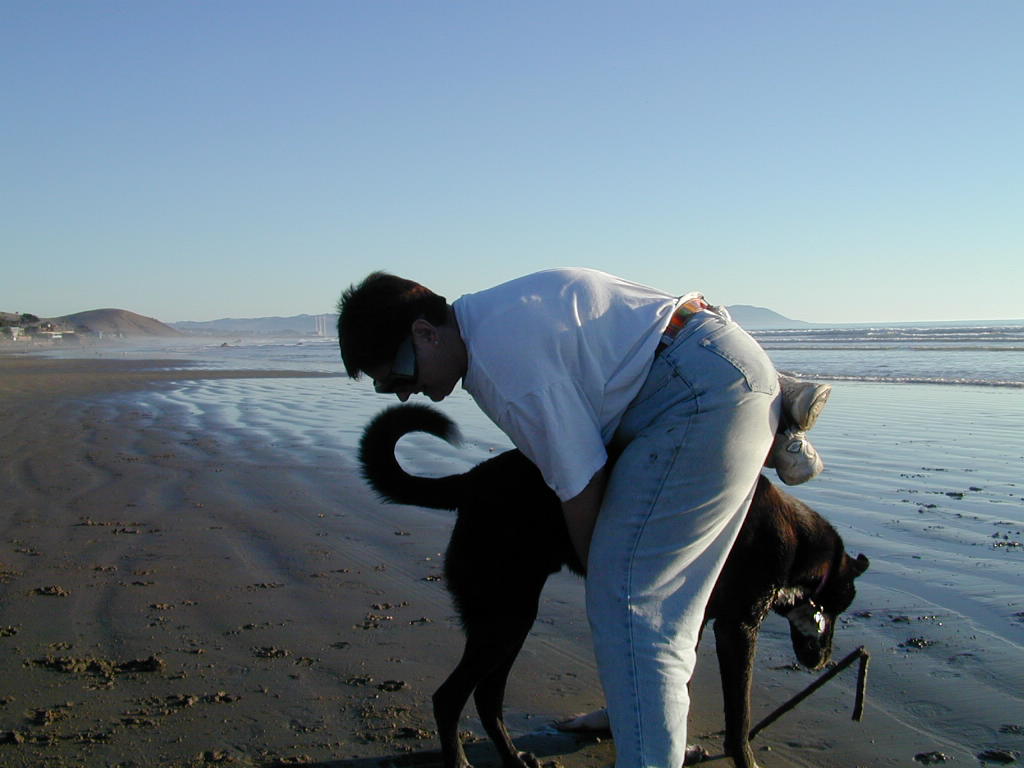
As you may know, I had to put my dear sweet Laddy to sleep last Thursday. While he’d been eating less and walking slower since July, last week there were drastic changes in his behavior and appetite and even in the look of his orange-brown eyes.
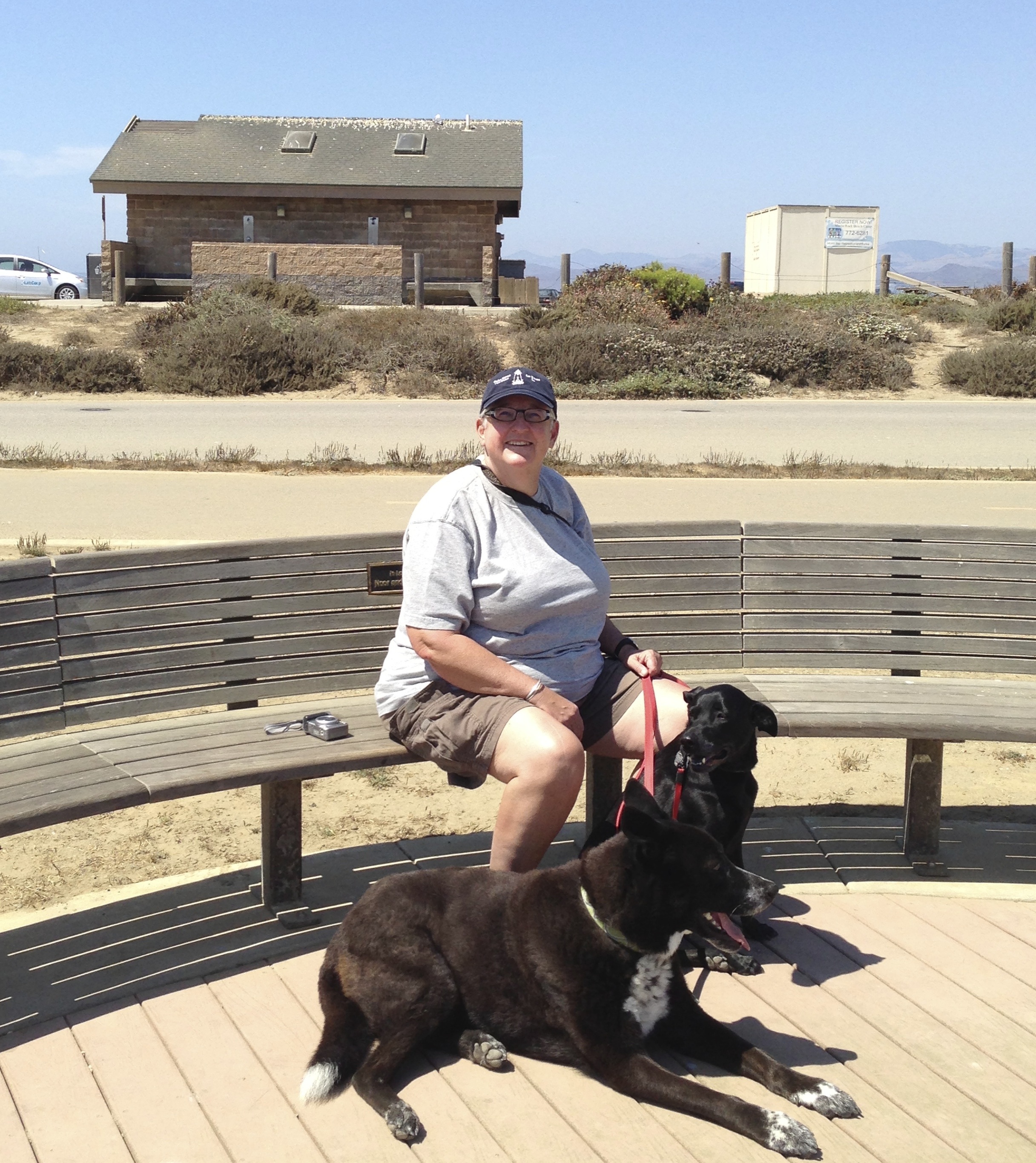 When Marika and Mabel were here visiting two weeks ago, the four of us enjoyed bluff walks and love fests and lazing around together in the RV. Laddy was being finicky about his food, but he had been since mid-July. He was leaving his kibble but loving the hot dogs, milk bones and home-cooked chicken that I added to his food.
A few days before Marika and Mabel returned to Phoenix, I noticed a wound on his foot so we took him to the vet. His blood work looked great and he was still happy to play stick toss every other day. But early last week, everything changed. He didn’t want to walk unless he had business, and crouching to poop was suddenly so uncomfortable that he had to lie down afterwards.
I scheduled an ultrasound to see what might be pushing on his internal organs. But while we were waiting in the back of my car for the radiologist to arrive, it was so clear that the test was unnecessary.
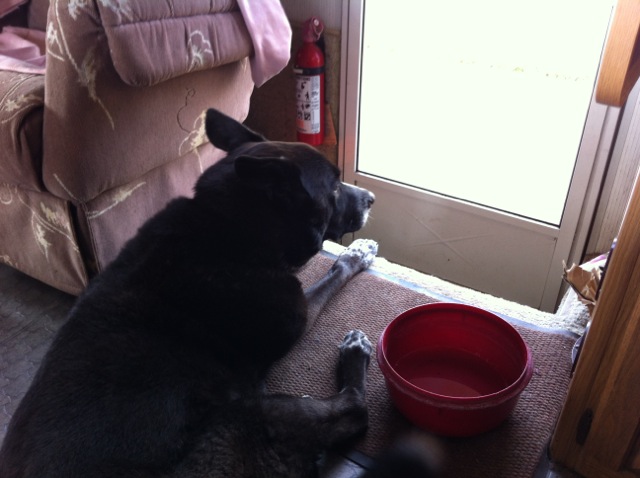 I could feel how many big, solid masses there were all over his abdomen. (It was hard to cuddle him in his bed under the RV table), and he was so uncomfortable, so ready. So the vet came out to the car where he felt safe and familiar and I thanked him and loved him, and thanked him and loved him. And then he was gone.
After I left the vet, I drove to the back bay and walked a bit, but then I just needed to sit and watch the terns and the tide coming in. I felt peaceful inside and out. No tears, no thoughts, just the chatter of the birds and the breeze. I could have stayed forever, but I knew I’d have to go home eventually.
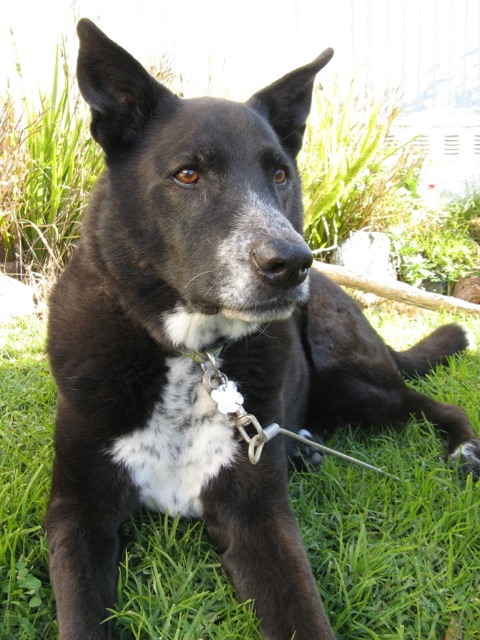 When I pulled into my spot, my neighbor walked over and asked if Laddy was with me. He hugged me when I told him and the tears finally came. I hung Laddy’s collar on the outside mirror, like a flag at half staff for anyone walking by. I picked up his water bowl and emptied his food bowl and put his bed on the picnic table so I could truly feel the space of him gone.
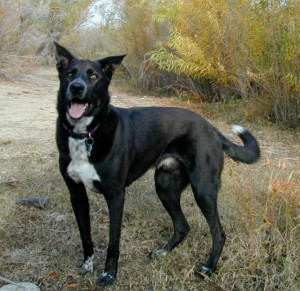
I talked to Marika and read so many online prayers and condolences that my eyes hurt from all of the crying and I had to take a nap. I swear I heard him breathing when I woke up.
In the evening I took my first beach walk alone. I didn’t see anyone I knew so I didn’t have to explain. Pelicans were flying and diving and several shorebirds were skittering in the surf and poking the barnacles on the rocks. Again, I felt peaceful, but somber. I took many deep, cleansing breaths and felt my heart literally aching with love.
Several months ago, on a lazy afternoon, I looked at Laddy and said, no, I don’t feel like a walk. And then I heard a voice—when he’s not here you’ll regret not walking with him when you could. And so I put on my shoes and we had a great beach stroll together.
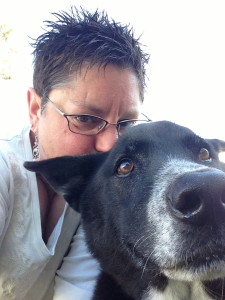
This is why I have no regrets, or should have’s, or wish I could have’s. Even on those last few days, knowing what was coming, I kept returning to the present moment where there was no room for grief because he was still with me.
I could still bury my head in his thick coat and complain about the fine hairs that stuck on my lip. I could scratch him on the white, star-shaped ridge on his nose and explore the wart behind his left ear, even though he hated it. And I could thank him and love him and love him some more.
And even in those last moments, I was fully present with what was, not how lonely I would feel to walk without him, or how weird it would be to have so much leg room under the dinette or how much I would miss him coming into the bathroom every morning for a neck massage while I was peeing.
This past year has been all about learning to be present, flexible, awake. To pay attention to the smallest sounds, the slightest shifts in nature, the quietest voices in my heart.
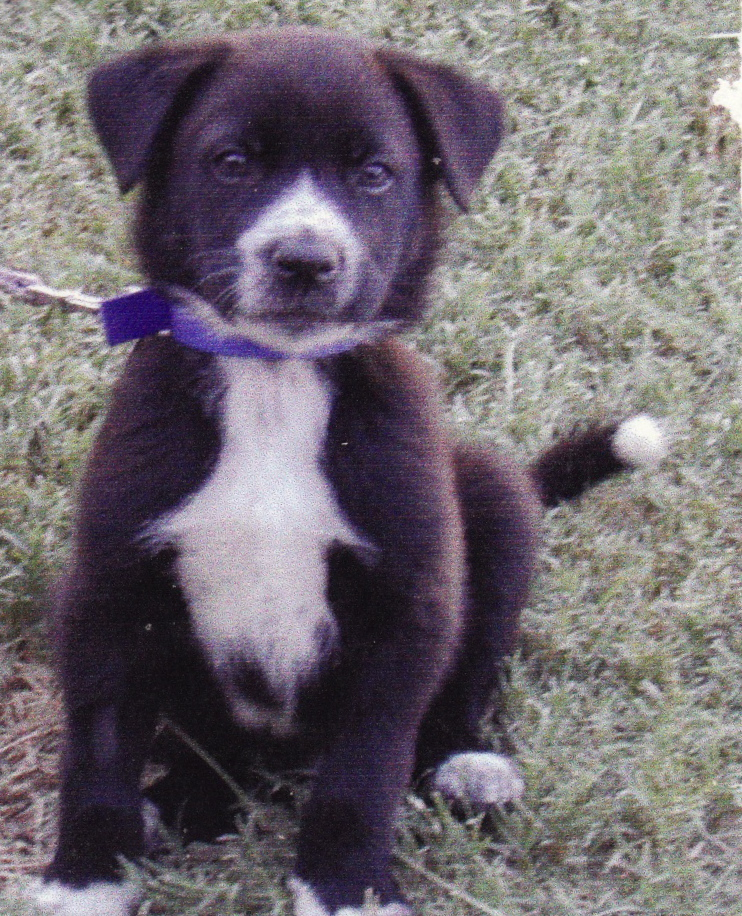 And through our twelve and a half years together, I learned how to really listen to Laddy’s needs and wisdom. He reminded me that even the skinniest stick is enough when it comes to playing. That sometimes just sitting together is activity enough. That walking is often the best cure for what ails you.
We were so alike: we both preferred shade over sunshine and thrived on routine. And we both needed our daily fix of social contact with others of our kind.
I am so grateful for everything he brought into my life and for being with me this past year on this great adventure of living at the beach. I honestly don’t know if I could have done it without his company. Even when having a dog drastically limited my house hunting options, there was never a doubt that we were meant to be here together.
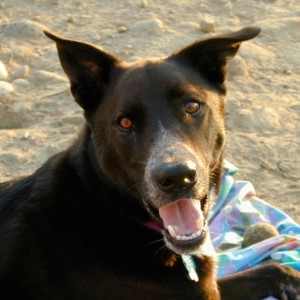
And now that he is not at the ready to join me for a walk, to stop and meet new people, to share a peach or a bag of baby carrots, I have to muster the courage to do it for myself.
And this is the hardest thing of all.
We did everything together. In a world where I still have very few friends, Laddy was the one I went exploring with, watched TV with, told my secrets to. He went with me on my town errands, first to the park for a walk, then he waited in the back of the RAV4 while I went food shopping, did my banking and filled the water bottles. On the few occasions where he didn’t join me, he’d poke his head through the RV curtains and watch me drive away.
And now I have to create a new life by myself.
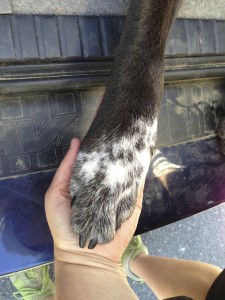
I know I am not alone. I feel loved and supported and held by such a strong, wide presence. But I am by myself.
A dear friend said she sees me, by myself meaning that I am walking alongside of myself, ready to care for my own self like I have cared for Laddy. Ready to cook for myself like I was willing to cook for him. Ready to nurture and tender my own heart with the same love and compassion that I offered my boy.
I am taking this all one breath at a time.
And saying thank you. Thank you. Thank you.
Because this is what true and unconditional love is all about.
The other day, I was walking on the beach in the opposite direction than where Laddy and I always went. I had stopped to watch the fog, trying to find the horizon and just breathe. I wasn’t even crying in that moment.
A young woman stopped and asked if I was ok. “I lost my dog,” I said. She looked around the beach. “No not lost,” and I put my hand my heart. She said “I’m so sorry. Can I offer you some words from God?”
I turned toward her and she said, “Don’t think about the sad things. Remember all of the fun you had here together running and playing and being happy together.” I hugged her tight and said thank you, thinking of Laddy barking for me to find him another stick for him to chase.
_______
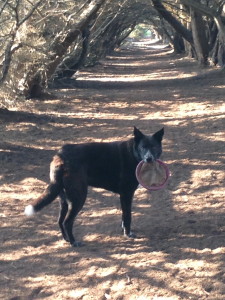
Tomorrow it will be a week since I kissed my boy goodbye, and I have been riding the waves of grief with amazing courage and grace, crying when I need to and stepping forward when I’m able. I think having the ocean waves beside me as a literal reminder has been so helpfully healing.
I’ve received so many sweet notes and photos and condolences, all reminders of how much love Laddy and I shared. A friend even asked where she could send a donation in his memory. (Richmond Animal League, c/o Amy McCracken, www.ral.org)
I donated his medicines and dog bed and dog cookies to a local woman who cares for elderly animals. I vacuumed up a week’s worth of dog hair (and I still keep finding more.) I even started imagining myself with a new companion when I return from my September/October travels.
But for now, this time is for me to be with me.
I never walked without Laddy. And we walked at his senior pace, and his senior distance. Now I am walking for longer stretches, at a faster pace, going a little further each time. Some mornings I tear up, watching young dogs romping on the beach. Other times I’m delighted to rub a dog head and have my leg sniffed.
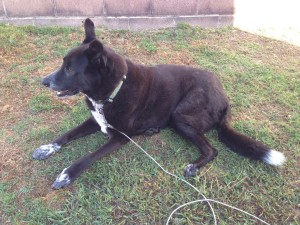
My conversations with people on the beach are different too. They’re no longer about how handsome my dog is, or questions about his breed. Instead, we talk about the birds, or the weather or just the simple gratitude we have for this beautiful place.
Of course, I feel his spirit around me. But more, I feel the love that connects us all. And I feel your best wishes and prayers that continue to surround and support me on this journey. And with every step, I will continue to say thank you!
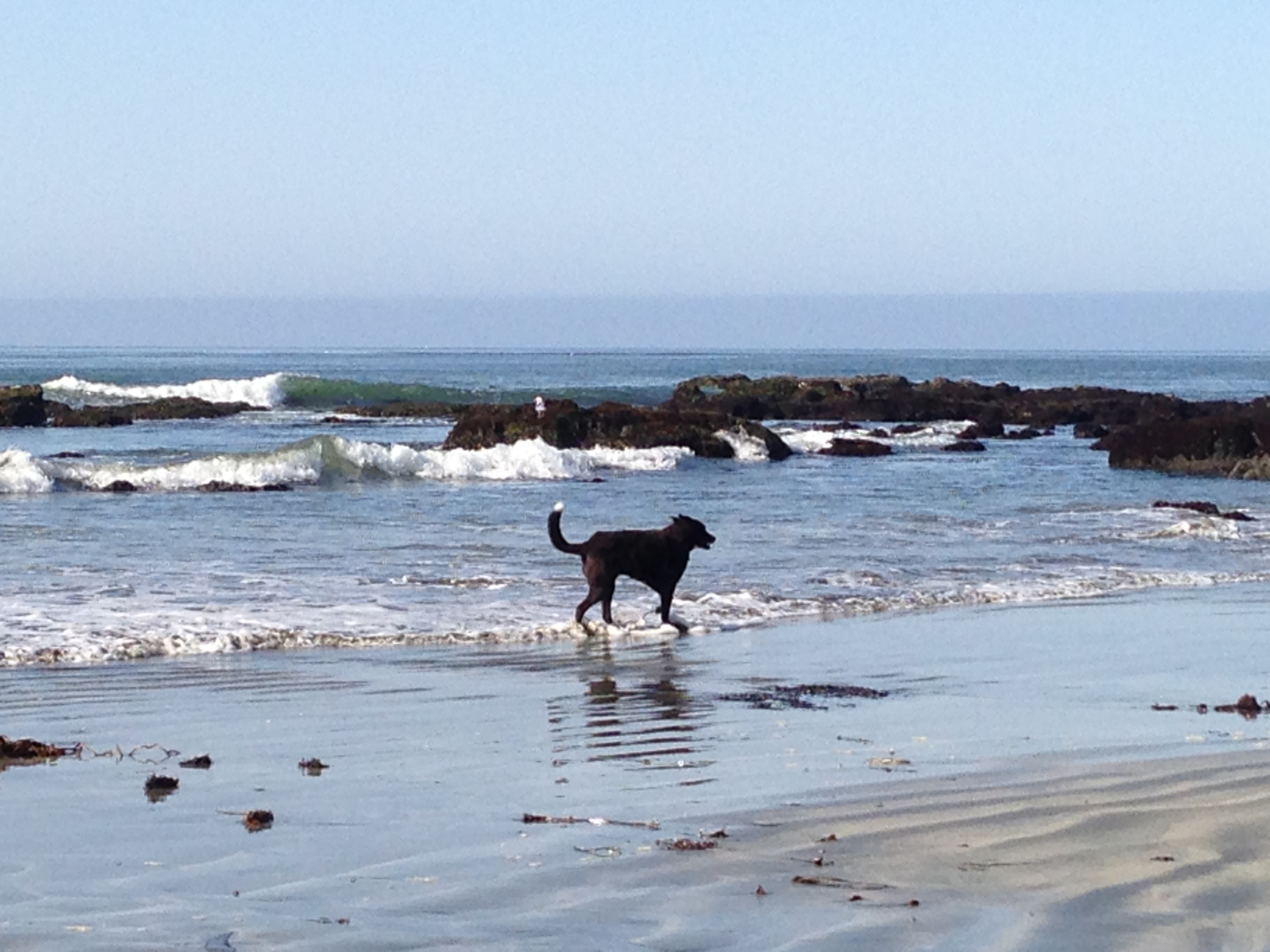
Do you have an animal love story you’d like to share? Click on the comments below…
[ssba]
