
That Thing You Love to Do
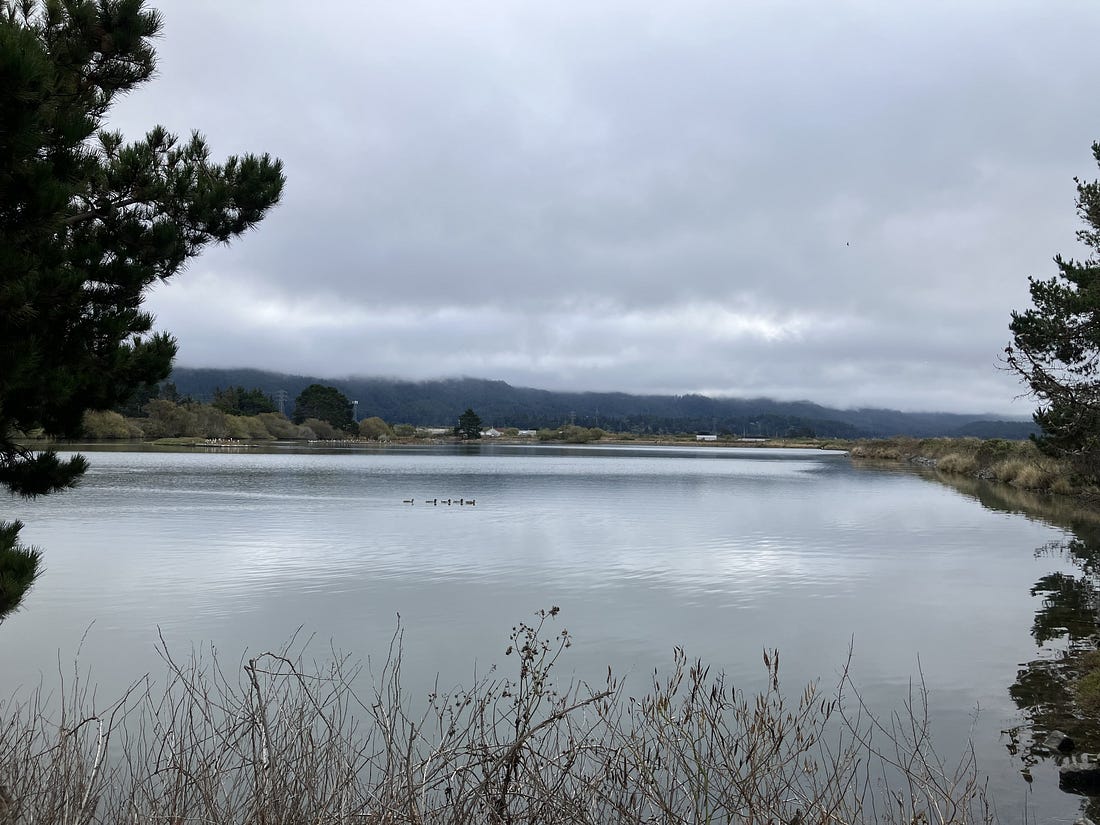
Fall has arrived on the Northern California coast. The mornings are damp from the overnight fog, the wild blackberries are ripening on the brambles, and large flocks of migrating shorebirds are passing through, feasting in the mudflats one day and gone the next.
This is my favorite time of the year, when it’s cool enough to wear long sleeves, but not cold enough for a jacket. I love the moody skies reflected in the marsh, the pops of reds and oranges in the trees along LK Wood Boulevard, and the honking Canada Geese flying overhead on their way to warmer weather.
Fall is also a time for harvesting, for celebrating the bounty of all that we’ve planted, and for remembering what really matters. So often we rush through everything, so focused on “done and next” that we don’t pause to celebrate, to honor, to step back and really recognize all of the big and small things we’ve experienced along the way. We don’t applaud our hard work, revel in the surprises that appeared, or tender ourselves for the things that didn’t work out.
Taking the time to reflect is an opportunity to say, “WOW!!! Look what I did!” and, “I learned so much from that experience.” It’s a chance to see how far we’ve come, to feel proud, joyful, confident, to remember who we are and how we contribute to our world.
Meanwhile, my six month writing workshop, The Art of Storytelling From the Page to the Stage with Nina Wise, began this week. Our Zoom class is small, six women and one man, most of us have worked with Nina before. After introductions, Nina read a few excerpts from published writers about why they write. And then we did a twenty minute free writing exercise with the prompt Why Do You Write?
Free writing isn’t about spelling or grammar or even making sense. It’s about being curious, following an idea to see where it goes. And if you get stuck you just start again with the initial prompt. Often, the best ideas come after you’ve written for a while and cleared out the obvious responses, and you don’t think you have anything more to say.
As Nina was explaining the process of free writing, I was thinking of all of the reasons why I write, and something caught in my throat. I started to cry. I felt like I was about to open a big new door, and I was surprised, not because I felt the vulnerability, but because we hadn’t even started writing yet.
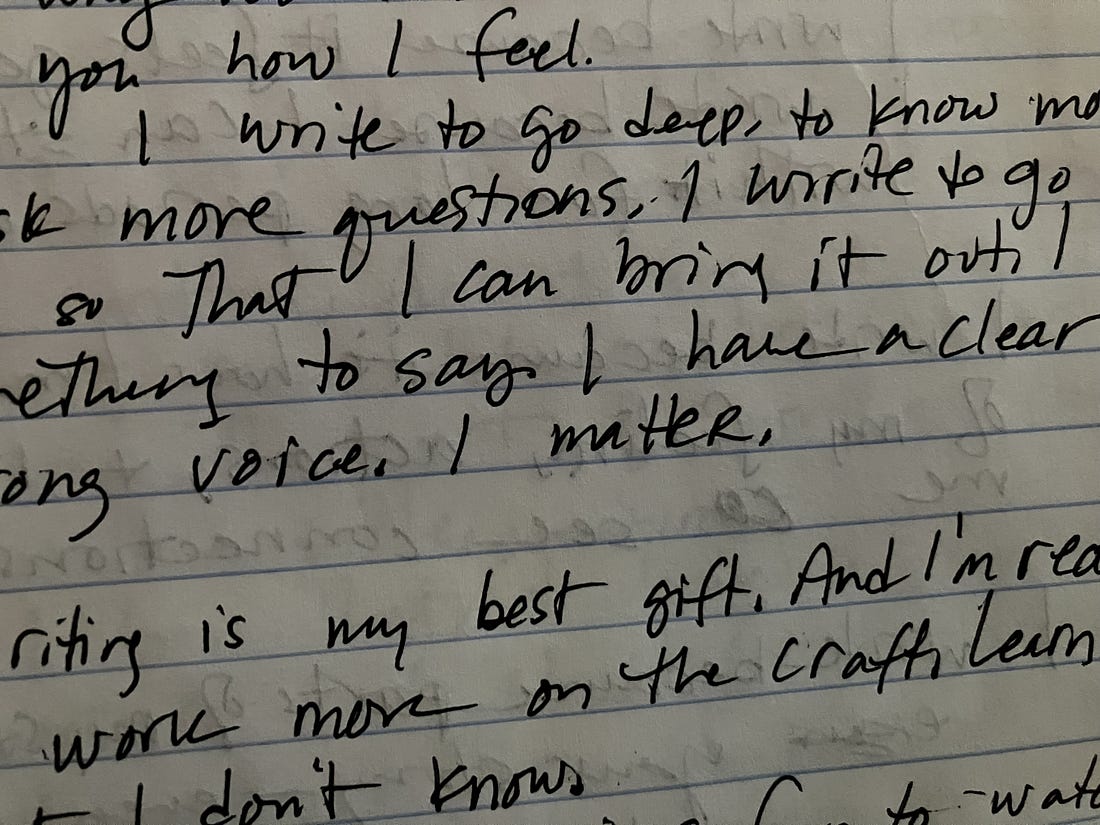
I wiped my eyes and, instead of diving right into the emotions that were coming up, I started listing the obvious reasons, “I write because it helps me make sense of things. I write to share my stories. I write because I’m good at it.” But the tears came again when I wrote, “I write to be seen and heard. To know that my voice matters.” I’d never articulated this before, but it felt so deeply true. I sat with the tears and kept writing.
“I write to go deep, to know more, to ask more questions. I write to go in so that I can bring it out. I have something to say. I have a clear strong voice. I matter.”
I put my pen down and just breathed for a minute. I dried my eyes and started again.
“Writing is my best gift. And I’m ready to work more on the craft, learn what I don’t know. I write because I love choosing the perfect word, finding the rhythm of a sentence, and rearranging paragraphs to make the most sense. I love the editing process as much as the writing, fine tuning, making things clearer, more detailed.”
And then I was done. I had nothing else to say. But we still had FIVE MORE MINUTES.
I turned to a clean page in my notebook and started again. “I write because my first grade teacher, Mrs. Phillips, said I had good handwriting.” I loved this detail. “I love the feel of my pen gliding across wide lined paper, and how wonderful it feels when I am in the flow of it all.”
“I write because parts of my story are your story-even if the characters and details are different, the themes are the same. I can articulate what others feel but maybe have no words for. I write because it’s fun. I write as a release.”
One of the reasons for the exercise, besides getting in touch with why you do this thing you love, is so that, when the voices appear that doubt your abilities, or your work, your subconscious can let it go because you are so clear about why are doing it.
After class, I kept thinking about Mrs. Phillips, and how writing is my way to be seen and heard. It has brought up all kinds of memories from when I was six and seven, before and after my brother, Lenny’s death. I thought I had told all of the stories, but now I am sensing there are more.
But, after that first class, I avoided sitting down to write. I just wasn’t ready to do a deep dive. But then, on Tuesday, I had a talk with myself about creating a writing practice. To just show up and not put big expectations on myself about what to write.
So I invited myself to do a twenty minute free writing. I pulled two random post its from my wall for a prompt. It really didn’t matter what the prompt was—I just started writing. Nothing profound or even interesting, really, but I wrote. And when the twenty minutes were up, I could feel the tension was gone. And I decided that this would be the beginning of a daily practice.
To make more space for this new writing practice, I’ll be sending out the Heart Sparks once a month for a while. If you want to connect in between, please do!
From my curious writer’s heart to yours,

AND, I invite you to get curious about why you do what you love to do. Find a quiet spot where you won’t be interrupted and grab your writing materials—pen and paper, computer, whatever. Set a timer for 20 minutes and, at the top of the page, write, WHY DO I ________? and fill in the blank with the thing that you love to do. And just start writing. I _____ because…..
If you get stuck, simply start again with that opening sentence. See what happens. Allow yourself to be uncensored. If something causes you to tighten up in your body or you feel like crying, just breathe and stay curious, with no judgment. After the 20 minutes, go back and read what you wrote and see what interests you, surprises you, sparks more curiosity. I’d love to hear what you discover!
[ssba]Permission to Let Go
I didn’t participate in Tashlich, the Jewish New Year tradition of tossing bread crumbs into a body of moving water to symbolize releasing your transgressions from the year. I realized that, while I have always enjoyed this physical ritual of letting go, I no longer needed it. I hold no grievances or grudges or regrets because I practice making amends and letting go every day. And I didn’t know any of the people who would be there, so it wasn’t about connecting with community, either. So I didn’t go.
It was a little sad, not to feel the pull to participate, but there was no guilt or regret. Instead I felt I was honoring the letting go of something that I once loved and no longer resonated with.
I’ve been practicing this kind of letting go a lot these past two years. I’m learning that, just because I liked something once, doesn’t mean I have to keep liking it forever. I can give myself permission to walk away from people, classes, passions, anything that no longer serves me, without regret or apology to others or myself.
I did it when I no longer enjoyed going to call and response Kirtan after a year of regular attendance. I stopped playing Mahjongg with the ladies because they just didn’t get my sense of humor. I said goodbye to one of the first women I was friends with here because she irritated me more than any joy we shared when we were together. And I let go of weekly fried fish and chips. It wasn’t always easy, but it was always the right thing.
Last fall I attended the Community Song Circle at the local Universal Unitarian Fellowship. I enjoyed the energy of the leader, the people were welcoming, and what’s not to like about singing with others about love and hope and peace. Still, I left at the break, and didn’t go back.
I berated myself for using the excuse that 4 o’clock was too late in the day to go someplace to sing, and promised my social self that, when they started up again in the fall, I’d go back.
Last week I attended to the first Song Circle of the season. Yes, it’s wonderful that people are gathering to sing about love and hope and peace. But again, I left at the break. On the drive home I asked myself why I didn’t enjoy the experience.
I knew it wasn’t about the time of day. But sometimes, those petty excuses are there to get our attention, to invite us to explore a little deeper and see where the real resistance is.
As I thought about the experience, I realized that I felt like I had to tuck in and quiet my energy in that room, with my presence as well as with my voice. And it didn’t feel good. Yes, the people were nice, but they’re not my people. By the time I got home, I was congratulating myself for keeping my promise to myself and going, and for knowing it wasn’t right for me.
And now, in the letting go, there is this new, open space. It’s not empty by any means, but I can’t clearly see what it holds. Yet. And it’s a little uncomfortable. But I keep reminding myself that this is the in-between. And I’m here. Open and ready. And all in. Which is perfect timing because my six-month The Art of Storytelling From the Page to the Stage begins today!
From my open and ready heart to yours,

Is there something you’re ready to let go of? How can you give yourself permission?
P.S. Yesterday marked nineteen years since I had emergency open heart surgery to remove a rare, benign tumor from my left atrium. Everything that I am living today is because of that literal heart-opening experience.
You can read the full story, featured in my book Heart Sparks: 7 Practices For Loving Your Life if you click here. Then click or read through the Introduction to get to the Prologue: Break and Grow.
[ssba]Bodies of Water
BODIES OF WATER by Ruth Davis
Two Turns of a Somersault
I was friends with Ilene Miller the summer after third grade because she had a swimming pool in her backyard. It was an above ground Doughboy, three feet deep with blue vinyl sides and white vertical ribs. We’d perch on the narrow, plastic ledge, then tumbletuck into the water, racing from one side of the pool to the other. Ilene usually won because she could turn around underwater.
Ilene and I invented Hiney Boppers. We’d hold hands and, on the count of three, jump up, spring to the bottom, then push off the soles of each other’s feet into backward somersaults. In a perfect Hiney Bopper, our butts would meet and bop against each other on the way around.
Ilene’s neighbor, Jill taught us how to do handstands in the pool, and we spent whole afternoons upside down, our legs spoking out of the water, judging whose stayed the straightest, the longest. We dove for pennies and had underwater contests, counting one-one-thousand, two-one-thousand to see who could hold their breath the longest.
My favorite game was Whirlpool. We’d walk counter-clockwise along the inside edge of the pool until the momentum of the swirling water lifted and carried us around the circle. When the water was moving the fastest I loved to turn around and push my body against the force.
The Pull of a Strong Tide
For most of my childhood, we lived on Long Island, the fish-shaped peninsula east of New York City. In sticky summer traffic it was an hour’s drive from our house to the beach. Weekdays, when my mother took us, we went to the bay. At low tide I could wade out more than a hundred feet and the water never got higher than my bikini–bare waist. Even on the brightest day, the water was a thick, murky brown. My brother and I did the Dead Man’s Float, lying face down in the water, eyes and mouth closed with nose plugs on, daring to see who would come up first, gasping and losing.
My mother stayed on the beach, watching us from the shade of the blue and white striped beach umbrella. She guarded our towels and eyeglasses and the Styrofoam cool chest, filled with green grapes and ready peaches and my uneaten ketchup and corned beef sandwich. On weekends and holidays when my father came along, we went to the ocean at Jones Beach. He’d body-surf with me through the waves, out to where the walls of water were breaking. Just as they peaked in front of us, he’d squeeze my hand and yell “Jump!” and we’d both push up off the pebble–shell bottom, taking deep breaths, just in case.
Sometimes I’d stand on his t–shirted shoulders so he could toss me into a high breaker. Once, instead of diving through the water, I went under. I somersaulted in the swells and my head banged into someone’s legs. Gritty salt water stung my eyes and flooded my nose. I came up for air just as another wave crashed, but I couldn’t stand up because my bikini top had slipped up. I held my nose and ducked back under, pulling my top back on as the wave roared over me. When I finally resurfaced, my father was several yards away, laughing, a clump of seaweed stringing from his glasses.
Buoyancy
I have my own swimming pool now – built in, with steps and a loveseat, even a diving board. Petita, our cat, likes to sleep at the end of the board, her thick black tail dangling over the chlorine–blue water.
Early mornings, when the summer sun is barely a light on the water, I plunge into the deep end, scattering the sunken mulberry leaves around the bottom drain. With my eyes closed, I tilt my head back, face skyward, and let the water pull my hair off my forehead as I come up for air. I stand, suspended, barely treading water as my legs touch pockets of cold below the already warm surface.
Mostly I swim at night when the lukewarm water is the only relief from the oven–hot desert air. I do laps of scissor kicks and make snow angels in the wake. I spring and splash from one edge of pool tile to the other, turning somersaults and making waves all around me.
When I’m done sloshing water onto the pool deck, I float on my back, my arms and legs spread–eagle just below the surface of the water. Only my toes and face touch the night air. Ears submerged, I close my eyes and breathe until I can no longer tell where my body ends and the water begins.
[ssba]Remembering Summer
Ah, summer….when the days are long and stretched out in light and heat and possibilities. For many of us, summer was the best thing about being a kid. There was no school, you could play all day, and go out again after dinner because it was still light out. Summer offered an escape where you could disappear into a book, or the swimming pool, or a favorite hiding place, and just be with your own imagination for a while.
Often, thinking about our childhood summers can spark a dream, or remind us of something we’ve forgotten we loved.

I grew up on Long Island, east of New York City, in a suburban wonderland of green lawns and good schools, and a mix of Jewish and Catholic families. Summer was weekly visits to the library, and staying up late with Beezus and Ramona, and Encyclopedia Brown. Summer was lying on the sweet, grassy slope in our front yard, imagining shapes in the clouds. Summer was playing kickball with the neighbor kids in the school yard across the street until dark. I was the youngest, and always had to leave before the game was over, called home by my mother flashing the front porch light on and off.
Summer was car trips to Washington, DC, and the Pennsylvania Amish country, with my parents taking turns behind the wheel, and me, in the backseat, reading the map. Summer was swimming in a lake in upstate New York, and spending a week in Atlantic City with my Philadelphia cousins. We always stayed at a Holiday Inn, because kids were free, and they had a swimming pool.
Summer was a Chocolate Eclair Bar from the Good Humor truck, and peaches so ripe that the sticky juice dripped down my face. Summer was standing in front of the window air conditioner in my grandparents’ apartment, sweating so much that the backs of my legs stuck to the plastic covers on their sofa.
Summer was blowing wishes on dandelions, and mowing patterns in the lawn with my father’s push mower. Summer was playing TV tag, and Red Light, Green Light, and climbing across the monkey bars, not afraid to let go of one rung to reach the other.
Summer was doing hiney-boppers in Ilene Miller’s above ground pool, and tumble tucking off the low diving board at the Plainview pool. Summer was sleepover parties with Fran and Karen, and hours of riding our bikes on the blacktop of the schoolyard, pretending we were teenagers, driving to our own apartments.

Summer was catching fireflies in a jar, grilling Hebrew National hot dogs in the backyard, and jumping off of my father’s shoulders into the breaking waves at Jones Beach. Summer was being stuck in traffic coming home, me in the back seat of our station wagon, happily distracted by the salty-sweet smell of the ocean on my arms.
~ ~ ~
What do you remember about summer? What were your favorite things to do? Where did you hang out? Who were your best friends?
Do you still enjoy any of your childhood summer favorites? Does remembering something about your childhood summers spark something you’d like to be or do in your life now?
I’d love to hear your summer memories.
[ssba]In Awe of the Bears
I hope your summer is off to a light and easy, relaxing start. Here on the northern California coast, the mornings are cool with blue skies, and the afternoons are sunny and breezy, sometimes full on windy. But it hasn’t stop me from riding. Last Sunday I parked at the clinic and rode the bike trail through town to the marsh, then continued along the coastal trail. The wind was pretty strong along the water, especially on the way back, but I was singing as I pedaled, “I’m riding in the breeze, past the swaying trees, and it’s eeeeease–y on my eeeee-bike.” And I wasn’t even in my highest pedal assist gear.

I am so loving my volunteer gig, stewarding in the Redwood trees for two hours, once a week. I get to the Sequoia Park Zoo a few minutes before it opens at ten, so that, even after signing in and getting my Sky Walk Steward gear, I have at least fifteen minutes alone in the trees before any visitors show up.

I walk past the flamingos and the bear habitat, turn the corner as I pass the donkeys in the Barnyard, then take my time on the ascent ramp, a zig zagging 360 foot walkway, which is almost as tall as one of the oldest redwoods in the world. I set my things on a bench on the Launch Platform thirty five feet above the forest floor and just breathe. Then I walk the quarter mile loop across the walkways and the rope bridges, feeling the change in the air, listening to the birds without needing to know their names, welcoming myself to the canopy.

Standing next to a giant redwood is magic in itself. Standing as high as 100 feet up in the redwood canopy is something even more mystical. How it sounds, how it smells, how it feels to literally be a part of the energy exchange between the branches is palpable. After my two hour shift, I feel like my heart has been bathed and massaged.

Last week during my shift, so many visitors were asking about the bears. We have three at the zoo, a brown one, a black one and a tan one, all Black Bears, all not able to survive in the wild. Their habitat is below the Sky Walk, which provides an amazing viewing platform to watch these wild creatures.
At 10:15, with the bears secured in their indoor enclosures, the keepers hide food all around their outdoor habitat. They toss heads of lettuce, bok choy, and apples on the ground, tuck carrot chunks under logs and into the holes of large plastic toys, all so that the bears can simulate their natural foraging behaviors. And then the bears are let out into the habitat to find and retrieve the various treats.

After they eat, two keepers take turns running on the outside of the fence while Ishŭng, the black colored bear, runs alongside.

Ishŭng was the first Black Bear to be placed in the care of the Sequoia Park Zoo. She was extremely overweight and out of shape when she arrived, but with her diet and exercise program, she’s now much healthier. But because Ishŭng is used to people, she cannot be released to the wild.

Tule was only a few weeks old when he was found, underweight and with many health concerns, including mange on his brown coat. He was rehabilitated at Lake Tahoe Wildlife Care before being placed at the zoo because his coat is not likely to regrow, so he can’t tolerate cold winters in the wild.

Nabu, the newest bear at the zoo, is golden colored. He arrived in June, 2025, also with coat issues and unable to survive in the wild. He stays in a separate habitat, within sight and smell of Ishŭng and Tule, as he acclimates and they get to know each other. The hope is that, in time, all three bears will be able to share the same spaces.

It is mesmerizing to watch the bears move around in their world. They smell, they pace, they climb the trees. Sometimes they just sit and play with a stick. And sometimes Ishŭng and Tule will chase each other, then stand on their back legs and wrestle. And then they go their separate ways.

I’ve talked with several visitors about the ethics of zoos. While it might be hard to see animals in captivity, ethically-run zoos provide a direct way for people to know and understand animals they might only see in books or TV. The mission of the Sequoia Park Zoo is to “inspire conservation of the natural world by instilling wonder, respect, and passion for wildlife and wild places.” And that’s a mission I can stand behind. And above. In the trees.
From my bear-y happy heart to yours,

The Magic of Hugging
I am a hugger. I’ll wrap both of my arms around you and hold us together for several moments in an enveloping embrace so that our hearts have a chance to connect. Even if we’ve just met. And before I let you go, I’ll give you a little squeeze, like an exclamation point at the end of a very important sentence.
I especially love to hug women who have a few extra pounds, like me, because it’s soft on soft, like hugging my mom. My friend Deborah gives the best soft on soft hugs that linger, followed by a kiss on my cheek and “Love you, sweetie.” It melts me and fills me every time.
When I first moved here, I asked Pam if I could give her a hug. She said yes, but looked very uncomfortable afterwards. So I asked if she was OK, and she said, “Oh yes, I liked it. I’m just not used to it.”
I guess there are a lot of people who aren’t huggers. Or they do a half hug with just one arm and a slight lean in to keep some distance between bodies. For me, there is nothing better than the energetic connection that a close hug can create between two people.
This past weekend I had four social activities. I even knew some people at each event. There were a few handshakes and nice to see you’s, but I only shared three hugs. The morning after all of the socializing, I felt a hollowness in my chest. I thought about the people I love, and the people who love me. I thought about the work I’m doing with my Heart Sparks women. It all helped lift my heart, but I realized that what I really needed was a good hug.
Studies prove that hugging lowers your blood pressure, lifts your mood, and releases those feel good chemicals. And the longer the hug, the greater the benefits.
Virginia Satir, a well-know author and family therapist, said that we need four hugs a day for survival, eight hugs a day for maintenance, and twelve hugs a day for growth.
Thank God for Tillie, or I’d be way under my quota. Still, I was needing a good hug that morning, and Pam wasn’t home to ask for one. Then I thought of my friend Kim, who loves to hug trees.
I had never hugged a tree before. So Tillie and I went down into the lower yard where I often sit at the base of the big mother Redwood tree. This time, I walked up to the tree and stood where I usually sit. I checked for spiders and bugs, then spread my arms as wide as wings, and still, I could barely reach around a quarter of the massive trunk. (Pam took this photo in a re-enactment the next day.)

I pressed my torso against the ridges of the thick bark and I breathed. I found a wide indentation to rest my left cheek, and I pressed my sternum against the tree and relaxed into it. I could feel the energy of the tree meeting my heart. I cried as I pressed my palms into the rough bark, feeling a filling up and a calming come over me.
It wasn’t soft and squishy like a person’s hug, but the connection was real. And strong. And it satisfied my need for a good, loving hug. And now I know that the mother tree is right there, anytime I need a hug.

When was the last time you hugged a tree? And how often do you hug your loved ones? I’d love to hear your stories. And if you, like me, have never had the experience of hugging a tree, I highly recommend it.
From my happy hugging heart to yours,
These Regal Redwoods
I’ve been studying my Redwood Sky Walk Steward notes to learn more about the redwood trees. To help me retain the information, I thought I’d share some interesting facts about these magnificent trees with you.
1. A redwood’s shaggy bark can be up to a foot thick. It deters fire and insect damage and protects the cambium, the inner living layer of the tree.

2. The oldest trees in Sequoia Park are 600-800 years old. The oldest known coast redwood dates to 480 BCE.

3. Redwoods are social trees, growing in large groups called groves. Redwoods have shallow roots that are rarely more than six feet deep. Roots from adjacent trees fuse together, creating a connected “wood wide web” that helps neighbor trees share resources.

4. The largest redwoods measure nearly 30 feet in diameter at their base. Although ancient redwoods can be more than 350 feet tall, the average canopy height of the trees in Sequoia Park is around 250 feet.

5. Those knobby growths on the trees are burls. Burls are like scar tissue, growing where a tree was heavily damaged. While many species of trees can form burls, redwood burls are the largest ever known. One massive burl discovered in 1977, just 30 miles north of Sequoia Park, weighed about 432 tons. That’s the equivalent of nearly 90 elephants!

6. The lower half of the redwood tree is focused on growth. The needles spread out like fingers to catch the sunlight. The needles at the top of the tree grow upward and closer together to catch the moisture from the fog.

7. Secondary trunks called reiterations can emerge from the main trunk or on branches, acting like trees themselves. On ancient redwoods, reiterations may be as big as mature trees – and even have their own reiterations!

One thing that’s not in the training manual is how it feels to stand among these giant trees, high above the forest floor. A calm washes over you. You notice how quiet it is. You feel somehow connected to the magnificent forest around you.

I remember meeting a man in Redwood Park last year. He was from the midwest and had only seen redwoods on television. He said they called to him, told him to slow down, enjoy life more. And I believed him.
This past week on my first Redwood Sky Walk Steward shift, my intention wasn’t to be able to answer a lot of questions, but to simply share the awe and magic of being in the trees. And almost every person I asked said it was wonderful.
One woman, after walking the loop through the trees with her friend, said she could feel something opening in her body. She told me she has cancer, and her friend thought coming here would be good for her.
I asked where in her body, and she put her hand on her chest and said, “My lungs.” I reminded her that trees help us breathe, and I shared that, after living here for two years, I no longer use an inhaler. I encouraged her to find a big redwood to hug. And then we hugged each other. Twice. She said she really could feel the energy of the trees, and that she could feel my energy, too. We both acknowledged the serendipity of being there at the same time. And then we hugged a third time.
There is so much we are learning about trees, so much more we don’t know. And maybe we don’t have to know, as long as we’re willing to tune in and simply listen.
From my redwood-loving heart to yours,
The Beauty of Singing
There are so many stories and images all around us, of pain, suffering, devastation, death, and worse. I thought you might appreciate a reprieve from all of that with a dose of something that feels good. I hope it brings you a bit of peace, calm, and maybe even a little hope.
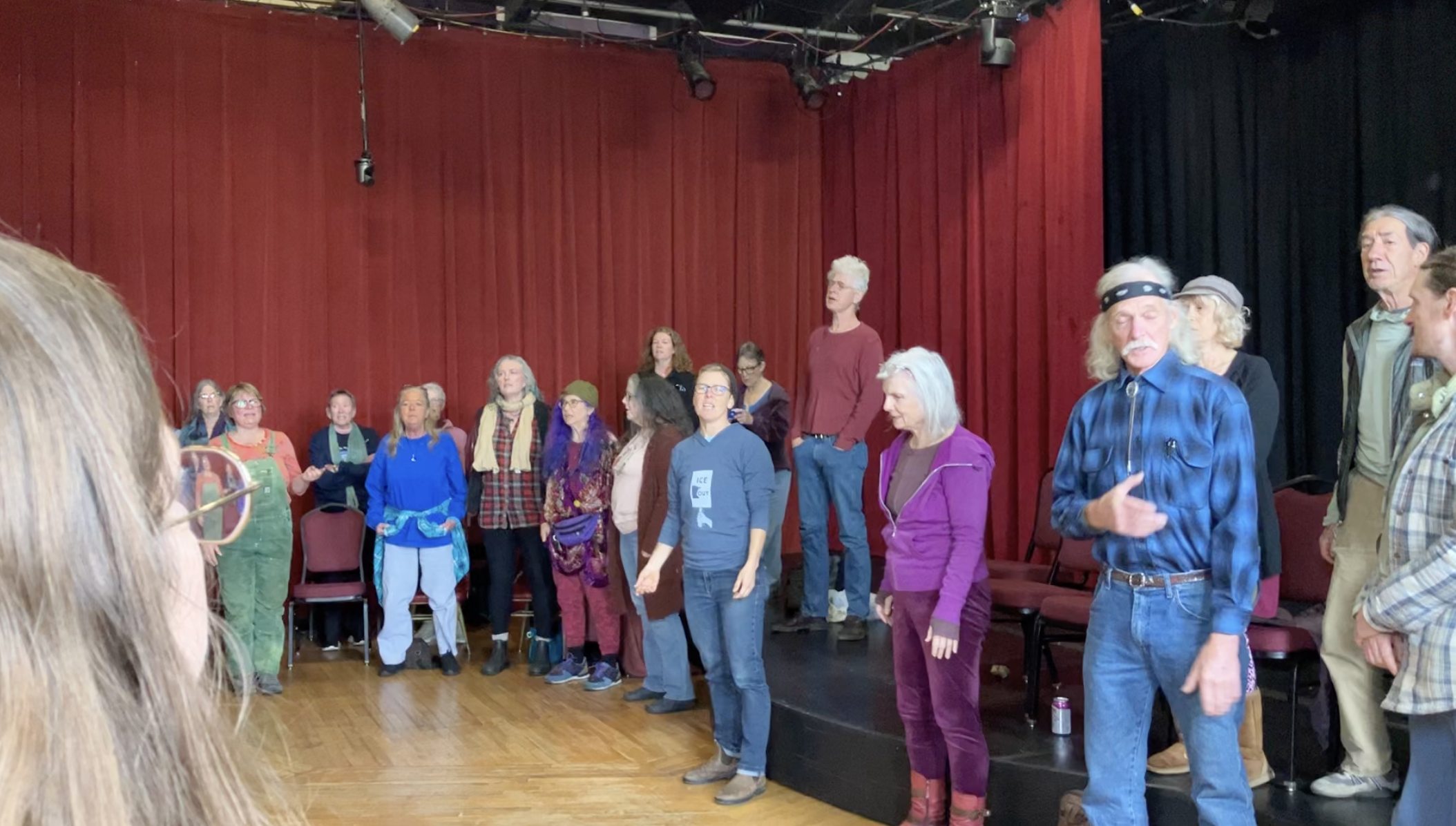
I attended a gathering last weekend that was advertised as a Community Singing for Solidarity, Resistance and Love. There were almost 100 people in the local Playhouse Theater, sitting in the audience seats, in chairs on the floor, and on the stage.
We started with some fun vocal warm-up exercises, playing with our voices and loosening our bodies. Then we stood in a ring of concentric circles on the main floor, closed our eyes, and we each made song sounds, listening to and singing with the sounds around us.
I heard high notes and low notes, lines of melody and rhythmic monotones. I started singing a single note on the offbeat, which morphed into two notes and a pattern that I kept repeating. I was aware that I couldn’t hold a note for very long, but I just kept breathing and listening and singing, breathing and listening and singing.
The woman on my left had the most beautiful, clear, strong voice, and I found myself singing with her, in harmonic counterpoint, almost. The sounds around us shifted and then, like the leader had predicted, all of us in the room were toning together in one harmonious sound.
OH!
To be in a room with so much positive energy, and love. And to feel that I was truly a part of such an amazing whole.
We all know that singing is beneficial to our health and well-being. Singing improves our breathing and lung capacity, reduces stress, and stimulates new neuron-pathways in our brain. Singing with others amplifies these benefits, and also provides a wonderful way to connect with others.
The organizers of the event talked about the Singing Resistance in Minneapolis, that singing at the protests made people feel safe. They said the movement is growing and that this gathering was the beginning of a local group.
And so we learned the melody and harmonies of three resistance/solidarity songs with the word LOVE in them, that the group plans to sing at the next protest. I won’t be at the protest, but I did sign up to attend the next singing gathering.
Perhaps there’s a Singing (Resistance) Group in your community that is calling your voice.
Click this link to feel and hear the love. I’m at the very beginning of the video.
From my song-filled heart to yours,
Happy Heart Month
Happy heart month. I hope that, in the midst of everything happening in our country, you are finding ways to stay heart-centered, resilient, empowered. And that you are breathing.
Now, more than ever, we need to focus on the people, places, and activities that make us feel safe, grounded, joyful, alive. We need to show up with our unique gifts, and concentrate our energies on kindness, compassion, and love. The more love we can send to ourselves, our friends, our families, and communities, the more love reverberates in the bigger world.
Here on the north coast of California, it is officially winter. It’s been raining the last four days, with daytime temperatures warming to about 45°.

When I left Phoenix last January, I spent three months at the beach in Morro Bay before following my deepest intuition to come here to Arcata in April, not sure, yet having a deep knowing that this was my new home. I had planned to return to Phoenix in November to pack up and sell the family house.
Instead, I have stayed here to experience what winter on the coast is like. Friends said it would be cold and wet, that it rained a lot. I imagined huge downpours like the desert monsoons that can flood the streets in a matter of minutes. But mostly, the rain here is a light but steady drizzle, which doesn’t keep Tillie and me from our daily walking.My raincoat keeps me dry, Tillie doesn’t mind getting wet, and she loves getting towel dried when we get home. And on the days that it does rain harder, I’m so grateful that we don’t have to be out in it, and that my cottage is perfectly cozy and warm. Yes, there is flooding, and rock slides, and even snow around the county, but the redwoods and I really love all of the moisture.

A dear friend from Morro Bay came to visit for a few days last month. It was fun to share some favorite spots and meals, and explore some new places, too. Our conversations were deep and rich, about everything from our spiritual beliefs and first girlfriends to my writing life and wearing a ring on your “wedding finger” even if you’re single.

All of that fun and talking prompted a clear phlegmy cough that turned into me losing my voice. So I rested, postponed some big things, and surrendered to the silence. I let go of all of the commitments on my plate, and just listened in. It was strange to not feel any pressure to hurry up and heal, or worry about what I wasn’t doing or planning to get done. I just let it all go.
I Doordashed some wonton soup and groceries, texted friends, and appreciated Marika’s recommendation to get some Mucinex to bring up the phlegm. As I started to feel better, I could also feel that I’ve turned some kind of corner. I could truly feel how full and rich my life is. I have friends, here and all over, favorite places to walk, and still, so many places to explore. I can see how I have been focusing my intentions these last nine months on settling in, meeting people, connecting with things familiar, like kirtan and Heart Sparks and riding my bike. And that now, not even a year later, I am home, completely and fully.
I used to choose a word every year that clearly defined my intention, so I could hold up any choice to the word, like a litmus test, to see if it supported how I wanted to be and feel. My word this year is BEYOND. Beyond what I know, beyond what I’ve done, beyond my limiting beliefs, beyond how I’ve done things in the past, beyond what I could ever imagine.

And so I am showing up for all kinds of new experiences and activities. I bought an e-bike rack for my car and drove to a park to begin my ride, but now I have to wait for warmer, drier weather to ride further. Next week I’m going to check out a Silver Sneakers class with a friend, and the following week we’re taking a Pickleball lesson together. I signed up for a cool, one day online workshop to discover the arc of my story by creating a Zine. And I’m teaching a new class for OLLI this month called Exploring Slow Stitching, that invites students to relax and create without an end product in mind.

I’ve also been creating my own slow stitch pieces using fabric remnants, trims and some of my mother’s jewelry. If you’re in the Phoenix area, check out the TOWARD2050 project at the Desert Botanical Gardens. I created four panels for the installation.

And this Sunday I am gathering four women for the first in-person, 7 week Heart Sparks Circle since 2012. I’ve led the circle many times since then via Zoom, but, oh, to sit in a circle, together, is going to be so much magic. Together, we’re going to explore how we can best show up for ourselves and others, with more presence and joy and love.
It’s so easy to get lost in the chaos of the larger world. It can be just as easy to pause, and simply breathe, to slow down everything outside of you and breathe deep into where you are, right here, right now, in tune with the strong and steady beat of your heart.
May you continue to feel safe and grounded, so that you can lean into the joys of your life, and keep spreading the love. And if you need some support or guidance, let’s talk.
From my happy, healthy, joyful heart to yours,
PS My article about volunteering has been published in PBS’s online magazine, Next Avenue. Check it out.
[ssba]