
Be the Light. Spread the Light.
Happy December! This time of the year is all about the light. Chanukah is called the Festival of Lights, with eight nights of candle lighting to commemorate the miracle of the oil. Kwanzaa is celebrated by lighting seven candles to represent the seven principles. Houses and trees are decked in holiday lights. And Jesus was born under the light of the star of Bethlehem. Everywhere you look, there are candles and fires, beckoning us toward the light and the warmth.
But in nature, this is the darkest time of the year.
This offers us a beautiful invitation to go inward to tend our own light.
If we’re feeling confident, creative, appreciated, it’s pretty easy to tap into our own glowing goodness. We radiate love and compassion, for ourselves and others. And our shining light reflects back to other people, creating an even bigger light.
But what about when sadness, grief, frustration, even hopelessness, overwhelm us, and we feel no light.
Even if your light is not roaring in radiant flame, it is still burning. It may be just a tiny glow of an ember, but it is there, offering a spark of hope. It may be a faint flicker, but it is alight because you are alive.
And if you fan the flame with a single spoken gratitude, the smallest of thank you’s, I promise you, the light will spark. And the more you can focus on what tiny goodnesses there are, the more that light will grow.
And when your light grows, the light around you grows. And, as corny as it sounds, one day you’ll look up and notice you are no longer huddled in darkness. You are shining, radiating, basking in the richest, truest light that is all of us.

I invite you to take some quiet time and feel into what warms your heart, what helps you feel authentic and loved. When do you feel most connected to who you truly are?
How do you spark your own light?
How do you spark the light in others?
How do others spark the light in you?
I invite you to tell someone how they shine in your life. Maybe even brave up and ask them how you shine in theirs. We are all sources and reflectors of love and light, and the more we shine, the more our world shines.
May you find your light, embrace your light, and shine your light in the world.
And may we see each other’s light, and help each other shine.
May this season fill you and your world with love and light.
With big, big love and gratitude,

P.S.
Before you rush into the new year, I invite you to take some deep time to reflect on this past year. Look back on all that you have been, done, and become. Notice how you have shifted, expanded, and grown.
Where were you brave?
What was easy?
Who did you ask for help?
How did you surprise yourself?
How did you offer your support?
Where did you show up fully as yourself?
What was your biggest motivation?
Where did you get stuck?
How did you move forward?
Where did you make a difference?
What has been your deepest Why?
How will you celebrate yourself for all that you have lived this year?
I’d love to hear your answers.
[ssba]The Threshold Between Winter and Spring
It’a already March, and the first full day of Spring is just two weeks away. I’m usually full of inspiration and excitement this time of year, but today, I’m still feeling the subtleties of winter hibernation.
The Heart Sparks Rest and Renewal Retreat was everything I imagined and so much more. We laughed, we lounged, we shared, we made art, and each retreater fell a little more in love with herself.
The week before the retreat, it snowed in Sedona. The freeway was closed just north of the exit to Sedona, and more snow was forecasted for the retreat weekend. With all of the planning I had done, everything was now up in the air. Would the roads be closed on the way up? Would we get snowed in once we got there? Would I have to cancel the retreat and refund everyone’s money?
The day before the retreat, four of us decided to caravan in the morning, so that, if we did have to turn around, we’d all be together.
That night, all I could do was pray and let go, and wait until the morning to see if the roads were open.
And they were. It was a clear and easy two hour drive north to our cabin, and the snow-dusted red rocks were stunning. We all enjoyed the brisk, wintery chill in the air, the rushing water in Oak Creek, and the constant fire in the wood stove.
We danced, we walked, we shared delicious meals and deep conversations about music, intentions, and deviled eggs. We talked about thresholds, and what we were leaving and entering. And we played with fabric collage and slow stitching to create unique artworks that expressed our experiences and self-reflections.
We decided to close the circle a day early, ahead of another snow storm. One retreater, who has a truck with 4WD, and experience driving a school bus over snowy mountain passes, was happy to stay another night for a solo adventure. She sent pictures of six inches of snow on Sunday morning, and I was so glad to be seeing them from the comfort of my own bed.
It took a full week for me to return to regular life. I realized I had been holding the idea of the retreat for almost a year, planning, imagining, advertising, and then cancelling the beach retreat, and then doing it all over again for the Sedona retreat. I had outlined the schedule, arranged the meals, and handled all of the logistics, and I was doing fine holding it all. But the uncertainty of the weather took its toll on me.
Unlike one retreater, who had a huge aha about returning to playing her beloved viola, I did not have a flash of inspiration about what’s next.
Exactly the opposite.
My message was all about resting in the now. Resting, not as in tired, but as in leaning back, and basking in all that I have created, shared, and received. And not just at the retreat, but this whole past season, and year.
For the first few days post retreat, I was happy to stay at home, watching TV, walking in the neighborhood with Tillie, riding my bike, and just taking care of the essentials. I did a lot of journaling, processing and assimilating all of the gifts and revelations from the weekend. I finished my fabric collage, and lingered in bed with Tillie every morning.
That week I had planned to return to the wonderful new yoga studio that I found, where the teacher talked about the breathe, and alignment, and radiating our hearts, but I was still feeling the need to stay tucked in, close to home.
Instead of berating myself, or analyzing my resistance, I focused on where I WAS making changes: adding fruit to my morning bran flakes, making my own granola, preparing a week’s worth of veggies, adding standing poses to my morning stretching, reclining in my favorite chair in the backyard sun.
It’s now a week after the retreat and I am still moving slowly, but I am trusting that this pace is just as much a part of the Flow as when things are pinging and rushing and happening.
I truly feel like I am a different person, which is something I said often during the retreat. My whole body feels more spacious inside, and kind of floaty. I feel intensely connected to something bigger than myself that is truly guiding my steps, so that I don’t feel the need to control or force or rush anything.
At the same time, it is so easy for me to fall back into worrying about income and money and the future. If I’m not working, and I have no housemate, how can I continue to afford this lifestyle?
When that happens, I cry to release it, and then I redirect my heart to embracing all that already is. Sometimes I can even begin to imagine how else I might want to feel. I eventually let the worry go and come back to the joys of the present moment, but it’s an ongoing practice and conversation.
I remind myself that I have always lived in this syncopated flow of money, never really knowing where it was coming from, and trusting that there is always enough. I also realize that I’m ready for a more stable and consistent flow of money for more peace of mind.
On my walk with Tillie this morning, I gave myself permission to take a little more time off, to not push or rush forward, but to continue to bask in all of this until the first day of Spring. To lean in and connect with the joy, to luxuriate in this life I have created, even trust in some spending on myself, and linger in the ending of winter, feeling the feelings, and rejoicing in all that is right here.
As uncomfortable and unfamiliar as this all feels right now, I know I am standing at a brand new, wide open threshold, and that amazing things are right there, calling to me from the other side. And I know that the bigger I trust, the bigger the prize. The more uncomfortable I feel, the closer I am.
And the more I listen in, I really can hear the winking of new growth and spring-like excitement.
I am thrilled to offer the one-day Fabric Collage and Slow Stitching Workshop at my house on April 1st. It was such a powerful and engaging activity for my retreaters, that I want to share it with you. Details are below.
And I just found out that the cottage I’m renting this summer in Arcata, a cozy college beach town in Northern California, with the ocean, bays AND redwoods, will be available sooner than originally planned. BIG YAY!!!
So Tillie and I will be back at the BEACH at the beginning of May. Just thinking about it lifts my heart and makes me happy. (And, of course, it sparks that worried-about-money conversation all over again.)
Thinking about my birthday makes me happy, too. It’s March 20, the first day of Spring, and for the first time in forever, I would really like to receive some birthday cards. So if you’d like to fill my heart with delight, ask me for my address.
I shared this excerpt about thresholds from John O’Donahue’s book, To Bless the Space Between Us, with my retreaters. I invite you to consider what threshold you are now standing at, and how you would like to cross it.
“At any time you can ask yourself: At which threshold am I now standing? At this time in my life, what am I leaving? Where am I about to enter? What is preventing me from crossing my next threshold? What gift would enable me to do it?
A threshold is not a simple boundary; it is a frontier that divides two different territories, rhythms, and atmospheres. Indeed, it is a lovely testimony to the fullness and integrity of an experience, or a stage of life that it intensifies toward the end into a real frontier that cannot be crossed without the heart being passionately engaged and woken up.
At this threshold a great complexity of emotion comes alive: confusion, fear, excitement, sadness, hope. This is one of the reasons such vital crossings were always clothed in ritual.
It is wise in your own life to be able to recognize and acknowledge the key thresholds: to take your time; to feel all the varieties of presence that accrue there; to listen inward with complete attention until you hear the inner voice calling you forward. The time has come to cross.”
I hope your threshold from winter to spring is filled with ease and delight and beautiful awakenings. I’d love to hear about them.
[ssba]This Time of In-between
I hope your new year is off to a healthy and happy start. My January was filled with wellness exams, lunches with friends, Mac clients, romps at various neighborhood parks, a speeding ticket followed by online defensive driving school, new glasses, an unexpected new computer, and the official filing of the divorce papers.
Reading through the legal paperwork, I was surprised by all of the emotions I felt, and it took me a few days to move through the new layers of grief and loss. And for the first time I allowed myself to be angry that I had to choose to give up a lifestyle that I really loved.
It’s been so empowering to watch myself move through each emotion as it arises, noticing that I’m feeling all the feelings, but not lingering in any one emotion or memory. I’ve been able to tender myself, talk about my feelings, and give myself full on permission and safety to feel it all.
I’ve also been consciously and actively shifting my focus to welcoming more joy into my life. After the last few years enveloped in so much sadness and grief, it’s time.
I’ve been paying attention to the simple things that make me smile: the perfect, sweet-tart taste of the grapefruits from my trees, playing backgammon in the backyard with a friend on a sunny Sunday afternoon, hearing a friend’s special ring tone when the phone rings, cooking crab cakes in my new air fryer, and all things Tillie. I’m still riding my bike every day, too, and that makes my whole being happy.
And, on a wild whim, I signed up for a free, online stitching camp that offered five days of experimenting with fabric, paint, and stitching. I love looking at all kinds of textile arts, and this seemed like a great opportunity to see if stitching might be my new thing.
I had so much fun gathering my supplies: scrap fabrics that I picked up several years ago at the Latimer Quilt & Textile Center in Tillamook, Oregon, muslin squares from when I made prayer flags, colored yarns from a huge assortment gifted to me by a friend many years ago, a few coordinating spools of thread from my mom’s Danish cookies sewing box, and a few items from my stash in the garage studio for the mark making.
The first lesson was using paint and random tools to make marks on the muslin. After the pieces were dry, I didn’t like the paint colors I chose, so the next day, I re-did the mark making with different colors. The second day we cut up our painted fabrics into 3”x4” pieces and reconnected them to create new designs. And we were supposed to stitch the cut pieces together in the new layout.
My fingers were stiff, the fabric was flimsy, and I struggled to pin the pieces together. I considered gluing them, so that I could continue with the next steps, or borrowing a friend’s sewing machine, but I realized there was no joy in any of it. And so I chose not to continue.
At first I was disappointed that there were no sparks, since I’ve been fascinated with all kinds of textile art for so long. But now I know. It’s kind of like the welding class I took last year. I thought for sure I was going to become a metal artist, but no, the only sparks that day were on the metal.
And so, with all of the things I thought I might love to do now off the table, I am opening to the unknown, to wider possibilities, new energies, and unfathomable opportunities.
Meanwhile, I have gotten my hands back into glue and water, and it is truly my happy place. I had a vision of decoupaging hearts, so I ordered some plastic, fillable hearts, and have made two Full Hearts for friends using their words of the year. (If you’d like me to make you one, I am taking orders.)


I know this is a challenging time of in-between for a lot of people. Almost everyone I talk to seems to be, in one way or another, between what was, and the unknown future. Hobbies that we used to find engaging are no longer interesting, activities we once enjoyed seem like too big a hassle to organize, and we’re just not sure how to reconnect with the world, or ourselves.
It’s as if we’ve outgrown our before-lives, but we have no idea what we want next.
Instead of getting caught in the angst of those extremes, can you simply breathe yourself into this present moment? Because, in the present moment, it is OK to not know. It is OK to not want to do the things you did before. It is OK to take time to feel your way back to yourself.
This time of in-between can be an opportunity to slow down, to notice where you no longer want to expend and share your energies, and pay attention to things that are winking at you from the sidelines.
Give yourself time. Find ways to let go of needing to know, and enjoy the mystery. Be curious without expectations. Say yes to the things that take you to your soft edge. Trust that when you get to the end of all you know, you will fly.
[ssba]Listen For the Spark
“And now we welcome the new year, full of things that have never been.” Rainer Maria Rilke
Happy New Year!
Do you have a ritual for beginning the new year? Maybe you eat black eyed peas for good luck, or spend time with the people you’d like to see throughout the coming year. Maybe you watch the Rose Parade in your pajamas, or take a walk in nature.
Some of us choose a theme for the year, or set goals, or make a list of places we’d like to visit. In the past I have chosen a word for the year, to help me focus my attention on my deepest intention. One year, I wrote a manifesto, declaring the qualities and attributes that I wanted to claim more of. When I was living on the road, the visions for the year were more about where we wanted to explore, and what kind of volunteering sounded interesting.
This year I am using the Heart Sparks cards to guide me. In December I picked two cards, one to guide me for the next thirty days, one for the next ninety days. I pulled LISTEN and SPARK.

When I read the text of Listen, my body resisted, so the first thing I did was turn off the TV. But I like having background noise when I’m putzing, so I turned on some old favorite music that I hadn’t heard in years. And it inspired me to dance around the living room. I listened to my body encourage me to get on my bike, even though it was chilly outside. And I listened in to the empty spaces between my usual thoughts.
I heard clarity. I heard boundaries. I heard how soft and healed my heart is.
And every night before bed I asked to be guided and supported, to do my best work in the world.
One morning I heard a strong message to revamp my original Spark the Heart, Ignite Your Life program. I pulled out all of my notes, and looked at the web page I had created in 2012 when I first offered the course. It was a beautiful, clear offering, with a lovely balance of words and images. But it needed updating, and, as techy as I am, I do not write HTML code. So I set it aside.
The next morning I thought to ask the woman who had originally created the page if she could do the updates. I sent her an email and she replied within the hour that she couldn’t do it, but she referred me to someone who could.
I contacted the referral and she was happy to do the edits, she had time in the next few days, and her fee was within my budget. I sent her the edits and she said she’d have it done the next day.
That night, I was all comfy cozy in bed, drifting off, thinking about the program, and I realized I needed to include a virtual group gathering to the experience, because now, more than ever, we need to feel seen, heard, and connected.
So I got out of bed, sent the new edits, and went to sleep feeling so full and happy. The page was finished that next day and registration is now officially open.
I sat back in awe of how quickly and easily and beautifully it all unfolded. And how the channels are opening up to the people who will benefit from the program.
When we are so connected to our authenticity, to our true essence, and we listen in to the messages, and follow the energy with no expectations, magic happens.
The second card I drew was SPARK. I noticed how much was sparking with my work, that I was meeting new people, and connecting from a different, more authentic place.

I also noticed that most of my focus was outward, on sparking others, through my work. And I wondered what I might like to spark in my own life, for my own self.
My first response was “I don’t know.” So I asked again, and I listened. I took out some paper and wrote the headings: Spiritual Life, Financial Life, Social Life, Physical Life. And I listed things that I’d like to focus on in each. But there was nothing exciting, nothing that roused any curiosity, no sparks.
And I noticed that I had completely forgotten my Creative Life. I pulled out a new piece of paper and asked what I wanted in my Creative Life. At first, I wrote about creating a regular writing practice. Maybe publishing some articles. And adding a weekly candle lighting practice.
And then I took a walk with Tillie, came back, and asked again. This time I wrote, “I want to spark my curiosity, my desire to learn something new, to feel devotion to something.” And my whole body tingled.
And I remembered feeling this desire in 2005, a year or so after Marika and I had split the first time. I wanted to learn something new that I wouldn’t be good at, but that I would love. I had made a collage with that affirmation and a few others, and a few months later, seemingly out of nowhere, I rented a cello and signed up for private lessons.
I had played alto saxophone and oboe in high school, and yet I was genuinely surprised by how big the cello was. And that it rested across my heart when I played. And, unlike the treble clef for sax and oboe, the music was on the bass clef, so I had to mentally transpose each note as I played.
I loved it. I practiced every day and had a lesson every week. When my teacher said I was ready to pick a song, I chose Vivaldi’s “Winter” from “The Four Seasons.” And I was pretty good. But after a year, I returned the cello, feeling complete.
And now, I’m aching for that feeling again. Of being a beginner, of discovery, of being devoted to something that brings me a new and deep kind of joy.
And I have no idea what it will be. And that is exciting too, knowing that there will be a moment when something is going to appear and my heart is going to soften and light up, and my whole being is going to say Yes.
Meanwhile, I’m showing up, still asking for guidance and support, and listening in for the heart sparks.
I invite you to take out some paper and write your own lists. Under each heading: Spiritual Life, Financial Life, Social Life, Physical Life, Creative Life, list what is working, what you’d like to create, and what you’re ready to let go of, to feel more supported and fulfilled.
Notice where there is contentment. Notice where there is resistance. Notice where your heart is calling you to shine.
I’d love to hear what you discover. And if you’d like some support and camaraderie on the journey, please join us for the Spark Your Heart, Ignite Your Life! program. We begin January 16.
Wishing you a year of good health, much laughter, deep connections, and everything your heart truly desires.
With a heart full of light and love,
Ruth
[ssba]Happy Season of Light
Happy Winter Solstice! This time of the year is all about the light. Chanukah is called the Festival of Lights, with eight nights of candle lighting to commemorate the miracle of the oil. Kwanzaa is celebrated by lighting seven candles to represent the seven principles. Houses and trees are decked in holiday lights. And Jesus was born under the light of the star of Bethlehem. Everywhere you look, there are candles and fires, beckoning us toward the light and the warmth.
But in nature, this is the darkest time of the year.
Which offers us a beautiful invitation to go inward to tend our own light.
If we’re feeling confident, creative, appreciated, it’s pretty easy to tap into our own glowing goodness. We radiate love and compassion, for ourselves and others. And our shining light reflects on another person, creating an even bigger light.
But what about when sadness, grief, frustration, even hopelessness, overwhelm us, and we feel no light.
Even if your light is not roaring in radiant flame, it is still burning. It may be just a tiny glow of an ember, but it is there, offering a spark of hope. It may be a faint flicker, but it is alight because you are alive.
And if you fan the flame with a single spoken gratitude, the smallest of thank you’s, I promise you, the light will spark. And the more you can focus on what tiny goodnesses there are, the more that light will grow.
And when your light grows, the light around you grows. And, as corny as it sounds, one day you’ll look up and notice you are no longer huddled in darkness. You are shining, radiating, basking in the richest, truest light that is all of us.
I invite you to take some quiet time and feel into what warms your heart, what helps you feel authentic and loved. When do you feel most connected to who you truly are?
How do you spark your own light?
How do you spark the light in others?
How do others spark the light in you?
I invite you to tell someone how they shine in your life. Maybe even ask them how you shine in theirs. We are all reflections of love and light, and the more we shine, the more our world shines.
May you find your light, embrace your light, and shine your light in the world.
And may we see each other’s light, and help each other shine.
May this season fill you with love and light.
“I honor the place in me where the entire universe resides.
I honor the place in me of love and light, truth and peace.
I honor the place in me where, when I am in that place in me, and you are in that place in you, there is only one of us.”
~ translation of the word Namasté
With a heart full of light and love,
Ruth
[ssba]Giving Voice to Silent Grief
I’ve been doing some deep grief work this past month. I didn’t even realize it at first. Three weeks ago I pulled an intercostal muscle under my right breast that went all the way around my back. It was painful to raise my arm, and it especially hurt when I coughed or sneezed. Driving and steering exacerbated it, so I mostly stayed home, resting, and icing.
And then a friend came for an overnight visit. When Marika and I split up, I didn’t share the specifics and details of why it got so bad that I chose to leave. Not even with my closest friends. Because they know Marika and it didn’t seem right.
But my visiting friend didn’t know Marika, and so I opened up about some of those details. Which brought back feelings of shame, and hurt, and sadness, and more shame for keeping it all to myself.
And it also tapped into that deeper trauma layer, when I was six and my brother Lenny died. My parents were so lost in their own grief, and my friends had no idea what I was going through, so there was no one to share my deepest feelings and secrets with.
Both were big heartbreaks and deep losses. But I realized that the grief that I was feeling this time was less about the breakup or losing my brother, and all about not being able to talk about my feelings about what was happening.
This is what some people call Silent Grief. Silent grief is when we feel compelled to hide our emotions and carry our pain alone because the people around us, either implicitly or explicitly, are not receptive to our suffering. And so our grief tucks itself into our bodies, waiting to be triggered, wanting to be released.
I think a lot of us have experienced big grief from all we have lost over these past two+ years. And we don’t know how to talk about it. Many of us are grieving for what life was, and how so much has changed in how we connect and relate. We don’t know what to do with our feelings of not wanting to go out, of feeling stuck, stalled, disconnected. And those of us who enjoyed the solitude and isolation, who turned inward toward creativity and growth, may feel guilty for not feeling such loss. So how do we begin to talk about all of this?
Back in the 60’s we didn’t talk about grief. Or cancer. Or death. Especially with children. There were no grief support groups, no books for kids, no language for me to process what I was feeling. And so I had to feel all of my feelings alone.
In my twenties, a dear friend encouraged me to ask my parents about Lenny. She said, “He was your brother. You have a right to know.” And, even though the conversations made my mother cry, it opened up an amazing dialogue and was the beginning of our deep healing and reconciliation.
Over the years I’ve done a lot of grief work with therapists, and I have learned that it’s OK to feel my feelings and talk about them, that they aren’t going to pour out and never stop. I’ve worked through many of my feelings of sadness and loss through my writing and my art. And still, something deep happened this time that took me to the healing core of it all.
A second friend came to visit for Thanksgiving. I was her last stop on a two month book tour, and she was happy to just have a place to rest, and work, and unwind. We took a lovely morning walk with Tillie and some friends on Thanksgiving morning, but then I was too exhausted to fix all of the sides I had dreamed about. I did manage to make mashed potatoes and roast some vegetables, and that was just fine for my friend.
I had no energy. My coughing went deep into my lower lobes. And I was sweating a lot. I took a Covid test, just to be sure, and it was negative. I knew I wasn’t sick. This was grief, showing up to move out of my body.
I have always carried my grief in my lungs. As a kid I had bedtime coughing fits, and the pediatrician told me to lie on my belly and hang my face over the edge when I coughed. Some nights my father would hold me in his arms and run the hot water in the shower until the bathroom was filled with steam.
In high school, I got bronchitis every January, and, sometime in my thirties, I was finally diagnosed with asthma. Coughing is so second nature to me that I don’t even realize it. But when it gets deep and painful, I know my body is trying to tell me something.
Over the next few days I continued resting, and icing, and writing. Friends texted and called, just to check in. It reminded me that here, now, in this present moment, I am not alone.
As much as I just wanted to lay around, I knew I needed to move my body. I started to stretch my right side, even though it hurt. The pain reminded me of recovering from open heart surgery, so I knew it was getting better.
I shared some of my journey with my friends on Facebook and it was so heart healing to be held and heard and loved. But the comment that struck the deepest was from Scott, who was Lenny’s best friend. He and I haven’t spoken in more than forty years, but I post a Happy Birthday message for him every year, even though I never hear back.
But this time, he wrote, “Lenny was my best friend and I know it was devastating for you, because it was devastating for me.” WOW! I cried and I bawled, and it felt like a deep zing of connection and opening and healing for both of us.
A few days later, another Facebook friend asked about a favorite book as a child. One of mine was “Are You My Mother.’ My mom used to read it with me, and I would be the sound effects for the crane. I saved very few books when I hit the road, but I kept the copy that my mom gave me in 1988 when I was 29 and she was 58. I had forgotten that she had written in it.
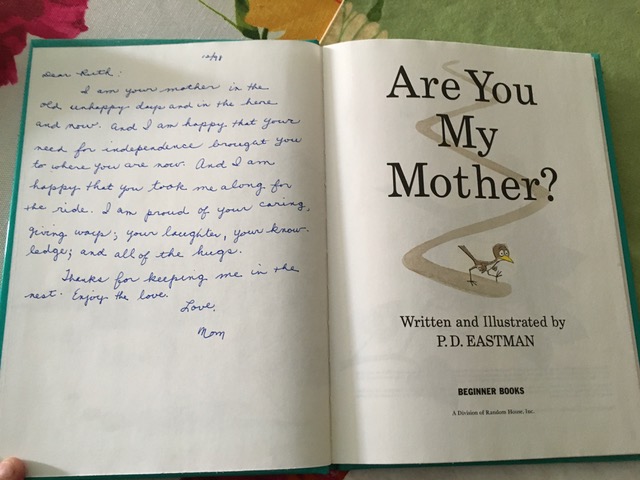
Reading her words, about the past and the here and now, I cried even deeper. Not because she’s gone, but because it was so powerfully healing again, in that moment, for both of us.
The next day, Marika, who I haven’t seen since April, needed to come over to pick some things up from the garage. I had asked her to come when I wasn’t home, but I didn’t feel well enough to go out. So I buried myself under my covers and bawled, waiting to hear the garage door open. It felt just like when Cody died, and I waited in the bedroom with earplugs in, and the whole RV shook when the funeral home man carried his body down the stairs.
But the deep, piercing grief in that moment wasn’t about Cody. It was about lying there in my bed, feeling utterly alone. Just like all of the other times.
But this wasn’t those other times. Right here, right now, it may just be me and Tillie, but I am not alone. In addition to all of the love in my life, then and now, I also have myself.
So I started to tender myself. I made Manischewitz split pea soup with extra carrots and celery. I wore my mom’s green turtleneck and gave myself literal hugs. I found pictures of my younger self, and embraced her tenderness and strength. I attended a Zoom chanting concert, and danced to a favorite Elton John song. I drank immune therapy hot tea from my special mug, guzzled Robitussin DM, and watched two seasons of Leverage-Redemption. And I spent lots of time cuddling with Tillie.
And I finally got back on my bike. The minute I started pedaling I felt revived. I rode for twenty five minutes, and felt lighter, less tired, and my chest didn’t hurt as much. I felt the griefs of the past and the present lining up like the layers in those transparencies of the human body, aligning and leaving my body.
Early on, I thought that an epsom salt bath would be a good thing to help draw out the toxins and the grief. But when I checked, I had no salts. Then I got some, and the tub didn’t have a drain plug. I found one the next day, but I wasn’t up for cleaning the tub.
Every night I thought about it, but the bathroom was too cold, and the thought of putting the heater in the room and turning it into a sauna didn’t sound good either.
Two weeks passed, no bath. Then I had two nights of waking up in pools of sweat, sweating on my bike ride, sweating on my walks with Tillie. So one morning, after my walk and ride, I made the commitment.
I cleaned the tub, ran the hot water, poured in some Epsom salts and got in. The water was just hot enough, but I had to keep half of my body out of the water to not feel like I was going to burn up. I looked up at the shower nozzle and thought, Oh, a cold shower right now would feel so refreshing. But I stayed in the hotness, feeling my body relax and adjust to the temperature. Eventually I wished the tub was even deeper, so I could submerge my whole self.
The next day, I was still sweating on my bike ride in 60°, so I knew I needed another soak. This time I filled the tub a little higher so that more of me could be underwater. I embraced the heat, knowing it was softening my muscles and releasing lactic acid. I bent my knees and crossed my ankles and slid further under so that my head was submerged, with just my nose and eyes above the water line. It was as wonderful as floating in a swimming pool, but better, because the hot water felt like a hug.
And now, a few days after that last bath, I feel like I have returned to the present tense. I feel lighter, my rib muscle is healed, my whole heart chakra area feels open and expansive. My chest is still tender, but I am hardly coughing. I truly feel like the grief is gone.
And I hear myself saying new things, like “Life is getting better every day,” and “I feel happy.” My whole being feels open and ready.
I read somewhere that we grieve to make room for more love. I am definitely noticing new channels and connections opening, and I have finally let go of a few that really didn’t serve me. As excited as I am about what might possibly be next, I know that the joy of the journey is in focusing on what is right here, right now, and noticing where I feel the true heart sparks.
And I definitely feel some sparks about supporting others in giving voice to their own silent grief. If this speaks to you, I see you. And I want to hear you. I want to offer a space where we can acknowledge our grief and start talking about our feelings. I don’t know quite what that looks like yet, but if this is something that feels good to you, please let me know. We’ll see what we need to create for our grieving hearts to heal.
With an open and healing heart,
Ruth
[ssba]TRAVELOGUE Part 4: Mendocino: Then and Now
TRAVELOGUE Part 4: Mendocino, Then and Now

We finally arrived in Mendocino on the California coast on Monday, May 24. Mendocino is a picturesque tourist town in northern California. Once a booming lumber mill town, Mendocino is now designated as a Historic Village, and that’s why we are here volunteering. We work for Mendo Parks, a non-profit organization that maintains and staffs the historic buildings and visitors centers within the state parks in this area.
When we pulled in, we met Amelia, our volunteer coordinator. She showed us to our campsite, dropped off our volunteer vests and working papers and, the next day, we went to the police station in Fort Bragg to be fingerprinted.
Instead of inking our fingers, the woman used a live scan computer program. We chatted about the technology, the area, and we asked her for restaurant recommendations. She told us that the best fish markets are down by Noyo Harbor and only open Thursday through Sunday, so we opted to share an order of fish and chips from a recommended Mexican restaurant nearby.
We took our food to the parking lot overlooking the Noyo River, and watched kayakers float by as we enjoyed our meal. The fish was flaky, the batter was crisp, and the coleslaw was creamy, but not overly so. Then we took Tillie to the off leash dog beach around the corner for her very first beach run.
While I made my way across the short, rocky beach, Tillie headed straight to the water. When she reached the surf, she broke into a full on Greyhound racetrack run. She ran to one end of the coved beach, then back to the other, then headed toward me, full speed. I called her name, raised my hand in the air, and she dug her feet in the sand as she came to a stop in front of me, ready for a treat. I don’t know who was happier.

She ran for a while longer, and then we got back in the car and drove to find the neighborhood dog park, but we didn’t stop because there were six dogs there. When we got home, Tillie watched the wildlife out the back window, then crashed for the rest for the day. She was almost too tired to get up for dinner.
Meanwhile, Marika and I continued to “move in.” We filled the water tanks so that we can use the water pump to get better water pressure for showering. We arranged two strands of bright white Christmas lights on the ground under and around the RV to deter mice from eating the wires and insulation, and we filled out our volunteer paperwork. I did ride two circles around the neighborhood, but it was damp and I was underdressed. And I was grumpy.
After spending the last year and a half visualizing our volunteering gig in southern Oregon, where we were supposed to be working this summer as wildlife interpreters, and camping at a park with direct and easy, dog beach access, I was having a slow time letting go of that vision and embracing being here.
Every volunteer job offers a unique RV camping setup. Sometimes we are with one or two other campers in a designated host area, sometimes our spot is right in the campground, next to campers. Sometimes we are in a village with other volunteers. Here, the volunteer sites are on the same property as the State Park’s offices, maintenance yards, and employee housing for the entire Mendocino-Sonoma Parks District.

The front half of the property is the maintenance yard, with wood shops, garages, heavy equipment, and all kinds of park maintenance materials. The back section is the neighborhood, with volunteer campsites mixed in between assorted employee housing: fifth wheels, trailers, one room cabins, and two bedroom cottages, painted brown with evergreen window trim, to match the forest.

Our campsite has a wide deck that’s big enough for our chairs, the grill, Marika’s propane fire pit, and two carpets for Tillie to lie on. We have a front lawn, gorgeous flower beds, and we get a good amount of light and sun. I love our campsite. But we are in the forest.
I do appreciate the calming, grounding feeling that washes over me when I breathe in the trees. It feels like a soothing bath. But I miss the cleansing, energizing glory of the rolling waves and the wide open horizon.
Yes, the ocean is just across the highway, but the road from here to the beach is long and windy and all downhill, about 200’ elevation change in a very short distance, which means it’s too difficult to walk or ride. And dogs have to be on a leash on the beach. But there is a beach. And there are many places that I can drive to and then bike, so I’m adjusting.
I am surprised that, instead of lamenting that I’m not riding as much as I had been, I’m delighted that I now have a walking companion. I took up bike riding when Cody and Marika weren’t able to walk very far, and I needed some kind of physical activity.
Tillie and I walk several times a day, and I feel like I’m strengthening all new muscles. We have found a comfortable trail pace together, and we both stop when the other asks. One night, after the employees were gone and the maintenance yard was asleep, we walked twice around the circle, her sniffing the edges of the bushes, and me catching peeks of the full moon between the branches.
In the morning, I was going to take her for a walk, but she was back at her window, so I thought I’d go for a quick ride instead. As soon as she heard me putting my jacket on, she came over. I wasn’t ready to try to ride with her, so instead, we went for a walk. We started in the neighborhood, sniffing the fence line of the across the street neighbors, where, earlier, a young, unleashed dog had peed several times.

We walked past the yard with the cats, but they weren’t there, and I said hello to Lexi, the dog who is afraid of other dogs, as we walked by. Her bark turned to whimpers, so maybe there is hope. We continued up the road to the top of the circle, then turned right, toward the maintenance yard. But instead of circling home, we turned onto the North Boundary Trail. Denise said it was a steep climb, and then it leveled out. Marika had walked it in the morning and said that, after the trail leveled out, it went downhill, so she had turned around. I wanted to check it out for myself.
The uphill was a holy hell of a climb, from 100’ to 200’ elevation in a very short distance. Tillie walked a few steps ahead of me and we maintained a slow, easy pace. I paused several times to breathe and look around at the variety of trees and plants. We were truly living in the forest.
As soon as the trail leveled out, Tillie stopped and stood by my side. I looked around, listened. I didn’t see anything. But there are black bears, mountain lions, deer and fox in the area. I took a few steps forward but she was still hesitant. I asked her if she wanted to turn around, and she did, and I followed her back down the trail.
On Wednesday, two days after we arrived, we had our first day of training at The Ford House in Mendocino, just 3 miles south of our neighborhood. The Ford House was built in 1854 and serves as a museum and visitors center for the nearby state parks. It was a full seven hours of learning the history of The Ford House and the town of Mendocino, how to use the Point of Sale computer system, the cash in and cash out procedures, how to fly the bird kites and hang the flags, where things are stored, who to call for assistance.

We did a great job, ringing up sales without incident, talking with visitors, asking Cindy, our boss, when we didn’t know the answers. And I even learned the secret route to the post office, because one of us will check the PO Box during our shift.
It was also Tillie’s longest time alone. The neighbor said she cried for the first five minutes, and then was quiet. We’re guessing she spent much of the day on the bed, watching out the big back window where Marika created a comfortable perch for her. She was lounging on the sofa when we got home, all chill, then very wiggly when she realized, oh, you’re HOME!!

We returned to work on Thursday for another six hour training day. This time, Cindy worked upstairs in her office, available if we needed anything. We raised the flags, put out the bird kites, counted the cash, opened the register, and greeted all of the guests.

We took turns sharing some history with visitors. The Pomo Indians lived in this area for 12,000 years, hunting inland in the fall and winter, and coming to the coast in the spring and summer to fish and gather plants. In 1850, the Frolic, a ship from China heading to San Francisco, was shipwrecked near Point Cabrillo. A lumber mill owner from San Francisco sent Jerome Ford to the area to salvage the ship. Nothing was left of the ship, but Ford saw all of the redwood trees and suggested they build a mill on the headlands. Soon after, Mendocino became a thriving lumber mill town.
We point to the 1/12 scale diorama of 1890 Mendocino that prompts a conversation about the water towers around town, then and now. Mendocino was, and still is on a well system. These days the towers are mostly decorative, but there are a few that have been converted into B&Bs. We share that Jerome Ford had this redwood house built for his wife in 1854, with the original kitchen and dining room in the basement, and that it was the second house built in Mendocino. We point out Portuguese Flats and Chinatown, and explain the roles that these cultures played in the community.
We move into the second room and point to the photographs of the oxen hauling logs, the dammed rivers, the mill equipment, and explain how they transported the cut logs to the mill. And then I show them a model of the precarious apron chutes that they used to move the cut wood planks from the headlands down to the waiting barges in the turbulent water below.
We talk about how, by the 1950’s, the lumber industry died, the trees were gone, and Mendocino became a ghost town. And that’s when the artists moved in. When the developers came in the 1960’s, wanting to build homes and business all along the Headlands, Emmy Lou Packard, a local artist and friend of Frida Kahlo and Diego Rivera, gathered the community and worked with the League of Women Voter to fight against the development. In the 1970’s, the state of California acquired all of these miles of coastline and headlands, to protect and preserve it for future generations to appreciate and enjoy.
Then we answers any questions, thank them for their attention, and invite them to also check out the special wildflower exhibit in the back room.
Sometimes people ask for restaurant recommendations, or the best place to see redwoods. Some visitors ask about the TV show, Murder, She Wrote, that was filmed here in the 80’s and 90’s.
I enjoy giving the tours. (I do have a minor in theater.) I stumble sometimes, usually trying to remember Emmy Lou Packard’s name, but the visitors are gracious and understanding, and I often make a joke about it. And I love when they appreciate the experience enough to leave a donation.
On our third working day, just when we were getting comfortable at the Ford House, we went to work with our neighbor, Denise, at the Visitors Center at Van Damme State Park, another place we’ll be working this summer. The register and sales systems are the same as at The Ford House. The biggest difference is that it’s in a campground, not in town, so it’s a different kind of visitor. It was the first time the visitors center was open for the season. We greeted four visitors, sold two hoodies, and Denise decided to close an hour early, so we were home by 3:30. And ready for the next seven days off.
Marika wanted to pick up Indian-Middle Eastern food for dinner at the restaurant next to the gas station in Fort Bragg, so we harnessed Tillie up and drove into town. I wasn’t in the mood for that cuisine, but I was too exhausted to look for an alternative. Then I remembered there was a Japanese restaurant nearby, and, since we were getting our food to go, I chose one restaurant and Marika chose another.
We took our meals to the Noyo Headlands parking lot for the ocean view from the car. And we saw that there was a dog park right there. So after our respective, delicious, hit the spot meals, Tillie got to play ball, and run, and smell, off leash.

The next day, our first day off, I slept until after nine. After so many weeks of planning, organizing, orchestrating, and re-routing, and then three, seven hour days of training, this was the first day I didn’t have to hold ANY information. My whole being was so happy for a day to be loose and free and relaxed. No plans (except the Farmer’s Market), no have to do’s (except a beach walk), and no information to remember.
A little before noon we drove into Mendocino to go to the Mendocino Farmers Market. But silly me, the market is on Friday, not Saturday. So I asked Marika to drive me to see Big River Beach. We turned back onto Highway 1 and drove less than a mile south to the Big River turnoff. All along the river, there were gulls, as well as holiday weekend kayakers and paddle boarders, families and free running dogs, even though it is a leash beach.

We drove a little further south, through more redwoods and Douglas firs, and so many varieties of plants and flowers, looking to see if there was a Little River beach. We ended up in the town of Little River, at the two-pump gas station, that also had a dinner restaurant, and a well-stocked market. I browsed the prepared food options – salads, burritos, corn dogs, hummus, sandwiches – while Marika finally bought her first California lottery ticket.
We stopped into the Little River Improvement Club and Museum, housed in the town’s original 1885 community hall. The docent, a scraggly bearded man in his 60’s, told us that he and his wife moved to the area in 2018, a life long dream, and he is the new director of the museum. He plans to host art shows and concerts, to re-create the community gathering ambience.

It was still a cold 53° and overcast, so we skipped a beach walk and headed home. My ideal weather is 65° and partly sunny. Anything over 78° is too warm for my comfort. And now I’ve discovered that anything below 60°, without the sun, and especially with wind, is the cold edge of my outdoor comfort.
And my wardrobe reflects this. I have eight pairs of shorts and only three pairs of jeans. Fortunately I have long sleeved T shirts, sweatshirts, a fleece vest and jacket that I can layer to keep warm. And I wear a camisole under it all to keep my core warm. I also have gloves and an ear cover that I wear on my evening walks with Tillie, but I may have to get a ski cap for longer outings. But inside, I prefer to have the window cracked when the heat is on, so that I can breathe.
Marika runs even colder than me, though her feet and hands never get cold. She prefers to be toasty warm, and will sit on the sofa in front of the electric heater with her sweatshirt zipped up and the hood over her head, with a blanket on her lap. Thankfully, we both like to sleep with the window open, so she wears heavy sweatpants and her hoody, while I’m in a t-shirt and lightweight pants, happy under my sheet-duvet-blanket layers. And, if there is no wind, I can hear the ocean as I’m falling asleep.
On our second day off, I slept until TEN, and in the afternoon, the three of us drove further north than we’ve been, through Fort Bragg, past MacKerricher State Park, past Cleone, where friends have just built a cabin, to Seaside Creek Beach. It’s a dream spot with a wide, flat, sandy, walking beach where dogs are allowed to run off leash. And boy, did she.

She headed straight for the low tide surf and took off running along the water line to the left, then she headed up into the sand, turned a full speed circle around me, and headed back to the water. Twice, without stopping, just full on running.

I started walking in the opposite direction along the low rolling surf, calling her to walk with me, and she did. And then she took off, chasing a sparrow toward the water. I worried that she would chase it into the surf, but she stopped before her feet even got wet. We practiced walking together, at our own paces, back and forth in the wet sand. We sat on a rock for a bit, watching the water, and then I leashed Tillie and we walked together, back to the car. She and Marika napped much of the rest of the day, while I wrote and relaxed on the sofa, watching TV.
After two days of sleeping late, and mostly hanging out at home, I woke up on day three feeling rested and rejuvenated and ready to take care of things. I drove into Fort Bragg, about seven miles north, did the laundry, and went food shopping. I was shocked by the California tourist town prices.

Gas is four dollars plus per gallon, bananas are 79 cents a pound, an ice cream cone at McDonald’s is $1.99, and a lunch portion of fish and chips, without coleslaw, starts at $17.00. Last summer, in Oregon, we paid $3.19 for gas, 59 cents for bananas, $1.00 for an ice cream cone, and $14.00 for twice the serving size of fish and chips, and it even came with coleslaw. M joked that we can’t eat out as often, unless we’re going to Taco Bell or McDonald’s.
One afternoon I drove into Fort Bragg and checked out several of the many thrift stores. I didn’t buy anything, but it was fun to look. The next afternoon we visited the Mendocino Coast Botanical Gardens, another gorgeous place to stroll among bursts of colors and scents, with walking paths that lead to wide open ocean views. Marika enjoyed walking there so much that she converted her admission price into a membership.

We checked out the Mendocino Farmers Market the following Saturday, and I was surprised that there were so few vendors. We did buy a delicious loaf of challah and Marika enjoyed a pasillo chile and cheese tamale. Then we found the trail behind the Presbyterian Church and followed it to a long set of steps down to the ocean side of Big River Beach. But instead of walking on the beach, we opted to stay up on the headlands and follow the trail for the views.

The colors of the water here are clear and sharp, with so many variations of blues and greens, and every view is different. The raw cliffs, exposed tree roots, burst of wildflowers, and the houses perched on the edges of the earth are stunning. And when the sun is out, and the sky is blue, it really feels like heaven.

The next day we went back to work at The Ford House. After so many days off, we were both worried that we’d forgotten everything, but we had a great day. We greeted 91 visitors and gave 18 tours between us. And we sold lots from the gift shop, too.

I worked several retail jobs in my early days, so I have experience and confidence ringing up sales, making change, balancing a cash drawer. Marika was a nurse all of her working life. She has experience counting medications, but anything to do with money immediately makes her anxious. In previous volunteering gigs that involved a cash register, Marika asked me to do most of the sales. But this time she has stepped up and embraced this sales part of the job. She said the computer system is clear and easy, and, even if she’s slow at counting the money, she’s accurate every time.
This has given me a great opportunity to practice patience, and support her desire to take on such a stressful challenge. And while she’s counting the drawer at the beginning and end of the working day, I get to wrangle the flags, my least favorite job.
On Memorial Day, I started the day grumpy and edgy, so I took a quick bike around the neighborhood, first alone, and then with Tillie. She trotted next to me instead of her usual, full speed run, and she stayed to my left so that I could have both hands hovering over the brakes. We rode at her pace, through the maintenance yard and up to the office. We stopped so we could turn around, but then we did our first left turn, back around the yard. And she stayed next to me the entire ride.
And then Marika and I went to work. We had a good day, with 61 visitors and 16 tours. We met fun people, and had interesting conversations. One woman said I was a spitfire.
When we came home, I took Tillie for a walk around, we ate our respective dinners, and watched an episode of Mare of Eastwood together. Tillie enjoyed being outside on her cable, lying on the carpet, watching for chipmunks and squirrels and birds. She is quiet and patient and, when she spots one, she stands up and stares, and her whole body quivers.
As I was entering our hours on the state parks volunteer page, I saw an notice that they were looking for volunteers for the Share the Beach Docent Outreach Program, which included educating people about the snowy plover.

We were snowy plover docents in Oregon in 2019, and since we’re only working two to three days a week at The Ford House, I asked Marika is she’d be interested in volunteering. She said yes, so I emailed the woman in charge and included my Snowy Plover Song. She was delighted, and we attended the training the next day.
We’ll be working about five hours a month, interacting with people along a stretch of the coast that is a snowy plover nesting area, as well as a conservation area for plants, flowers, and other wildlife. It will be great to be outside, walking on the beach, talking with people, and directing dog owners to the leash free beaches.
And now that we have our schedule for the rest of the month, I can create a routine for me, for Tillie, for getting things done. I can get a morning lap or two of riding in around the neighborhood, take Tillie on a couple of walks, and make my lunch before we leave for work at 10:15. And on our days off, I can stick to that same schedule, and be ready for whatever we’re doing that day.

This past week, it’s been in the low 60’s and the sun has been out almost every day. This means blue skies, crisp ocean colors, and that I can wear just a long sleeved T-shirt over my camisole, which makes me very happy.
And Marika is in bird heaven. We have stellar jays, song sparrows, olive sided flycatchers, acorn woodpeckers, chestnut backed chickadees, robins, doves, ravens, crows, turkey vultures, and two kinds of hummingbirds in the neighborhood. And, according to her e-bird app, there are more than 300 species within 20 miles, many of them in and around MacKerricher State Park, just 10 miles up the road.
Later this week we’ll be exploring the trails there. We camped at MacKerricher in 1996 when we spent two weeks RVing along the northern California coast. We both remember walking back from the seal rookery on the boardwalk trail, where we met a woman in high heels, who asked us, with a very strong, nasally New York accent, “Is it far? How far is it?” A few days later, Marika and I were hiking up a steep hill carrying our bicycles, lost and exhausted, and we kept asking each other, “Is it far? How far is it?”
I remember how much we loved the quaint, quiet town of Mendocino then. We only spent a morning there, so that Marika could go on a bird walk on the Headlands. I remember just sitting on a bench, watching the waves, and then eating the most delicious apricot cheesecake with a ginger graham cracker crust. The bakery is no longer there, but yesterday, we picked up Chinese food from Lee’s Chinese in Fort Bragg, a restaurant we rode our bikes to from MacKerricher all those years ago.

This time we took our food to the new Pomo Bluffs Park parking lot, rolled down the car windows, and ate with chopsticks, right out of the containers. The waves were rolling and crashing against the rocks, and there were so many shades of blue in the water and the sky.

Then Marika took out her binoculars, and Tillie and I took a walk along the bluffs. She was so intent on tracking the scents in the flowers and grasses, that I had to keep pulling her away from the edges. Afterwards, we got two of those $1.99 ice cream cones at McDonald’s and shared them three ways.
When we got home, I hooked Tillie to her cable and she went right to the end of the deck where the chipmunks hang out. Marika filled her bird feeders, and I got on my bike for a quick ride around. Welcome home, indeed.

TRAVELOGUE Part 3: California, Here We Come
Flexibility. Following the energy. Asking for what you want. This is life (on the road).

DAY 12
On our last day in Brigham City, we drove out to Promontory Point and the Golden Spike Historical Park, where, in 1869, the Central Pacific and the Union Pacific Rail lines met to create the first transcontinental railroad. The original wood burning Jupiter engine and the coal burning 119, have been refurbished and are used in the daily re-enactments of the historic event.

The Ranger mentioned the ATK Rocket Park nearby, so we stopped on the drive home to see actual NASA rocket boosters and missiles. The reusable rocket motor from the Space Shuttle was 159 feet long. One placard showed the two rail line grades in the background, and the space program items in the foreground, remarking how only 100 years separated the two innovations.

DAY13
Welcome to Wells, Nevada, the Gateway to the West
There is not much to see between Brigham City and Wells, NV, except so much wonderful wide open space. The dry stretches of desert are dotted with ranches and cattle, a town or two with a bar/restaurant, but mostly it is breathtaking vistas and not much traffic, which made for an easy 216 mile driving day. We even drove under two underpasses that were created for wildlife to cross.

I loved that we were following the same route that the Central Pacific Railroad created to meet up at Promontory Point with the Union Pacific, just in reverse. Our first stop west from Promontory Point would be Wells, then Winnemucca, and Reno, where we’d actually be staying a few miles further west, in the border town of Verdi, then on to Sacramento where we’d be camped about 30 miles north of the city.
We stopped at a pullout for lunch, a walk, and to change drivers, and Tillie found a massive pile of manure to roll in. I tried to grab her in time, but that just made it worse. As soon as we arrived at camp, guess who got a cold bath outside?
Camp was an oasis of green grass and thick old trees in the middle of the vast and barren high desert of northeastern Nevada. We were parked in the grass, with water and electricity, and there was even a little stream that ran along the border of the park, with waterfalls, benches, flowers, and robins.

Marika was suddenly hungry and the only restaurant in town was closing in thirty minutes. So she went to eat, and Tillie, still wet from her bath, and I played in the huge grassy field.
I attached her purple walking leash to her 20’ rope leash and we took her ball out to the grass. I kicked it, she ran after it, with me, running close behind, holding onto her leash. We did this for at least fifteen minutes, me kicking, her chasing, until her tongue was hanging.
We came inside and I was sitting at my desk, writing, and I kept catching whiffs of manure. I changed my shirt, since I did brush up against Tillie. Still smelled it. I thought for sure I was going to have to scrub down before bed.
When Marika returned from her mediocre eating experience, we all took a walk around the RV park, and Marika pointed out the little mounds of manure scattered throughout the grass. I was relieved that it wasn’t me that stunk, after all.
Day 14
Wells to Winnemucca
With all of the rest stops closed on I-80, and very few town options, I ended up driving the entire 165 mile, three and a half hour stretch across Nevada. It wasn’t an issue since the roads were good, and the truckers were courteous.
We had reservations in windy Winnemucca for two nights, to break up the every day driving, and to learn a bit of history about this Wild, Wild West.

Our spot was a back in, next to a converted school bus. There were a couple of young trees on either side of the gravel spot. I chose the park because they advertised wifi and a dog park. The wifi was non-existent, and the dog park was just a big area of chunky gravel, which felt like walking in snow, and a single bench. Still, it was fenced so Tillie could roam and smell, off leash.
After a light salad lunch, we all took a two hour family nap, then drove to the neighborhood Riverview Park. There were placards with information about the California Trail, and how the emigrants crossed the Humbolt River just outside of Winnemucca, to get to grassier lands. It boggled my mind to imagine being a pioneer, traveling across this vast and unforgiving landscape, for months, years, seeking a better life.
We stopped at McDonald’s for dessert and Tillie enjoyed her first licks of ice cream.

DAY 15
We started with breakfast out at The Griddle, except they are now closed on Wednesdays. A woman in a van also pulled in, found it was closed, and asked us for a recommendation for another local place. Marika, having perused all of Yelp’s reviews, said Sid’s Family Diner, and we all drove there.
Marika asked if I wanted to sit at the counter, but I preferred a table. We ended up sitting across the separator from Kelly, the woman with the van. She was on her way to a dog show in Logan, Utah, with her 180 pound Mastiff, Sweet Pea, who was a veteran winner, and her young pug, Violet, who she was going to show in the all-dog category.
She was born in Phoenix, now lives outside of Oakland, and was familiar with Fort Bragg, the next town up from Mendocino. We exchanged emails so I could send her the latest Heart Sparks newsletters of our travels, then we walked out to her van to meet the dogs.
We drove to the Visitors Center, where they have a display of rocks and minerals, and stuffed animals found in the area. But they were closed for lunch, so we walked back to the car and headed to the Humbolt County Museum.

As we approached the parking lot, we saw big spots moving in the road, on the sidewalk, in the lot. Thousands of three-inch-long grasshoppers, nicknamed Mormon Crickets, because they originally came from Utah, were everywhere. They don’t bite, and they don’t even crawl on you, but they were everywhere, literally as far as the eye could see. I took slow, single steps to avoid them as I walked to the museum entrance.

Nel, the volunteer at the desk, said the grasshoppers come every year, that they had just shown up that morning. They were making their way into town, probably be there by the afternoon. Later I looked up the phenomenon, and these grasshoppers eat crops, plants, even the paint on houses, which is why some folks cover their houses with plastic when they come through. They also eat each other, which is why they just keep moving, and they can cover a mile in a day.
The museum had a display of the humongous mammoth skeleton found in the area, as well as artifacts and photographs from the 1800’s, before and after the railroad came through. We learned that 7-UP was invented in Winnemucca, and that there was a flourishing Chinese community of rail workers and their families in town. There was also a restored church and a house from the 1800’s on the property, but they were closed for renovations.
When Marika asked Nel if she’d live in Winnemucca all of her life, she shared that, when she was 11, her family moved from New York to California by car. When they drove through Nevada, her father said his dream was to have a ranch and be a cowboy. After he died, Nel moved to Winnemucca, and bought a piece of land, and is slowly going to turn it into something, in honor of her father.
After the museum, we stopped at a thrift store and found a 50 cent squeaky chicken for Tillie, and a container that will work perfectly as our much needed replacement napkin holder.
Back at home, I took a walk with Tillie, Marika and I each called a friend, then we made a shopping list of necessities until we get to the big city in two days. After the supermarket, we picked up crab rangoon and BBQ pork with vegetables, because who can say no to a four-star rated Chinese restaurant? It was pretty good, and there was enough for traveling leftovers the next day.
Day 16
To the Edge of Nevada
I was so anxious about the weather warnings – winds up to 22 mph, rain, with snow in the mountain passes – that I asked Marika to take the first driving shift. We were driving a short, 165 miles to Verdi, Nevada, a small town a few miles west of Reno, at the border of Nevada and California, just before the mountain passes. I didn’t think we’d see snow, but rain is no fun, and winds higher than 25 miles per hour can turn to dangerous when you’re 32 feet long and towing a car.
I-80 was long and mostly straight heading west out of Winnemucca, and the wind was coming at us from the northwest at 17 mph. Very doable, though it does require more upper body strength to keep the RV straight against the gusts and passing semi trucks. We drove through the barren Black Rock Desert, a challenging stretch of terrain for the emigrants on the California Trail.

After an hour and a half, Marika was ready for a break, so we stopped at a rest stop and switched drivers. Soon after, the winds picked up to 21 mph, and the road began to curve and climb toward the western edge of Nevada and the Sierra Madres. The high desert turned to tall pine trees and greener, leafier bushes, and huge snow capped mountains loomed in the distance.
Even with the wind, we made good time, and arrived at our overnight RV park a little before one. Check in time, according to a review, was one to two, closer to two. I went into the office and the woman was having lunch. She said check in was at two, but yes, my spot was ready, so we could pull in and come back later to check in. I thanked her, and went out to help Marika unhook the car so we could back in to our spot.
The RV Park was attached to a casino, with a gas station, Jack in the Box and a Starbucks. The sites were asphalt with nice grassy lawns at each spot, full hookups, wifi and cable. And there was a walking trail at the end of the park that actually crossed into California. There was a line between the states made up of two fences, one with metal stakes on the California side, and the other with wood stakes on the Nevada side, with a few inches in between.

Because it was going to get below 32° that night, we filled our water tank so we wouldn’t have to risk the city water connection freezing. Marika hooked up the electricity, and also ran an extension cord from the 20 amp outlet at the post through the window so we could plug in a high wattage space heater to compliment the house propane heat without worrying about blowing a fuse.
As soon as I finished filling the water and Marika returned from a walk with Tillie, it started to snow! Tiny popcorn balls of frozen water fell from the sky. I was now even more grateful that we arrived when we did, and that we were able to settle in early. Just in time.

Marika said she was happy to be in a new place, that she was liking being in all kinds of new places, visiting museums, talking with people. We were both a little sorry that we only had three more days before we would be at our summer destination. I vowed to plan for us to be on the road for a longer time after our summer gig, to really appreciate the rhythm and flow of this life.
DAY 17
We woke up to light snowfall and a little anxiety about the upcoming 7200’ Donner Pass. But I checked the weather apps and there were no warnings or advisories. It would be wet, but not slippery.
So we agreed to continue as planned. We got the RV ready for travel, with the slides in and the jacks up, and then we needed to check the air in one of the back tires again. For the first time, instead of going to a tire store, we were going to do it ourselves.
We have six tires on the RV, two in front, and two sets of two (duallies) in the back. A year ago to the day, we had a blowout on the I-10 freeway only 30 miles out of Phoenix. Both back right tires had gone flat and we needed to be towed to Discount Tire, where we bought four new back tires. In the last year, the outside back right tire has frequently been low and needing air.
It’s much easier for me to get on my knees, so Marika was my cheerleader and I was the air filler. Because the two tires are next to each other, it’s a challenge to reach the tire stems, so we use extenders, four-inch-long metal gadgets that screw into the tire stem and provide a fill valve that’s easier to reach to fill both tires.
I attached the compressor valve to the tire extender stem, but I couldn’t get a seal. Marika tried, same thing. I kept maneuvering the valve on the stem, while Marika went next door to ask the neighbor for assistance.
He tried too, then we took the extender stem off and tried to fill directly into the tire stem. But he still felt air leaking. And when he looked closer, he said the inner tire was rubbing against the outer one. We looked under the back of the RV, and saw an inch-wide nail head in the inner tire. So we had two flat tires. And we only have one spare, so we needed to be towed.
Marika called AAA for a tow to the Discount Tire in Reno, just ten miles east. I went to the RV Park office to see about staying a second night. And then AAA called back and said they didn’t have a flat bed big enough today. But a different company could come in the morning.
So we rolled the RV back a few feet back in our spot so that we were lined up to dump the tanks, we re-leveled, and moved back into the RV for the day. And then AAA called back and said no, because it’s the back tires, they need a Landall, a different kind of tow truck, and one wouldn’t be available until mid-week.
We went to our backup plan and called Les Schwab to schedule a mobile repair for the next morning. They could inflate the outside tire and fix the nail tire, so we could drive to Discount Tire for a complete assessment. Mind you, they don’t fix tires on site. They take the tires off, bring them back to the shop for the repair, and then return and put them on. And they charge $130/hour, starting from the minute they leave the shop until they return to the shop after the job. He estimated a $400.00 bill, plus any supplies.
But it seemed our only choice.
And then Marika called our insurance company, because we also have roadside service through them. They have a larger database of tow companies and they did find one with a Landall, and they could even tow us that evening. But Discount Tire closed at five, and we didn’t want to spend the night in their parking lot. So we opted to call back in the morning to get on the schedule.
We figured we would call at seven, get to Discount Tire by ten, and be on the road by one, since it was only a 120 mile, three-hour drive. The first 50 miles would be over the mountain pass of the Sierra Madres. There would still be weather, but the snow had turned to rain, which was expected to continue, with possible snow pellets, on and off, through the weekend. But we would take it slow and easy, and then, finally, we’d be in the warm sunshine of Sacramento.
With a plan in place, we drove into Reno and did our big city, Costco and Walmart stocking up, since we wouldn’t have the extra day to do it in Sacramento. We even picked up Thai food on the drive home. We were exhausted, and still holding a lot of unknowns, but at least we had Pad Thai and a plan for the morning.
We each handle stress very differently. I breathe a lot, cry, talk things out, brainstorm possible solutions, and trust that all will work out. Marika gets quiet, stoic, focuses on the immediate next step, while holding on to all of the previous stress. Somehow, we meet in the middle, and we get through it.
There was a moment where I was feeling so overwhelmed that I just needed to be still, and breathe, and I thought we could both use a hug and some belly breathing. I asked Marika to join me, but she was resistant. Then I asked her if she could just hug me while I breathed. And she did. And I calmed down. Later, I thanked her, and, in that moment, she was ready to share a full on hug.
Tillie’s easy, adaptable nature also helps keep the calm. She is a silent, happy traveler, and loves to lie in the bed, and watch the world out the big back window, just like she did at the house. She’s been watching birds, squirrels, people, kids, even other dogs, and she doesn’t bark. She just watches. Intently. For hours.

DAY 18
Tired of Tire Woes
We were up early to make the call to get towed to Discount Tire. While we waited for a time, I told Marika that I was still stressed, because of so many unknowns. But I kept breathing and trusting that however the day went, all would be OK in the end.
And then the dispatcher called us back to tell us that the overpass at our exit was too low for us to be towed on a flat bed tow truck. Now our only option was to use a mobile repair place.
As promised, Les Schwab called me at nine and said they could come out to inflate, but not repair, the nail tire, and put the spare on to replace the outside tire that wasn’t holding air. Then we could drive over to Discount Tire where we bought the tires just a year ago, to patch the nail tire and get to the bottom of things with the other.
And we both agreed, that, instead of driving to Sacramento afterwards, we’d stay at the RV park one more night.
Our tire tech, Jason, arrived a little after 10, and took off both tires. He put air in the nail tire, and noticed that the stem was cracked, so he swapped it with the spare. The other tire was fine, and holding air. He said it just couldn’t handle the weight of the RV with the inside tire being flat. We thanked him and paid him $130.00, then drove the RV to Discount Tire.
Tillie and I waited inside the RV in the Discount Tire parking lot, while Marika walked over to pick up El Pollo Loco for lunch. Less than two hours later, the nail tire was patched, the broken tire stem was replaced, and the outside tire was taken off the wheel, examined, remounted, and checked thoroughly for leaks. The other four tires were also checked, and we drove back to the RV Park.
We were both exhausted, still processing the stress of the past two days, and were glad we had agreed not to drive that day, even though we had to move to a different spot in the RV park. Our new spot had mountain views, and we each relaxed and released the stress of the previous days in our own way.
Marika had a cocktail, did the laundry, and enjoyed the toasty fire in the community room. She even drove with Tillie to an e-bird hotspot less than a mile from camp for an adventure walk. I stayed home and smoked, took a walk around the park, wrote, and watched TV.
And I said so very many thank you’s.
That we checked the tires and found the problem before it became a hazard on the road. That we asked the neighbor for his opinion, and he discovered the nail in the tire. That we had a safe, comfortable place to wait and figure things out, with full hookups. That we worked together to explore our options and make decisions. That we finally found someone to help us. That the outside tire didn’t have a problem. That the Discount Tire was on the west side of Reno, so we didn’t have to drive through crazy traffic and construction. That we found an easy place to have lunch. That the snow had turned to rain, and it would be clear driving the next day when we went over the mountain. That we could afford to pay for unused and extra camping sites, and be flexible with our schedule. That our insurance company would reimburse us for some of the extra expenses. That Tillie is so adaptable and easy in every situation. That our new spot was even closer to the laundry, so we could walk over. That we were back on the road. That we have each other, and we’re a pretty good team.
DAY 19
Usually on a traveling day, we are up at seven and on the road by nine-thirty. Even though I had gone to bed at nine the night before, and fell asleep long before my Yoga Nidra meditation was over, I was still so tired when the alarm went off, that we agreed to sleep longer. When I got out of bed after nine, there were patches of blue in the sky, and I was ready for the driving day. Tillie and I had been walking into California for the past two days, but today, we would finally be driving over the border.
It was an easy, three-hour drive up and over the snow dusted Sierra Madres, with gorgeous clouds popping in and out of blue skies, no rain, and no snow pellets. I drove the first half, Marika drove the second, through the suburbs of Sacramento, so that I could navigate the lane changes.
We arrived at our campsite at the fairgrounds north of Sacramento and were leveled and hooked up by two. After a walk around, Tillie and I were content to hang out inside, with the A/C on, me writing and her watching out the back window. Marika went to Home Depot for some supplies, and brought home some yummy Mediterranean food for dinner. All three of us slept long and hard, glad to be over the mountain and heading to the ocean.

DAY 20
Home to the Coast
After almost three weeks as travelers, we headed north and then west to the Northern California coast to begin our volunteering summer with Mendocino Parks.
I drove the first leg up I-5, past rice paddies and agricultural fields, to California 20, which begins as an easy, curving road around Clear Lake, the largest and oldest lake in the United States. After two and a half hours, we had our lunch in a casino parking lot and switched drivers.

After a few more uphill climbs, the two lane road became 35 miles of hairpin turns, with hardly a shoulder, up and over the mountain with 5-10% grades the whole way. It took us a little over two hours, and then we were on Highway 1, just 10 miles from home.

Home for the next three months is a campsite in the Sonoma-Mendocino Coast District complex, on the east side of Highway 1, across the street from Russian Gulch State Park and the Pacific Ocean. The huge property includes the maintenance yard for the campgrounds, offices, a variety of cabins, single wides and trailers for employee housing, and campsites for volunteers.
Our spot is tucked in the pine trees with peeks of blue sky. It is a balmy 57°, with no wind. We have a patio deck, and a garden with an array of flowers. What we don’t have is cell or TV reception. But there is public wifi, so I can stay connected online, but I can’t make or receive phone calls with my ATT iPhone. Fortunately, Marika has Verizon, and she’s getting a single bar of service, so we do have a working phone.

Our State Parks Volunteer Coordinator met us when we arrived, showed us to our spot, went over some paperwork and gave us our name tags and vests. Tomorrow we have to get fingerprinted, and Wednesday is our first day of training.
Our neighbors, Denise and Matt, were at work when we pulled in, but we chatted a bit when they got home. They have been volunteering here for several years. They’re here all year, except for November and December when they go to their daughter’s house in Sacramento so they can take care of medical things.
Their dog, Callie, is a very laid back eleven year old Springer Spaniel, who is off leash because she’s going deaf and is never far from their side. She and Tillie had a quick sniff exchange, but that’s all. Tillie was too interested in all of the other smells around.
They have a 30 foot trailer and double that in outdoor space, with tables, chairs, a grill, an ice maker, and a small refrigerator. There are several seed feeders and a hummingbird feeder, strings of lights, garden stakes, welcome flags, a bounty of fresh flowers, and even three tomato plants.
We talked a little about the job and the area, and they said they have a fire every Friday and Saturday night, so come on over.
We were both exhausted from all of the getting here, but after dinner, we drove down to the beach, and there was no one there. I let Tillie off her leash and she ran a huge circle around the entire area of the beach. Full speed. Twice.

We walked closer to the water and she chased the small rolls of surf up and down the edge of the water. And she came every time that I called her. Oh! There is NOTHING happier than me and a dog on the beach!
When we got home, Marika set up her propane fire pit on the patio, and Tillie, cabled to a 20 foot line, smelled every inch of the front lawn. I sat inside at my writing desk, watching them, loving it all.

TRAVELOGUE Part 2: The Joys of Utah
Flexibility. Following the energy. Asking for what you want. This is life on the road.

Day 6
Painted Rocks Campground, Yuba Lake State Park, Utah
We were supposed to leave on Monday for our next camp site, but it was so quiet and spacious at Yuba Lake State Park, with only three other campers in the entire campground. So we stayed an extra day.

Marika spent much of the day outside with her binoculars, watching the birds. She saw western kingbirds, Bullock’s orioles, yellow warblers, Blackburnian warblers, western tanagers, white crowned sparrows, killdeer, mourning doves, Canada geese, white pelicans, black billed magpies, a robin, and some swallows.
And Tillie and I did something that was bigger than a bucket list item, all about a dream come true. She ran next to me while I rode my bike. She watched me, I watched her, and we rode the length of the camp road, twice. She loved it, I loved it, and Marika took pictures of the whole thing.

Day 7
Yuba Lake to Antelope Island
I was expecting the day to be the horrendous traffic/construction drive through Salt Lake City Day, and so the morning blessing was all about courtesy and ease and safety.
But it was an easy drive 150 mile drive from Yuba Lake State Park to Antelope Island, with no construction or delays, not even through Salt Lake City. I guessed the fifty miles of construction began after the exit we took for Antelope Island. So we would experience it on our NEXT traveling day, which would be a short, one hour hop up to Brigham City. This meant that, even if it took twice as long, it would still be a very short driving day. Now I could lean in to being on Antelope Island for the next two days without fretting.

As soon as we pulled in, I unpacked the inside of the RV and Marika sat outside with her binoculars, watching and listening to the Meadowlark, the orange headed blackbirds, the Western Kingbird. She even hung a hummingbird feeder because someone on youtube said they do pass through.
This was our first time in over a year that we were boondocking, which meant we had no hookups to water or electricity. We had forty five gallons in our fresh water tank, and full batteries for the 12 volt system which runs the lights and the water pump. We also had solar panels connected to an inverter if we needed 110 volts to run the TV or my mini blender. The fridge was switched from electricity to propane, and the stove is always fueled by propane. It’s wasn’t too warm to need the air-conditioner, but if we did, we could turn on the generator to run it, and if it got too cold, we had propane heat. And, we had amazing panoramic views.

The terrain out my writing window was slow and low rolling hills covered with the same sticker weeds as the last campground. Trees had been planted at each campsite, but it would be a few more years before they’d provide real shade. But they did offer the birds food and habitat, which made Marika very happy. There was also a ramada and a picnic table, and a free-roaming bison at the top of the hill, less than 1000 feet from our campsite.

Outside the sofa window, the hills sloped down to a wide stretch of brown dirt and white alkaline beach, and then the glass blue water that is Great Salt Lake.
Great Salt Lake is one of the largest and saltiest lakes in the world, and provides habitat for millions of shorebirds and waterfowl. Antelope Island is the largest island in the Great Salt Lake. It is home to free ranging pronghorn, bighorn sheep, American bison, porcupine, badger, coyote, mule deer, and millions of waterfowl, and a state park campground.
We were originally going to be on the island for three nights, but because we opted to stay an extra night at our last campsite, were only there for two. There were several other campers in the campground, but all of them were at the other end of the loop, so Tillie and I had room to run/ride again.

That night Marika took a drive down to the ponds to watch some shorebirds. Tillie and I stayed home, safe inside from the biting bugs, and watched the sun set like a creamsicle, over the lake.
DAY 8
Antelope Island
Riding an e-bike is as thrilling as riding a regular bike, plus you feel like you’re flying! OMG! I signed up for an hour and a half guided ride around the island and it was the best $99.00 I’ve spent in a long time.
It was just me and Ethan, my 24 yer old guide. I had asked Marika if she was interested, since biking was a huge part of our early years. But with her replaced knee and new hip, she didn’t feel secure. So I went by and for myself. Other times I might have resented that she said no, or lamented that I had to go alone. But I was doing it all for me, and it was absolutely thrilling.

We rode all around Antelope Island, stopping at trailheads and parking lots for views and information. I pedaled with the wonderful electric assist that the e-bike offers. I could ride faster with less effort. And even when I was on an uphill and pedaling hard, I was doing 11 mph. And the downhills, OMG! I maxed out at 34 mph and loved every thrilling moment of it.
We pedaled up the visitor center, then down to the day use beach access area. The water in the lake is so low that it’s about a half mile hike to the water’s edge, and another half mile or so before it’s deep enough to actually float. Ethan said he remembered doing it in fourth grade, and how sticky and smelly he was when he got out of the water, and that’s why they have showers at the day use area. After hearing his story, I decided I didn’t need to have the experience first hand. Especially since the no-see-um bugs were showing up.
They only attacked when we were standing still, so Ethan limited his tour information, and we kept riding. We peddled out to the area where they round up about 500 bison every fall, to keep the island population under control. Two horses stood in a pasture and one came up to the fence for some pets. We saw a lone antelope, and lots of swallows and gulls.

On the ride back to the rental place, a bison was standing on the shoulder of the road, too close for us to pass safely. So we stopped and watched, thinking we’d pass behind a stopped car for protection. And then the bison walked a few steps away from the road and started rolling in the dirt, so engaged that it made passing him safe.

After lunch, Marika drove us around the island and I pointed out all of the places and vistas I had ridden to, and the downhill from Buffalo Point where I hit 34 mph.
The no-see-ums and mosquitoes kept me inside the rest of the day, though Marika sat outside with her mosquito netting face cover on, and called a friend. Tillie joined her, happy to lie on her outside cushion in the shade. I was glad to turn on the inverter and relax with the Food Network playing on the TV through my phone.
Day 9
Antelope Island to Brigham City
I had been fretting and worrying about driving through the traffic/construction on I-15 for DAYS. Even though Marika said she would be behind the wheel, and I just had to navigate. I am not usually one who spends a lot of time worrying about future things, but OMG, this was ridiculous. And for nothing!
There were NO accidents, NO slow downs, and only ONE place where the lanes split. Easy peasy. 37 miles and we were at our next campground before 11 am, two hours before check in time, but our spot was ready so we pulled in.
Before we had to change our plans, twice, we had reservations at a state park about fifteen miles south of Bear River Migratory Bird Refuge, the focus of our time here in Brigham City. When we finalized our plans for the third time, I chose to come into the city and stay at a private RV park, an easy ten minute drive to the refuge.
As much as I love camping in nature, it’s good to pull into an RV park every once in a while to take care of things. The Golden Spike RV park was clean and small, with three paved rows and ten spaces on each row. Our site was level and paved, which is always nice, and we had a manicured patch of grass and a picnic table. There was a laundromat on site, a Walmart across the street, and lots of fun restaurants to consider. With full hookups, we didn’t have to conserve water so we could clean thoroughly, and take longer showers. And they even had wifi and cable TV hookup, so we were really living it up.

The park was surrounded by box elder maple trees and pine trees, all in full spring bloom. Brigham City used to be called Box Elder for all the trees in the area. The grassy areas all around the campground were dotted with hundreds of dandelions. Of course I picked one and made a wish. When the breeze blew, I felt like I was walking in a snow globe of dandelion wishes.
After we set up camp and had a light lunch, we took Tillie to The Barking Lot, a dog park with grass and trees and agility equipment, behind a vet’s office. We were hoping Tillie would find a friend to play with, but there were no other dogs there. But there was lush grass, and so many smells, plenty of room to run and play ball, and then a soft, shady spot to relax.

We came home, rested a bit, then drove up to Main Street for dinner at the local’s favorite family diner because Marika had a hankering for ground sirloin with gravy and potatoes. I had crispy fried shrimp with tater tots and a delicious salad, with enough for leftovers.
And then we drove out to Bear River Migratory Bird Refuge so Marika could see where she’d be driving in the morning. Bear River Migratory Bird Refuge is one of the largest refuges in the country. Situated between the Pacific and Central flyways, hundreds of thousands of bird stop here enroute from north to south in the spring and fall. In April and May, songbirds and shorebirds, ducks, and birds of prey can be seen along the refuge roads.

The two lane road into the refuge cut through wide open areas, some with sand and dirt, some with reeds and ponds. The road followed a canal for twelve and a half miles to the beginning of the auto route, a twelve mile, one way road that takes you past ponds, mudflats, marshes, and fields, and all kinds of habitats for birds.

I was not up for the hour plus drive around, so we turned back toward town. Marika spotted terns, avocets and a few gulls on the drive out. We stopped at Peach City, where a carhop brought us mint chocolate chip ice cream cones, then we came home to a sleepy, happy puppy.

DAY 10
Brigham City
Marika left at six this morning to get to the Bear River Migratory Bird Refuge. Tillie and I snuggled in bed until after eight, then took a short walk around the park before breakfast.
I appreciated the overcast skies, the grey clouds creeping over the snow streaked mountain tops. It was only going to be 79°, and cloudy, so I didn’t have to rush out to get my bike ride in, like I did in Phoenix.
I was looking forward to the homey day – writing, laundry, food shopping, restocking supplies inside. But, due to Covid, they required a reservation to use the laundry, so it went on the schedule for the next day instead.
After Marika returned and rested, we shopped at Walmart. I restocked the house supplies, and wrote another 500 words. I rode my bike around the park, and then Tillie and I enjoyed another run/ride up and down the campground road.
Marika had an amazing time at the refuge. The mosquitoes showed up around ten and kept her in the car, but she saw enough birds to fill three pages of her spiral notebook. Tillie and I joined her for a drive on the auto route that evening.

There were thousands of white faced ibis and avocets feeding in the channels. Hundreds of red winged and yellow headed blackbirds flitted between the reeds, hovered in the air, even sat in the road. There were cinnamon teal ducks, mallards, two kinds of grebes, terns, and a handful of black necked stilts. And my favorite, floating fat white pelicans.

Tillie was just as interested in the activity as we were. Her nose poked out of the opening in her window, and she shifted from one side of the car to the other, tracking all of the movement.
DAY 11
Brigham City
Marika left at 6 again in the morning morning to head over to the refuge. Tillie and I lingered in bed until after 7, then enjoyed a lovely, cool, and quiet walk around the campground.
This campground was a lovely place to be spending our first extended stay of the trip. We could visit some local places of interest and not have to cram everything into one or two days. We also had time to nap, watch TV, and talk about where we were and what we were experiencing. It was a wonderful place for us to reconnect.
Marika and I are very much opposites. I am a planner, she’s a procrastinator. I clean up as I go, she leaves a messy trail. She fears change, I thrive on what’s next. She uses her imagination to worry, I use mine to dream. She likes spicy foods, I’m all about the sweet. I’m a sprinter, with a short attention span, she thrives with detail work and repetition. She locks the bottom lock, I lock the top. When we back into an RV spot, she will back up to the left and then pull forward to the right, while I will always go to the right and then the left.
Yet it is in our extreme differences that, when we come together, we bring the best of our strengths and powers and gifts, and we are an amazing team. In our 32 years together, Marika has helped me be more present, compassionate, and focused, and I have helped her embrace change, have fun for fun’s sake, and take more risks.
But when each of us is not happy with our own selves, those opposites clash, and become sharp points of contention. And in this last year and a half, with Covid, and not working last summer, the isolation has really exacerbated our differences.
The few months before we left Phoenix I was unhappy with much of my life. Marika was a very non-communicative hip surgery patient, and we were barely speaking about anything. I did my thing, she did hers, and all was fine. Except I felt so alone that I wasn’t sure I wanted to continue this life with her.
When I shared my feelings with her, she shared that she was probably depressed. And also healing from surgery. She felt she had no purpose. And that she didn’t want us to get divorced. I told her that I needed more connection and communication and intimacy. That I was committed to working on the relationship, with the hope that these next six months could give us space to reconnect and redefine our relationship. And I was clear that if things weren’t a lot different by the end of our summer gig, we would return to Phoenix and figure out how to separate.
I’d felt this way before, and even talked about breaking up before. But this time I felt clearer. Stronger. Because I finally realized that I can’t make her feel or do or be anything but who she is.
I realized that most of my misery came from expecting her to love me in certain ways. That I was putting all of my love eggs in her basket, and coming up resentful and empty every time.
I needed to re-spark my relationships, not just with Marika, but with myself, and the world. I realized that I wanted to fall in love with my own self. To be my own biggest source of feeling good.
Every night, as part of my Yoga Nidra for sleep practice, I set the intention to enjoy my life more. I wanted to feel as good about myself and my life throughout the day as I did when I was riding my bike.
I planned a weekly play date with a fun friend. I called friends on the phone. I started my online exploring of Mendocino, where we will be spending the summer. And I have been writing 500 words every morning, which I LOVE. I even told Marika that I was falling in love with myself, and she was tickled by the idea.
This new perspective has been everything. I find delight in what I’m doing, because I’m doing it for me, and with me. I don’t feel the old stories of resentment that I have to do it by myself because no one is doing it with me. And when, out of habit or simply feeling good, I want to say I love you, I say it first it to myself. And, when I am truly feeling love for Marika, I tell her.
Things are shifting with her, too. Now that we are finally on the road, she is relaxing, opening up, beginning to enjoy the newness of the adventure. She is engaging in conversations with people we meet, and walking without hip pain. She is saying thank you, doing little things for me, and sharing her observations. And now that we are in birdwatching country, she too, seems happier, filled up, falling in love with something.
And Tillie fills my every day with pure love and delight. She rolls on her back to be belly rubbed, tucks her nose close to my knees to be head petted, and even seems to enjoy being hugged and kissed. She usually comes when we call her, but she is also very easily distracted by scents and movements, so she is always on a leash. And even though she weighs 50 pounds, she sleeps long and lean between us in the bed, and we both have enough leg room to sleep.
And, best of all, she has adapted to a regular bathroom schedule, stays alone in the RV alone without incident, and waits inside until she’s invited down the steps. And she is able to get her zoomies in by racing from the sofa to the bed, and back again.
I guess we are all adjusting to the new rhythms and routines of the road. We’re remembering how good it feels to be in nature, to learn new things, and connect with people. We’re seeing how well we work together as a team when we both show up, and how much we both really enjoy living this life.

TRAVELOGUE Part 1: From Arizona to Utah
Flexibility. Following the energy. Asking for what you want. This is life on the road.

DAY 1: Wednesday
Our first traveling day was a success. We drove 168 miles via I-17 and Highway 89 from Phoenix to Cameron, Arizona, just 30 miles north and east of the south rim of the Grand Canyon. We used half of our $140.00 fill up of gas, made stops for propane, pooping, and checking in to our campground. Five hours later, we were leveled in the dusty dirt, and cooling off inside the RV at the Cameron Trading Post, overlooking the Little Colorado River Gorge.

The Cameron Trading Post was established in 1916 as a place to trade with the local Native Americans. They still sell and showcase gorgeous Native American art and craft items. There’s also a motel, restaurant, and RV Park, where we spent the night.
After dinner at home, we left Tillie alone in the RV for the first time, and drove across the highway to the restaurant for some Indian Fry bread to go. It was crispy and warm, served with hot packets of honey, and containers of powdered sugar and cinnamon. Delicious.
The three of us walked around the campground to admire the Little Colorado River gorge, the suspension bridge and the vistas, all while encouraging Tillie to do her business. She does NOT like to pee and poop in public. So she went 24 hours between poops. We’re hoping she relaxes a bit about that with practice.
She does seem to enjoy the driving and all of the new smells. And there’s enough length inside to play ball! My biggest worry was teaching her to wait when we go out the RV door. But by the second morning on the road, she was waiting until she got permission to come down the steps.
She’s also learning to watch without barking, which is something I am also practicing when something upsets me. Instead of arguing or reacting, I am practicing just observing. (We teach what we most need to learn, right?)
DAY 2: Thursday
Highway 89 begins in Congress, Arizona, southwest of Prescott. It winds through Sedona and Oak Creek, and continues north from Flagstaff, where we picked it up and continued all the way into Utah. The two lane highway rolls through red rock canyons and the vast high desert, surrounded in the distance by snow capped mountains. There are ample passing lanes and few semi trucks, which made for an easy, four-hour driving day to Kanab, Utah, where we were staying for two nights.

The Hitch ’N Post RV Park is tucked behind a house on the main drag, which is highway 89, across the street from several restaurants. Behind the park is a church, some houses, and a dirt reservoir set up with trails for ATVs.
Our spot was at the back of the park, quiet, with a few trees. It was in the 80’s, too warm to sit outside after the driving day, so we relaxed inside, watching some television. Later, I walked across the street and picked up delicious junky food from Big Al’s. The onion rings were some of the best we’ve ever had.
DAY 3: Friday
Every town has its own weather advisory on the weather channel app. In Phoenix, it’s the UV Index, in Los Angeles it’s air quality. In Kanab, there is a Dry Skin Index, and the warning was extreme, advising people to moisturize and bathe in lukewarm water. I was drinking even more water than usual, and my fingers and lips were drier than when we were in Phoenix.
We put on sunscreen and wide brimmed hats and the three of us spent the morning walking around Best Friends Animal Sanctuary, just up the road. Established in 1984, the huge complex is on 20,000 acres, and they take care of an average of 1600 animals (horses, pigs, cats, dogs, birds, parrots) on any given day.

We picked up a map at the Welcome Center, and drove along a wide dirt road through the red rock canyons to our first stop at Angel’s Rest. Marked with a gorgeous iron gate, and bordered by rock walls and pavers, the area is the final resting place for hundreds of animals. Eighteen hundred wind chimes are dispersed among the markers that are adorned with pet photos, healing stones, painted rocks, and trinkets. The stone walls have niches that hold boxes with cremains, photos and collars, all surrounded by more trinkets and rocks.
We walked along the markers, reading names, me waving my hands through the wind chimes to make them sing. Tillie was ultra-cautious around the life-sized dog and cat statues, stopping several feet away to look, smell, tilt her head, then inching a little closer until she was close enough to sniff the statue’s face.

We drove a little further up the road to a labyrinth and Angel’s Lookout. Marika and Tillie took a walk and I followed a path to the top of a hill, so aware that I had no pain walking. My legs felt strong from all of my riding, and the 5000 foot elevation wasn’t even hard on my breathing, because I had used my inhaler in the morning.
A labyrinth is not a maze. It’s a spiraling path that leads to the center, and then back out again. Each turn leads you closer to the center, but the turns go out and then in, so it is not a direct, linear journey. Just like life.

The labyrinth overlooked a gorgeous gorge, with canyon walls colored in millions of years of layers. I stepped on the path, reminding myself to focus on my steps, and only the path in front of me. The sun felt warm on my arms, and soon I was sweating. I do not like to sweat.
And then I thought of a friend who recently shared that, when she goes to the gym, she doesn’t like how it feels when it gets uncomfortable. But that if she just does twelve minutes of hard cardio, she knows she is conditioning her heart, and that’s what she wants. So I thought about how sweating is a great way for the body to release toxins. And I want that. So I was willing to sweat for a few minutes, because I knew it was good for my body.
And when my mind wandered off of the path and I realized that I was wondering where the trail was that I had taken to get there, and how would I get back, I paused, breathed, and, chuckled at myself. And when I was fully present again, I followed one foot after the other.
When I was almost to the center, and the path curved back out, I thought about how life is the same way. We think we’re so close to our goal, because it’s in view, but there may be more turns in the road before you get there.
I stood in the center of the labyrinth, touched a few of the trinkets and stones that people have left in the circle, then returned along the same path to the beginning. I said a few thank you’s, then found the trail back down the hill and met up with Marika and Tillie. We sat on a bench at Angel’s Lookout, overlooking Angel’s Gorge. I tried to name all of the variations of colors in the rocks, but settled on simply red, orange, brown, white, and tan.

We drove home and Tillie and I enjoyed some time together while Marika went back to the Sanctuary for a tour of the Wild Parrot area. Some parrots can live to be 60-80 years old, so most of the rescues there were abandoned after their owners’ deaths.
Later, we drove through the neighborhood to Ranchos Park, a big, green, grassy space with a few picnic tables and a softball field. We had the place to ourselves, so we let Tillie play and free-walk on her 25’ leash. She did NOT automatically come when I called her, but she did, eventually, come back every time. And she pooped a second time. And peed. In public.

We stopped at the local market for some bananas and lettuce, and a great photo op on the way home, then we all rested in bed for a little bit. I fed Tillie as we walked out the door to go for dinner at the Mexican restaurant down the street, hoping it would distract her. It was our first time leaving her for longer than twenty minutes. She found her way to the RV passenger seat to watch us leave, and I prayed that she would go back to eating and then relax.

We sat outside at the Mexican restaurant, and a couple with a large white dog sat at the next table. We said hi to the dog, and enjoyed a lovely conversation with them while we waited for our meals. They live in Wickenburg, AZ and were heading to Montana for the summer,. They offered to text us some directions to avoid the mess of construction traffic on I-15 through Salt Lake City.
We came home an hour and a half later and I asked the neighbor if he’d heard any barking or howling. He said he didn’t even know we had a dog. Tillie was relaxing on the sofa when I opened the door, then she came over to greet us, butt and tail hyper-wagging.
DAY 4: Saturday
It was an easy drive from Kanab to our Levan, Utah, where we had reservations to camp for the next two nights at the Painted Rocks campground in Yuba Lake State Park, about two hours south of Salt Lake City. Both of us were tired, so Marika drove the first hour, I drove the next hour and a half, and she took the last hour. The terrain was wide and open, through canyons and valleys with very little human presence. We passed horses grazing, antelope, groupings of mobile homes with sheds, and many wooden stalls arranged along the pullouts, with signs advertising Authentic Navajo Jewelry.

We drove through small towns, some with a grocery store, a couple of restaurants, a gas station, and at least one shop that sold Indian jewelry. And we stopped for gas when we changed drivers the second time, because there was a Flying J right there, so now we don’t have to fill up between here and our next spot two days from now.
Tillie continues to be an amazing traveler. She lies on the sofa for most of the ride, checks on us a few times, rests her head on Marika’s shoulder for a few minutes, then returns to her perch with a view.

It is high desert here, with low, scruffy bushes, no grass, but lots of green weeds with stickers that get in Tillie’s pads. All around us were brown mountains, dotted with the same green. The lake is not really a lake, it’s a reservoir created by the nearby Yuba Dam.
When we pulled in, it was windy, with 17mph gusts, and 59°, so we took a short walk after we settled in, then hung out inside, resting from the drive. After a three-way love fest and some crazy ball playing, Marika and Tillie napped in bed, and I sat at my writing desk, watching the rippling lake water from my window.
I could hear Marika’s out puffs of air, and the buzz of ATVs rolling through the campground and over the surrounding hill trails. The camping man next door was trying to split a 12” diameter log with a small hand axe, with absolutely no success. His wife was sitting on the picnic table under the ramada, trying to quiet their crying baby. Somewhere across the camp road, country music faded in and out of the wind.
And then a few hours later, even though the fridge and freezer were stocked, Marika drove into town eighteen miles away to pick up Chinese food. She was so excited to be supporting a small business in a small town. And we are forever searching for the perfect egg roll.
Tillie and I stayed home to fill the fresh water tanks, instead of hooking up directly to the camp spigot. This way we could be more water conscious and have a better sense of our usage, since we didn’t plan to dump again until Thursday.
After dinner, which was just OK, but fun, nonetheless, we drove down to the lake just in time to see the sunset. It was too windy and cold to want to get out of the car and walk, but I was sure we’d go back the next day. And I couldn’t wait to get into bed and go to sleep without an alarm.

DAY 5: Sunday
A good, quiet sleep with no alarm, and breakfast outside means we are officially camping. I sat at the cold metal picnic table with my bowl of dry cereal, a cup of coffee, and a view of the lake. Tillie was on her long cable, roaming the edges of our campsite. Marika sat in her camp chair, watching a rare Blackburnian warbler, a bright yellow, black, and white bird with an orange throat, flitting in a nearby bush.

It was cool and quiet, the neighbors were still inside, and we played Tag-Team-Tillie brushing, which she loved. And then her cable was double wrapped around a pole so I unleashed her for a minute to retie her, and she took off. She was walking too fast to catch her, then she ran down the hill into the brush. She looked back when I called, and again when I squeaked her toy, but then she kept going.
I was wearing slippers, Marika had on hiking boots, so she took the leash and some treats and followed Tillie’s path. I had faith that she was just exploring and would eventually come back. She finally came to Marika for a treat, got leashed up, and they headed home.
So, big lesson. Yes, she’ll come when she’s in a controlled environment, but she will also explore on her own when given the chance. And she needs to run in the mornings, but she’ll have to do that on a 20’ leash, unless we’re in a contained space.
After fours days of traveling and touristing, Sunday was our first day with no plans, no destination. This is what camping is all about. I spent most of the morning writing at my desk, something I haven’t done since October. I took breaks playing and walking with Tillie, and watching our neighbors pack up. I kept saying I was going for a bike ride, but then I’d sit back down to write a little more.
I also had a few to do’s on my list. One of them was to NOT worry about the drive through Salt Lake City. I’d been obsessing about what the couple had told us about the fifty miles of construction through there. But Marika said she would be behind the wheel, and she wasn’t freaking out, so I just needed to be patient and calm and trust that we would get through the shifting lanes safely and with ease.
And the reward would be three nights camping at the state park on Antelope Island, boondocking with no hookups, alongside antelope, bison and coyotes. And, if the no-see-um bugs weren’t too bad, we were going to rent e-bikes and explore the island.

By noon, the last of the weekenders had pulled out. There were only three other campers still in the campground, so the views were now open and endless. It was so quiet and relaxing, with birds right on our patio, that Marika suggested we stay an extra night. She checked with the rangers and yes, our spot was available. So we cut a day off of our next destination, to enjoy being at the lake for a whole extra day. Now we could really relax and lean in.
I finally got on my bike around three, and circled the campground several times. It was windy, but my legs were strong, and I made it up the steep hill without too much trouble, and really enjoyed the fast ride back down. I stopped to chat with one of the other campers, and picked up a self-pay envelope at the entrance station for our additional night.
And then we drove down to the lake. Three white pelicans floated in the water beyond the boat ramp. A Canada goose walked on the opposite shoreline. We heard the sharp chatter of the Blackburnian warbler in the bushes. The three of us walked as close to the water as we could before the dirt became too muddy, and we just stood there, taking it all in. You know I was saying a whole lot of thank you’s.

