
Allowing the Unfolding
I absolutely LOVE teaching art classes for kids. The kids are so open. Willing. They are happy to dive into whatever we are making, often without even knowing what the final product will look like.
Sometimes I show the kids samples so they can see different interpretations of the process. But not always. Because often the kids will think theirs has to look exactly like the sample.
I recently taught a Changing Story book making class. I intentionally didn’t show them what the finished book would look like. Instead, we began by brainstorming nouns and verbs and adjectives. The dry erase board was filled with words like hot dogs, zebra, flowers, puppies and run, play, sweat, dance and smelly, tall, fat, purple. Together, we combined some of the words into silly sentences. Then the kids wrote their own sentences.
Once the kids had their content we began on the construction of the actual book. One twelve year old girl kept asking why are we doing this step? What are the lines for? Why do I have to measure this?
Instead of explaining the process, I asked her if she’d be willing to NOT know, and maybe feel excited when she figured it out. I asked her if she could just trust the process.
She thought about it for a minute and then said yes.
She seemed to relax as she drew the lines across her pages, then wrote her word phrases in the boxes she had created. When we finally got to the step of cutting the lines between the phrases, her face lit up. “OH!” she said, “I get it now!”
All around the room the kids were discovering that, by cutting the pages in thirds, the story would change, depending on which part of the page they turned.
After class I asked the twelve year old how it was to just follow the steps without knowing why. She smiled and said she was really glad I didn’t give it all away.
Sure, sometimes we need to know why we are doing something. We need to know what’s next, so we can be ready. But NOT knowing can be equally valuable. Not knowing gives us a chance to be surprised, delighted, and present in what we are doing in the moment.
Several years ago a friend and I were having lunch and I was bemoaning that I couldn’t see how I was going to do some big thing with my life. She said, “How about if it’s ok that you don’t know? How would it be if you just let it unfold?”
Her words struck me so deeply. “I would LOVE that!” I said. “But how do I do that?” Of course she laughed, because it was all about NOT doing.
For the past few years, I’ve been practicing this letting go, allowing things to unfold. Being OK with not knowing.
And it’s been amazing. Just taking one step at a time and then, just like the girl in my class, experiencing such delight when suddenly I see how it all comes together.
Where in your own life can you let go and not know?
How can you embrace this idea of allowing the process to unfold?
Please share your thoughts by clicking the Comments below.
[ssba]Leap and the Net Will Appear

It’s leap year, leap month and, today, February 29th is Leap Day. And so it seems so fitting to talk about leaping. Taking the plunge. Taking a deep breath and just going for it.
It’s such a wonderful concept, this leaping.
It’s all about risk and faith and letting go and pushing aside all of the monkey voices in your head that talk you out of doing some big, scary thing and just going for what you really want.
Although the phrase “Leap and the net will appear” is sometimes attributed to an unknown Zen source, it is, in fact, a quote by American naturalist John Burroughs.
I first heard the phrase in the song, “Right Outta Nowhere” by Christine Kane.
“Right outta nowhere
You open your heart
And let go of everything
You’re going somewhere
And all you need to know
Is that you’re free to go
Dream and the way will be clear
Pray and the angels will hear
Leap and the net will appear”
The song encourages us that all we have to do is open our hearts, let go of any expectations, and trust that the wide open space will hold us, guide us, support us.
Leap and the net will appear reminds us that, if we want to do something beyond our comfort zone, we have to take that first, unknown, scary as hell step. We have to leap with the faith that we are on our true path. And that some net, some larger force, some divine energy will keep us from falling, from failing.
Leap and the net will appear is not about knowing how it will turn out. It’s not about having all your ducks lined up, with more than enough funds in your IRA, just in case. It’s about trusting that this thing that calls you, that your heart is guiding you toward, will support you and teach you and bring you to a richer, fuller more authentic way of being you.
Sometimes leaping is the only possible next step.
What does leaping look like for you?
taking a cooking class?
submitting your artwork to a gallery?
applying for a new job?
training for a marathon?
joining Toastmasters?
saying YES to your first women’s retreat?
painting your bedroom lavender?
moving to Morro Bay, CA?
And what can you do TODAY to get this leaping in motion?
Not sure how to begin the leaping process?
Join me for a fun and inspiring Leap and the Net Will Appear workshop that will help you identify your leap desire, release and move past the things and voices that keep you from doing it, and offer some definitive steps you can take to get you moving forward, building momentum, so you will be ready to take the big leap before the end of this awesome leap year.
[ssba]Stepping to the Edge

Have you ever been called to do something that pushed you to the edge of your comfort zone?
This soft edge is where we can learn so much about ourselves.
We can observe how we respond to the challenge. We can hear the stories we tell ourselves.
At this uncomfortable edge we can choose to step back from the fear and stay safe and small.
Or we can choose to move toward the discomfort and uncertainty and say YES to this thing that excites us and scares us, knowing that something big and beautiful is bound to happen when we do.
I had never considered going on a retreat. In fact, I really didn’t even know what it entailed.
At this uncomfortable edge we can choose to step back from the fear and stay safe and small. Or we can choose to move toward the discomfort and uncertainty and say YES to this thing that excites us and scares us, knowing that something big and beautiful is bound to happen when we do.
I had never considered going on a retreat. In fact, I really didn’t even know what it entailed. I hated sleepover camp and I prefer small groups and my own bed.
But I been reading Christine Kane’s blog for several months, connecting with her words, resonating with the themes and ideas she shared. So when she announced that she was leading a women’s retreat in Asheville, North Carolina, something deep and strong inside of me said, hmmmm.
But then all of the other louder, more familiar voices chimed in. North Carolina?? That is all the way across the country. In NORTH CAROLINA! It was certainly NOT a state I ever intended to visit.
And it was expensive. PLUS the cost of the travel to get there. And I had never been to a retreat before.
I was overwhelmed with the unknown.
What would it be like to spend a weekend with myself? With people I didn’t know? I never went to sleep away camp as a kid and, in high school, when I did go to a week long summer camp, I cried the first few days because I was homesick.
And what if I didn’t like my roommate. Or the food. Or. Or. Or.
But that deep strong voice that said hmmmm, was saying YES! GO! FIND A WAY. THIS IS SOMETHING YOU NEED TO DO.
I asked my friend who lived in Chicago if she might want to go with me. She said she’d think about it. Meanwhile, I imagined what it might be like to do this thing that excited me and scared me at the same time. And, as scary as it was, I knew I wanted to do it.
I looked at airfares and car rentals and even considered driving from Arizona to the east coast.
And then my friend called and said yes, she would go. So we made a plan to both fly into Nashville and drive together on a three hour mini road trip to Asheville.
Just saying YES changed so much in my life. I knew I was stepping bigger, stepping deeper into knowing myself and taking care of myself.
This was the first time I was doing something just for me.
Of course, the entire experience was magical. From the traveling and the road-tripping to the actual retreat weekend.
My body rejoiced being in the lush mountains, so different from the Arizona desert. I loved the quiet time, the deep questions, being nourished with delicious food and intimate conversation.
And even though my friend and I shared a room, we actually spent very little time together during the retreat. Each of us focused on connecting with ourselves, and with different women. So we had lots to talk about on the drive back to Nashville.
I returned for the fall retreat, this time by myself. It was the same place, the same basic agenda, but I was different, the season was different and it was a completely new experience for me. I met women there that I’m still friends with, almost a decade later. And I’ve been to several other retreats since then.
Retreats immediately take you out of the comfort and predictability of your regular life. You are usually in a beautiful place, surrounded by nature, and fed incredible food. There is space and time and your whole body breathes. And even the tightest places in our heart peek open to the light.
If the idea of a retreat scares you and excites you at the same time, maybe it’s time to try it. The Women, Wonder & Waves retreat at the ocean with me could be just the place to try on a new brave.
Have you had a similar experience, being called to do something that pushed you to the edge of your comfort zone?
I’d love to hear your story. Please share by clicking on the Comments below.
[ssba]What Others See Can Help Us See
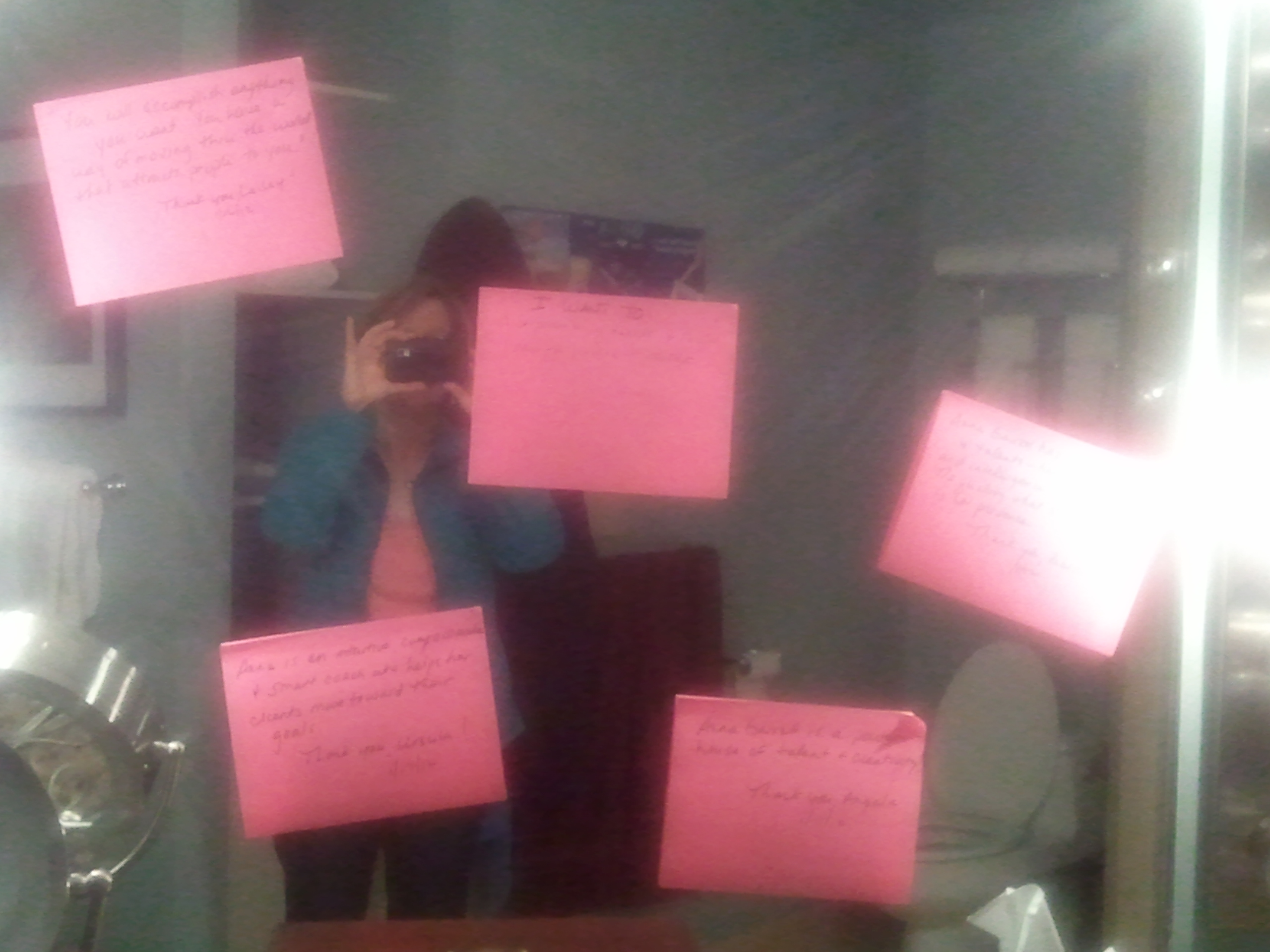
I was talking with a client about her new coaching practice and the strengths she brings to her work. She shared that she had been sitting at table with several colleagues at a recent training and one woman told her that she could accomplish anything she wanted to, that she has a way of moving in the world that attracts people to her. My client was stunned to hear this about herself.
“Isn’t it funny that others see us so differently than we see ourselves?” she said to me.
I suggested that she post this colleague’s words on the mirror in her bathroom so that she could begin to believe it for herself.
She loved the idea. And she took it a step further. She looked at all of the recommendations she had received on Linked In and posted those too. And then she sent me a photo, with a simple : ) smiley face as the subject of the email.
It can be so enlightening and empowering to hear what others see in us.
We usually only see our flaws, our bumps, our shortcomings. But our friends, our co-workers, our coaches, see our strengths, our gifts, the bigger picture of us.
So here’s your challenge:
Choose five people in your life and ask them:
What do you think are my strengths, my gifts? What am I good at?
After you get past the initial discomfort of asking someone to praise you, to say something nice about you, you’ll probably be thrilled and surprised by the responses.
You may choose to write them on big post it notes and stick them on the mirror in your bathroom.
And you may realize that, if someone else sees those amazing qualities in you, then maybe, just maybe, they might actually be true.
I’d love to hear how it goes!
[ssba]
Detach and Connect: How To Come Back to Now
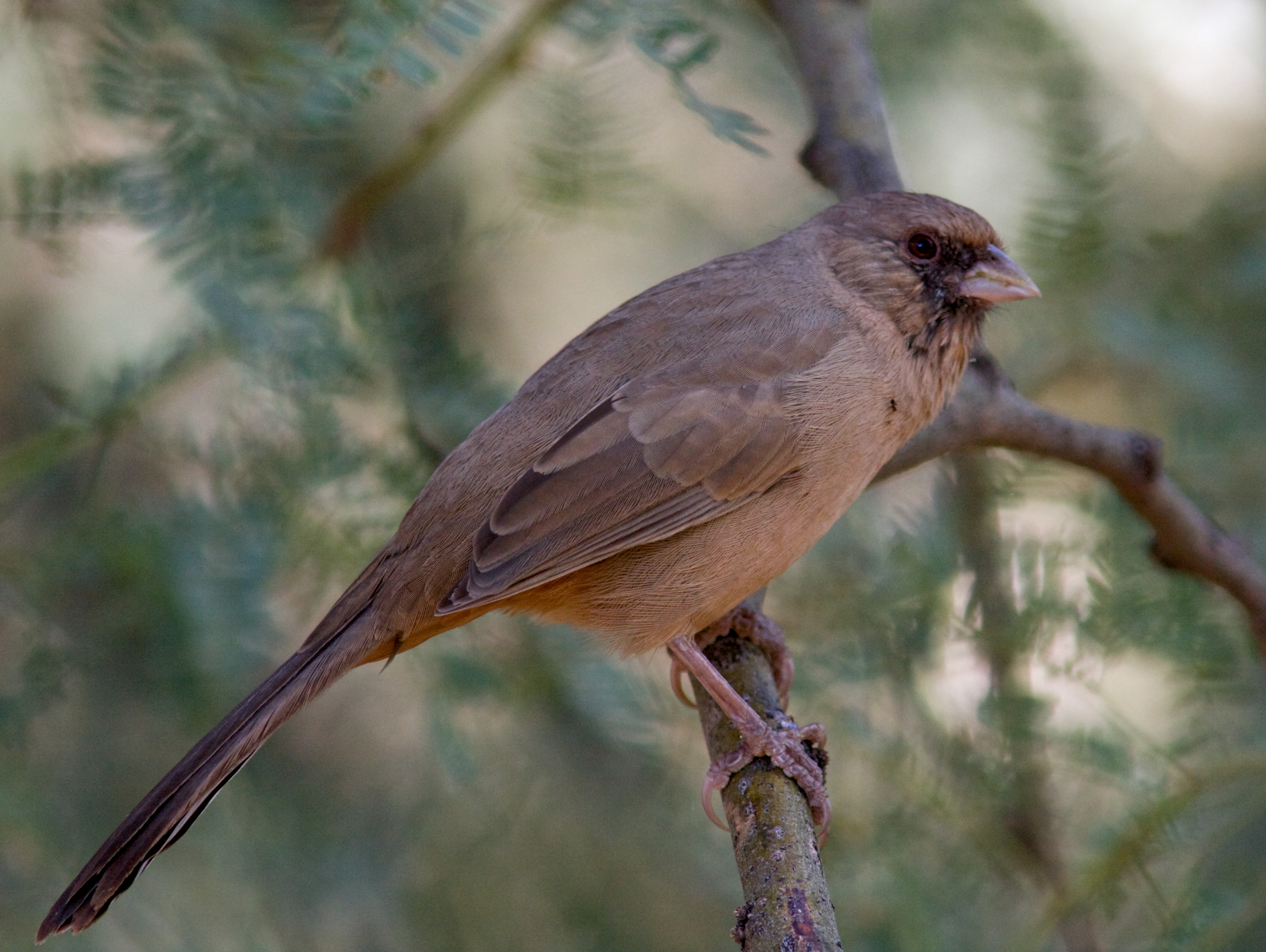
Every morning after walking the dogs, I fill the birdfeeder and sit out on my back patio with my coffee and a bowl of bran cereal, no milk, sprinkled with dried cranberries and sometimes a sliced banana, and the birds and I share breakfast.
This regular morning time is my opening time, my quieting time, my daily meditation.
It is the space where I am not in my thoughts, my ideas, my to-dos, but instead, focused on the world outside of me: the sky colors, the array of birds at the feeder, how the pecking order changes from sparrow to mourning dove to pigeon.
But for the past two weeks it has been too cold to sit outside in the mornings and instead, I’ve been having my coffee with my email. Today, it caught up with me.
My head was spinning with too many thoughts: preparations for tomorrow’s workshop, remembering to treat the stain on my brown shirt before doing the laundry, the things I will teach 28 lingerie salespeople about their new iPads, what I will have for lunch, how to structure the next Mac training videos, and on and on.
And I knew I needed to get out of my head or I would spin myself dizzy.
I pulled on my sweatshirt and took my coffee outside. I filled the bird feeder and waited. More thoughts dizzied my head and there was no flurry of flapping at the feeder to distract me. There were no birds at all. I guess they come later when it is this chilly.
So I focused instead on listening.
I heard the cars on 7th Street, a trash truck raising and lowering several blocks away, a string of short, high pitched chirpings in the neighbor’s tree. Then I caught a flash of movement in the mulberry tree. I scanned the bare gray branches and spotted a single towhee perched in stillness, his body puffed up against the cold. I kept my eyes on him but he wasn’t moving, and soon the litany of thoughts started up again.
Several minutes passed before I realized I was no longer watching the bird.
I took a deep breath, consciously following it in and then out, slowly bringing my awareness out of my head and back into my body: me, sitting in my chair, in my yard watching a towhee on a bright winter morning.
I scanned the tree again, looking for the bird. He had moved to a branch closer to the feeder, but he still wasn’t moving much. It took so much concentration to stay with him. I traced the outline of his body with my eyes, discerning the short beak, the flash of brown on his underbelly.
I tuned into the rustling and noticed a second towhee on the ground, pushing the mulch with his feet. His body looked browner in the light, his eye a beady red circle.
The bird in the tree jumped onto the feeder and poked his beak into the filled tube, flinging seeds onto the ground.
I watched them for a while longer, then took my coffee inside to gather my calmer but still swirling thoughts, vowing to sit outside the next morning, and the next again, to begin the practice of quieting.
I don‘t often have this kind of mind chatter. And I’m sure it’s because I have a regular practice of quieting. But, like any practice, if you don’t do it for a while, even a little while, it loses its effect and takes time to get back to it.
It’s the same with a person who goes to the gym regularly. Each time the workout gets easier as you build stamina, endurance. But if you take a month off, you may be surprised that you’ve lost some of your strength.
And so you begin again. Where you are. Without judgment, without impatience or frustration or beating yourself up.
This is the practice.
The more you do it, the more you do it.
And if you find yourself disconnected, pause.
Connect with your breath.
Find something to watch.
To observe.
Without judgment or thought.
Just detach and connect.
Keep coming back.
[ssba]Keeping the Dream Alive

This past weekend several women gathered and created their own Dream Altars, beautiful physical manifestations of what they want to happen in their lives this year.
I know from my own experiences that naming and claiming our dreams is only the beginning.
To bring our deepest dreams forth into reality we have to nurture them, honor them, keep them in our daily awareness.
Maybe we do this with a daily affirmation, an altar, a poster on our bathroom wall that we see every morning and remember.
Yet, at the same time, it cannot become an obsession.
We need to maintain a balance between asking and receiving, between action and waiting, between knowing and letting go.
After all, it’s not for us to figure out the HOW of our dreams. Our job is to stay focused on the WHY, the WHAT, the essence of what we desire. WHY do we want this? How will it feel? How will living this dream serve others?
As you may know, I am in the midst of manifesting my own big dream. For years I have wanted to live at the ocean where the air is cool and clean. I am making plans, setting dates, shifting my work life to support this dream.
There are moments, days, even, where I have a very clear picture of how I am living my life there, how my whole world will open up, and how much more deeply I will do my work.
And I share my excitement and plans with my friends.
And then I get stuck in the financials, the logistics, the details. And I change my mind about HOW I’m going to do this. My heart fills with doubt and regret that I have changed my mind, yet again, and I wonder, what will my friends think.
But you know what? They think I’m human. They think I’m creative for coming up with so many ways to do this. They think I’m brave and inspring for taking this giant leap into my dream.
A friend recently reminded me that dreams are fluid. They are not frozen in time exactly as we originally imagine them. Our dreams are always shifting, changing, seeking their own level, like water.
Remembering this brings me so much peace and comfort. Of course I’m going to change my mind several times as new information comes to me. Of course I will waver between excited and fearful. Of course I won’t know how it all unfolds until it happens.
And so I keep flowing with the energy of the dream, keep bobbing in the waves of change and always, my dream on the horizon, getting closer and closer.
How do stay connected to your dreams? Please share by clicking on the Comments below.
[ssba]How To Make Any Decision

image by dreamtime.com
We’ve all been there. You have to make a choice whether to do something or not and you just can’t decide.
You make your list of pros and cons, only to find just as many reasons on each side of the list.
So how do you decide?
A client recently struggled with a decision she had to make. Several months before, she had volunteered to take on a big project for a group she had recently joined. At the time, she was excited, motivated, committed.
Now, almost 12 months later, the committee was finally ready to move forward with the project but my client’s enthusiasm was gone. She wasn’t even sure she still wanted to be a part of the organization. But at the top of her pros list, she felt an obligation to follow through.
I asked her–do you want to do it? Her first response was, I don’t know.
I asked her to move out of her head, where she was still going back and forth between the pros and cons, and to breathe deep into her belly.
After several quiet minutes I asked her again. Do you WANT to do this?
She looked me straight in the eye and shook her head, NO.
Her heart was no longer in it.
Still, she wrestled with the idea of backing out, of not following through. We talked about the option of doing the work, even if it was purely out of obligation. She said that wouldn’t feel right either. That she wouldn’t be being authentic.
I asked her WHY she said YES in the first place.
She shared that this was the first independent thing she had done after her divorce. That it felt great to belong to a new group, to feel she had value, something to offer. But now, she has a new job, new friends, a full schedule. She didn’t feel the same connection to this organization.
I asked her if she could find a way to honor what the experience had given her, to celebrate how she was able to step up and now, to stand in how very clear she was about being authentic.
Her shoulders relaxed. She sat back in her chair and started composing, out loud, the letter she would write to graciously say no.
How do YOU make a decision? Do you stay in your head or are you able to move into your heart, your gut, to hear your deeper knowing?
Click on the Comments below to share.
[ssba]This. Here. Now.
This past holiday weekend Marika and I took the motorhome and the dogs to southeastern AZ to see the migrating sandhill cranes. We camped at the Whitewater Draw Wildlife Refuge in the middle of desert brush, agricultural fields and man-made ponds created to attract migrating birds.
The refuge is surrounded by the Dragoon Mountains to the west and the Chiracahuas to the east, with Mexico just a short 25 miles to the south. And all around, a big wide eye sky of blue and birds.
We walked along the burms of the ponds as the sun set, the sky darkening against the crescendo of thousands of red winged blackbirds roosting in the reeds. Marika, an avid birder, pointed out a Harris Hawk circling above the field. She counted unnamed sparrows flitting in the brush and we heard a Great Horned Owl in the nearby trees. A sky full of sandhill cranes circled the farthest ponds, grawking and honking as if they were conversing, where do you want to land?
Later, back in the RV, after dinner, my mind began to wander. No longer captivated by the sounds of the birds and the color changing sky, I started thinking about my annual New Year’s Day party. “I’ll ask everyone to bring an hors d’ oeuvre,” I said. “And maybe this year we’ll play croquet again.” I started making a checklist in my head of where I’d position the furniture and how many chairs I’d set up outside. Since January first is less than a month away, this seemed like a reasonable planning activity.
But then I jumped to my birthday party in March and a possible going away party in April. Suddenly I was all teary-eyed and feeling very, very sad.
And then Marika gently said, “You know, you’re not here anymore.”
What a great gift to have someone right there to bring me back to the present moment.
Just like that, I realized that all of those emotions were NOT part of the present moment. That, when I came back to the present moment I was truly content, happy, comfortable, so glad to be camping, in nature, belly full with dogs at my feet.
We spent the rest of the evening playing cards and Rummikubs to stay connected to the here, the now. What is.
The next morning, Marika went on a day long birding adventure with a hired guide. As the dogs and I sat around camp, I started to feel that same sadness coming over me. I realized that my thoughts had been wandering again and I needed to bring myself back to the here and now.
I leashed up the dogs and we walked out into the desert where, now, leash-free, they ran and sniffed, digging into rabbit holes, finding stray sticks for fetching. The sky was clear and blue and wide and I breathed in the cool air and stood in the courage of warrior pose, facing the morning sun.
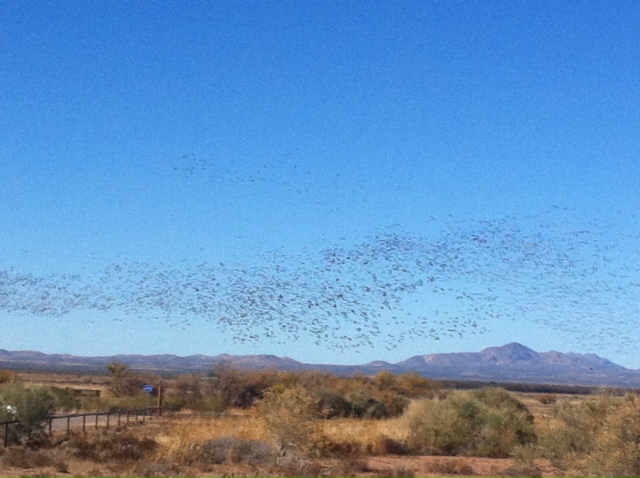
When we got back to camp we sat outside as the cranes began to fly in after their early feeding in the nearby agricultural fields. I heard their sounds first, the invisible but raucous chorus of trilled grawking and honking. Then a string of fast moving dots appeared in the sky. As they got closer the dots became v-shaped patterns ribboning toward me, getting even louder.
I could make out the silhouettes of their 72″ wingspans, fast-flapping in the air. They circled the shallow ponds in a noisy display, flying low, then around in a circle then low again to land.
And then, just as the sounds seemed to settle over the water, another burst of honking filled the air to the east. The line of dots appeared, fast and close and the honking from the air sparked the honking of the birds below that had already landed. Even from my vantage point a quarter of a mile away, the sounds were almost deafening.
More cranes appeared, as if the noise from the ground had called them and soon my inexact counting reached one thousand cranes, and still, more were coming. Honking, flapping, trilling their calls as the surface of the ponds became a field of solid gray.
Being in nature, paying attention to sounds and colors, the wind and the sky are the best ways that I know to stay connected in the present moment.
How do you bring yourself back to the here, the now, what is?
I’d love to hear from you. Please share by clicking on the Comments below
[ssba]Giving Thanks
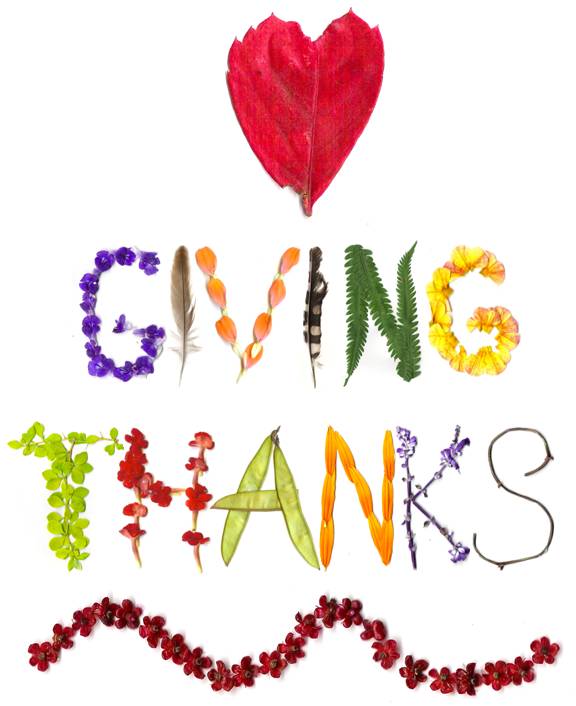
image by Spirit Juice Studios
It’s that time of year when it’s easy to remember to be thankful. All of the turkey and ham commercials on television remind us to be grateful for what we have and for the people in our lives.
But gratitude is an act for every day living, even without the festive meal. Click here to read all about gratitude.
Still, this is a wonderful opportunity for me to say thank you to YOU, my loyal reader, for your enthusiasm, your support, and your open heart.
May this season bring you more ways to rest in your own heart and share your special gifts with those around you.
Hand in hand with being grateful is the self-less act of giving, of doing something simply to better someone else’s situation.
We can give money, time, our talents. We can donate our used items to an needy organization.
We can also give with simple acts of kindness.
- Open the door for a stranger
- Let someone go in front of you in line at the supermarket
- Check on an elderly neighbor
- Smile at every single person you pass, even the person asking for money
- Say thank you and mean it
- Give your partner or your child or your friend your full attention
- Pick up the litter on your neighbor’s lawn
- Wave someone into your lane in busy traffic
- Give someone a genuine compliment
- Call someone you haven’t talked with in a long time
I’d love to hear your ideas for giving. You can post them below by clicking on the Comments.
[ssba]Simple Joys
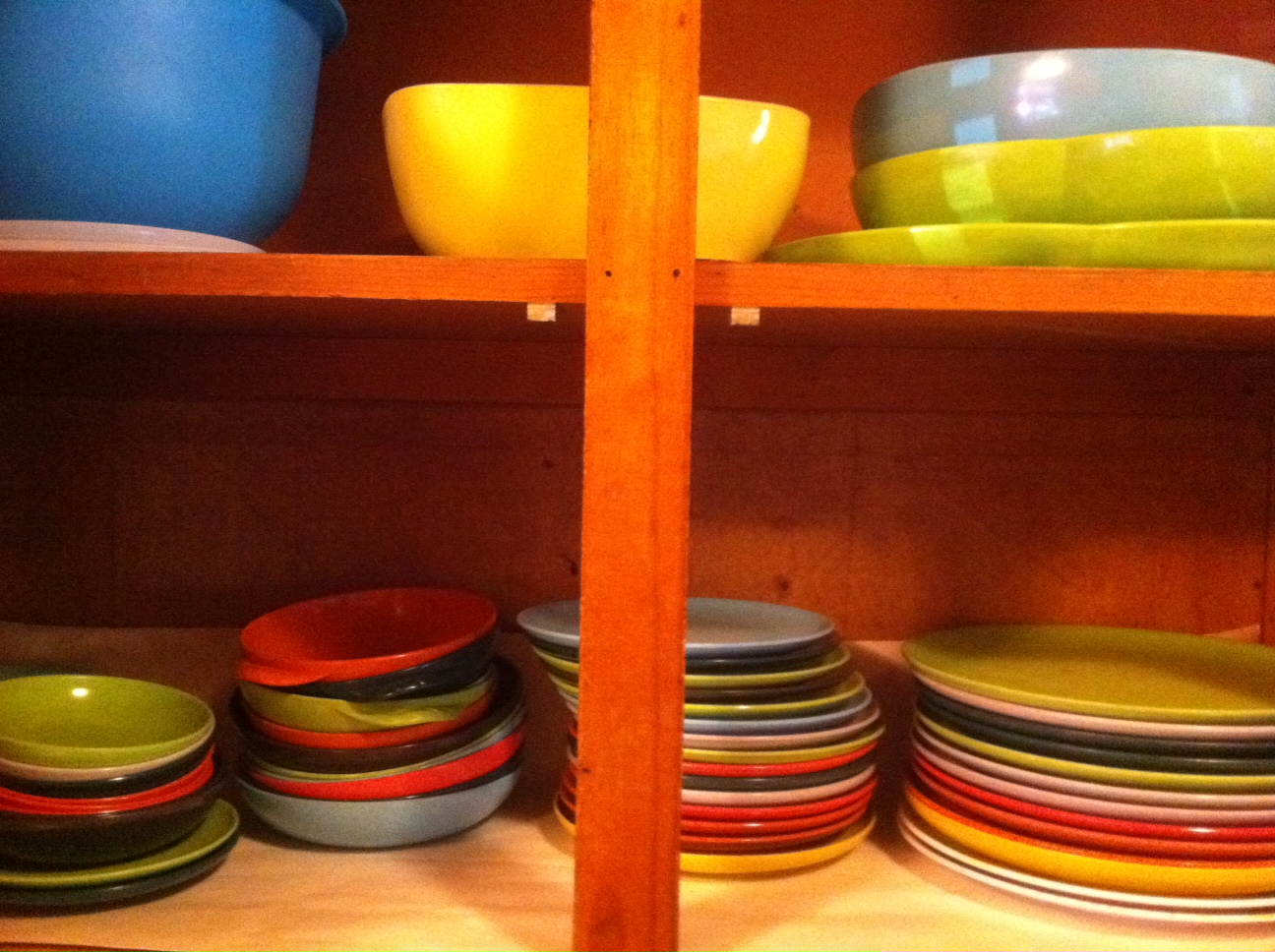
It is a simple joy
every morning
to choose my breakfast plate:
lime
forest green
raspberry
black
orange
gray
white
turquoise
all Colorflyte by Branchell, from the 50’s
collected over the years
from thrift stores, yard sales, on eBay
because food is more delicious when served on the perfect color
Too often we are so focused on the giant billboard kind of happiness that we neglect to notice the small and ordinary moments that bring us real joy. I invite you to slow down, to notice the small things, the simple joys.
Let’s compile a list of our Simple Joys–Click on the Comments below and share something that makes you smile and lifts your heart.
[ssba]