
On the Road, with Chimpanzees
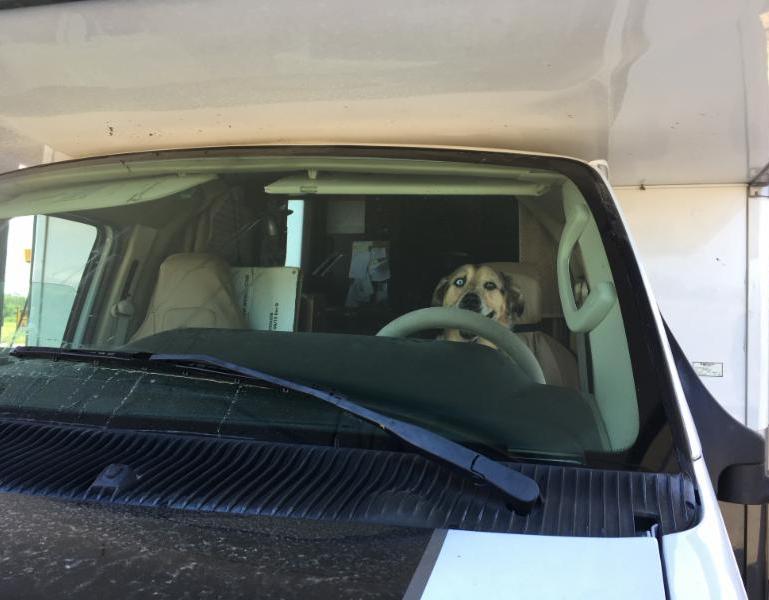
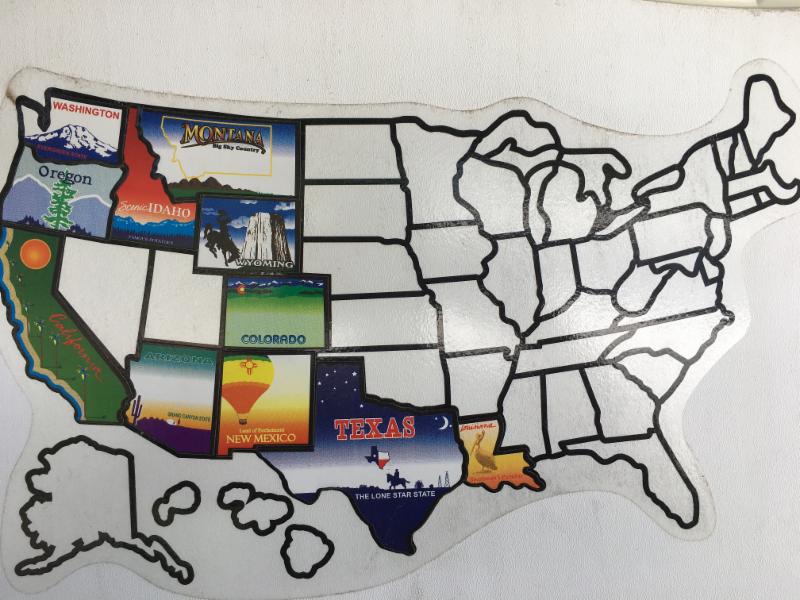
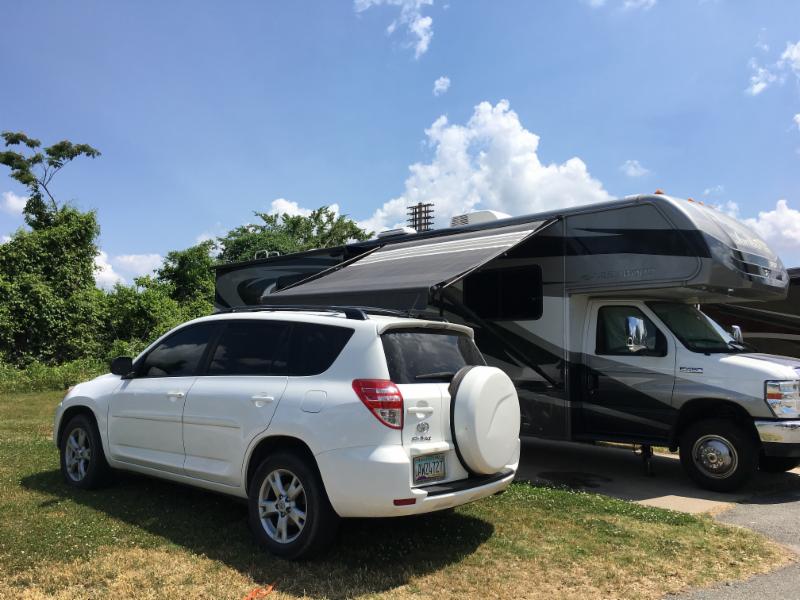
All is well with the transmission pump and we are officially back on the road. After a muggy weekend at a state park near Jasper, we finally left Texas and added a new state sticker to our map.
We’re spending a week in Bossier City/Shreveport, Louisiana, so that we can volunteer at the nearby Chimp Haven, a sanctuary for chimpanzees who were previously part of biomedical experiments. There are 260 chimps at the sanctuary, and they are building more compounds for the 200 chimps still in labs across the country.
As volunteers, we’re helping with food prep and making enrichment snacks. We have no direct contact with the chimps. Only a handful of doctors, behaviorists and medical personnel have any interaction with them. Everyone else needs to stay at least six feet from the enclosures for safety, because chimps are aggressive and strong, and they will throw feces at you if they don’t know you.
Amy, our volunteer coordinator, drove us around the facility, explaining that, when the chimps arrive, they are studied and assessed, then assigned to a family group of about 21 chimpanzees. Some of the chimpanzees prefer having access to the forest and outdoor habitats. Others won’t leave their bedrooms without enticement, and only feel safe with a roof always over their heads.
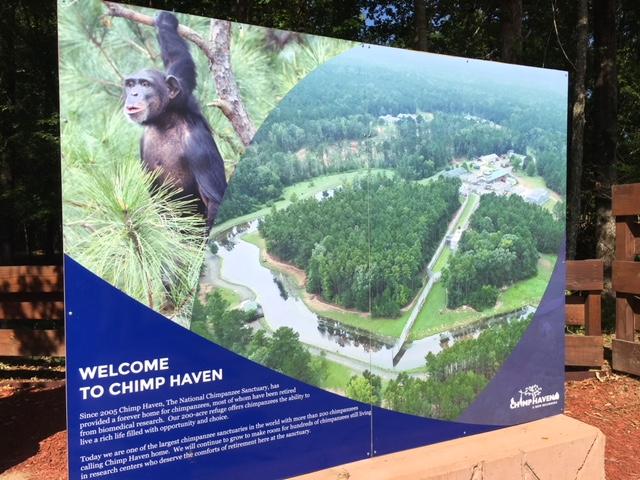
We saw several chimps lumbering in the grass, and others moving between their enclosures. They scream and bang things and keep an eye on the people working around the facility.
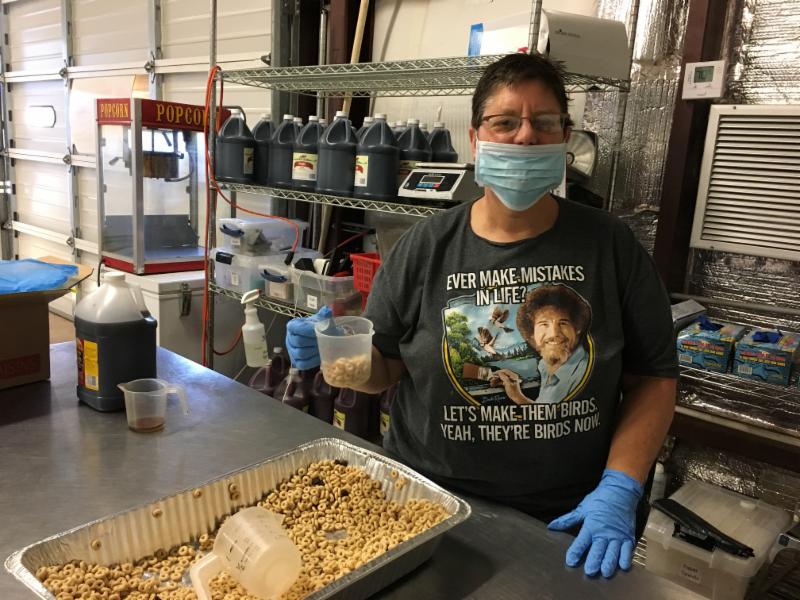
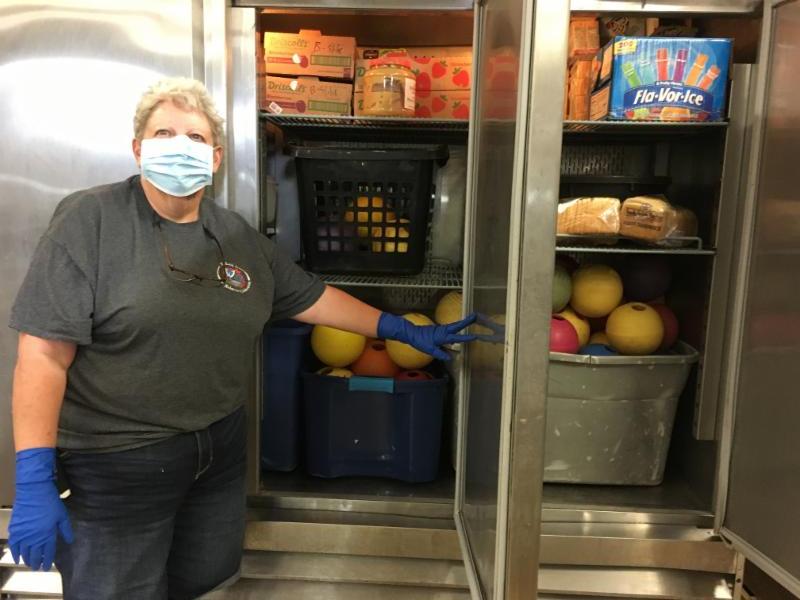
After the tour and safety lessons, we put on masks and gloves to protect the chimpanzees from any germs we may be carrying, and went to work. We stuffed bananas into PVC tubes with bigger-than-finger sized-holes. The tubes will be frozen, then hung on the mesh of the enclosures for the chimps to enjoy.
We mixed together industrial-sized cans of vanilla pudding, mandarin oranges and pineapples, then spread it inside a PVC U-joint. They’ll also be frozen, then hung on a chain from the mesh.
We got to see a chimp being wheeled out of the medical room on a gurney, and then we walked over to the food storage area, an air-conditioned hangar-like building with walk-in refrigerators, freezers and several pallets of biscuits specially formulated for chimpanzees. There was a full-sized garden shed with wall-to-wall metal shelves of huge jars of peanut butter, family-sized bags of peanuts, and industrial-sized cans of fruit cocktail, applesauce and pudding.
There was a stainless steel counter with three sinks, and two long tables where we worked. We cleaned recycled plastic drink bottles, then filled them with a mixture of Cheerios, raisins and a sugar-free maple syrup. We chatted with a few staff people, and then filled some more bottles with frozen blueberries, grape syrup and water.
On our second day we finished making the blueberries juice bottles, then squirted the same grape syrup and water mixture into Boomer Balls, hard plastic balls with three bowling ball finger holes drilled out. The juice balls are frozen and the chimps love scraping out the slush. The biggest challenge of the job was to stack the balls in 5 gallon tubs in the freezer without the liquid spilling out.
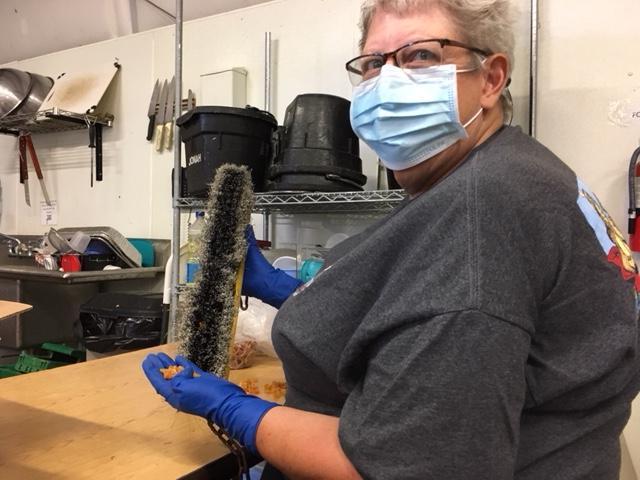
After our lunch break we made a foraging treat, stuffing finely chopped pieces of apricot between the bristles of a utility broom. The chimps have to separate the bristles to find the fruit, mimicking their grooming behavior.
Marika asked if we could come a little earlier on Thursday and do another drive around to really observe some of the chimps, and Amy said, “Absolutely.” And then she asked if we wanted to do a feed throw, tossing some of the enrichment treats into the compounds. So tomorrow, we’ll get a great look at more of the chimpanzees, and watch them literally enjoy the fruits of our labors.
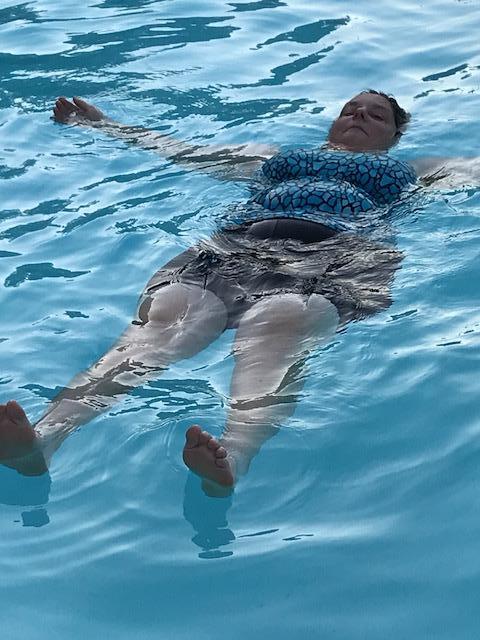
We only work half a day, then come home to relax and hang out with Cody. In the evenings, I’ve been luxuriating in the RV park swimming pool, and last night, Marika had her first taste of real barbecue. Next week we head to Memphis, where we’re meeting up with a friend to explore the area and sample more barbecue. I’m hoping this unseasonably hot and humid weather passes so that we’ll be able to enjoy some outdoor time.
It’s great to be back on the road, seeing new places, enjoying new experiences. And it’s really nice to have a place to show up and be of service. Free time is great, but we both need some structure and purpose in our days, or we can get mighty cranky.
Finding the balance seems to be the key.
When Freedom is Lonely

We’re in the last week on the coast and it’s been glorious. I’ve been to the beach twice a day, every day, sometimes with Cody, sometimes alone, even a few times with Marika. Most days I pick up litter, watch the pelicans, and do modified sun salutations at the water’s edge. Weekends are getting busier and noisier, with more trucks and golf carts and families on the beach. This past Saturday we enjoyed a fireworks display right out the living room window.
Marika has gone birding almost every day, and she has seen more varieties of birds, and so many new birds, than ever before. Already we are talking about returning next spring.

I’ve been reading and writing, making postcards and binge-watching Netflix, really enjoying the feel of being on vacation. And one day last week we drove to Port Arthur for a day of touristing. We visited a Buddhist Temple, and the Museum of the Gulf Coast, drove around the refineries, and ate no-frills Vietnamese food.

But here’s the thing about all of this freedom: it can get pretty lonely.
Marika is gone most days, from early morning to late afternoon. And when she comes home, she updates her bird lists, studies her bird book, and then lies down in front of the TV because she’s had a day.
And that truly is wonderful. For her.
But I’ve been alone all day, and I am starving for someone to engage with.
Yes, I’ve chit chatted with the RV park owners, and waved and said hello to several neighbors. But I haven’t had a real conversation about anything deep and meaningful with someone in weeks. Or so it feels.
Of course I keep in touch with friends in Phoenix. But a quick catch-up phone call, or a back and forth email conversation is not at all the same as a three-hour in-person sitting together, with several full-on body hugs sprinkled in.
So I’ve been spending a lot of time crying, feeling sorry for myself, and aching for community and connection. One morning, after I posted a picture on Facebook of my morning beach walk with Cody, and hinted at my loneliness, a friend shared how the water is always healing for her, like a mother.
And so I walked back to the beach, but, instead of focusing on picking up litter and counting steps, I walked to the edge of the water, looked out at the low gentle rolls, allowing the cool water to wash over me. I stopped thinking and feeling and simply opened to healing.

And again, of course, I remembered that I am responsible for my own happiness.
And so, as I plan our route for the next few weeks, I’m making sure we visit some friends along the way, so that I can get some much needed in-person time with real people, and real hugs.
When we leave the coast on Sunday, we have to return to Houston to deal with the transmission pump in the RAV4 AGAIN, because the alarm won’t stop alarming, which means we can’t tow it. Maybe it will be a three-minute fix, maybe a three-day fix. So we’re keeping things loose until we know.
Once the pump is fixed, we’ll begin our travels north and east toward Washington D.C. We’ll spend a few days in Lufkin, Texas visiting with a friend, then we’ll be in Shreveport, Louisiana for a week. We’re volunteering at Chimp Haven, a refuge for chimpanzees who were the subjects of testing and experimentation. Marika has been a supporter of the organization for years, and has dreamed of volunteering there, even though you don’t have contact with the chimps. We’ll be chopping food, cleaning buckets, folding laundry, and who knows what else. And we’ll be able to observe the chimps in their open-space habitats, simply being chimps.

We’ll spend a few days in Memphis to hug another friend, visit some museums, and restock at Costco. And then, who knows.
The last three weeks of the trip are still unmapped. The calendar is marked with stretches of lines marked “Someplace” and “Someplace else,” so that we have space and time to enjoy the traveling, to explore off the highways, to not know exactly where we’re going until we get there.
If you’re along our route (we’ll be traveling north of I-40, staying on smaller highways, heading to D.C.), let me know. I’d really love to get together!

Happy Spring Migration!
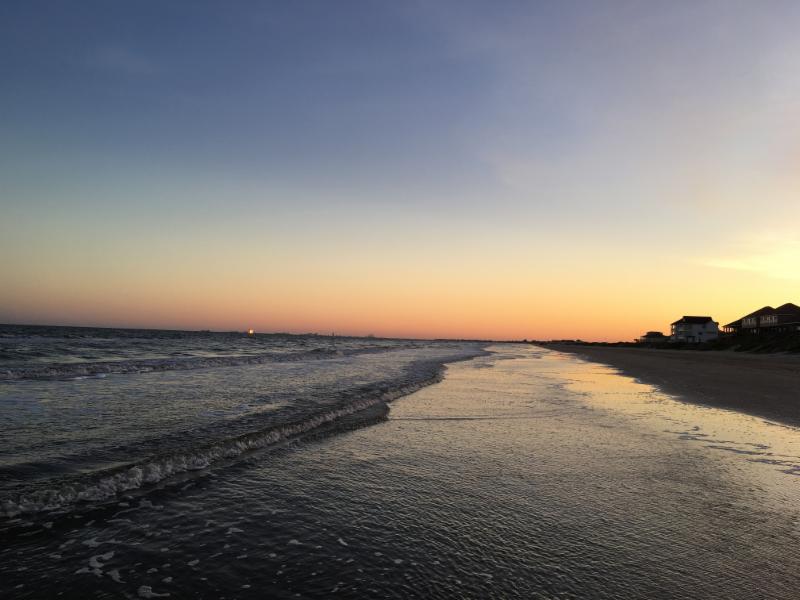
We’ve been back on the Gulf Coast for a couple of weeks and, for the first time since we’ve been living on the road, I actually feel like I’m on vacation.
When we were here in February, I had some Mac client calls, I was focused on getting us a hosting job for April, and I was working on the new Photos For Mac e-book. This time here, I have no work commitments and my time is all mine. And I’ve been loving it!
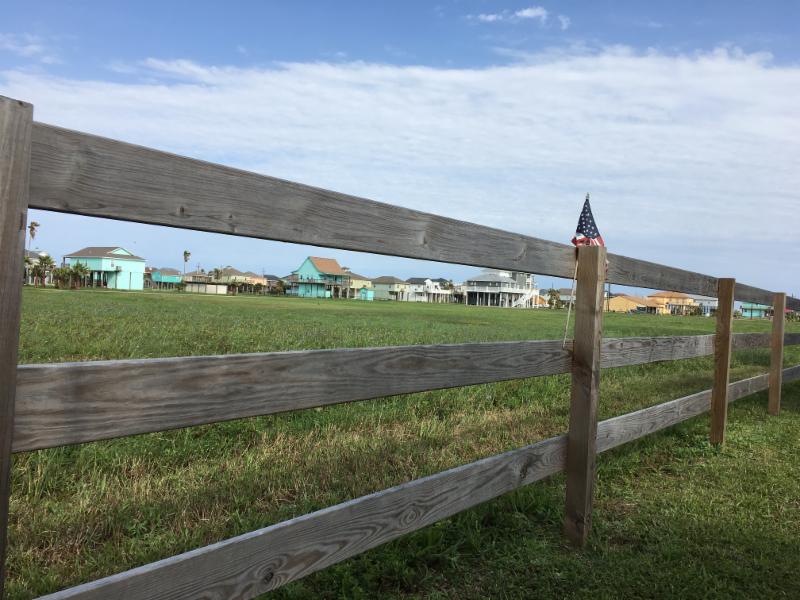
Every weekday morning, Cody and I drive down to the beach for a good, leash-free romp along the waves. Weekends are too crazy-busy on the beach with campers and party folks with their trucks and hot rods and golf carts driving up and down the sand. During the week we have the beach to ourselves.
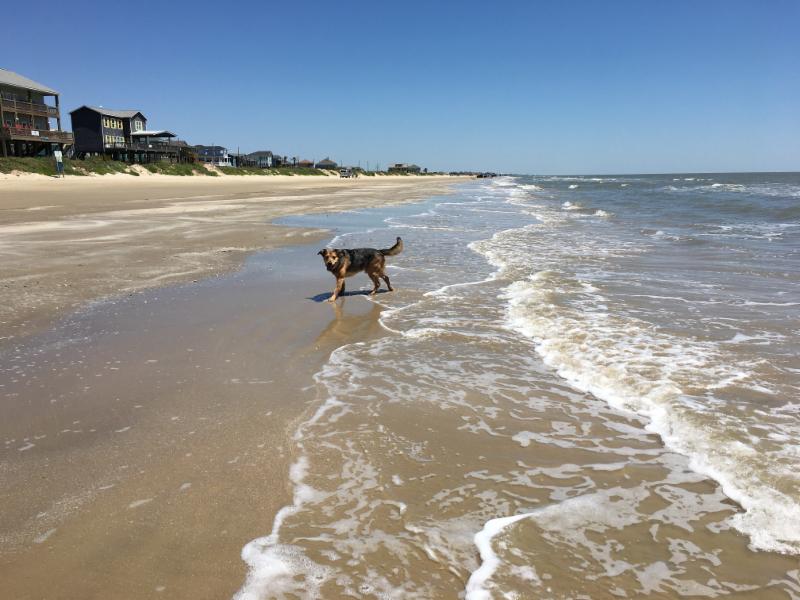
Cody and I walk together, at our own pace, him searching for a stick or running in the shallow water, and me, picking up litter. There are trash cans every few hundred yards, so I clean in sections. Sometimes I follow him into the water and it feels so good to get splashed by the waves. The pelicans fly overhead, and it is instant happiness for me.
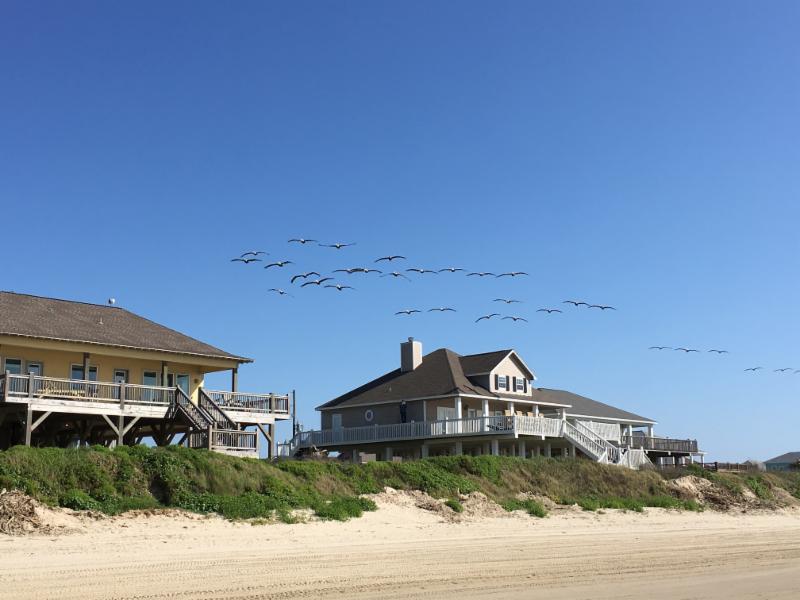
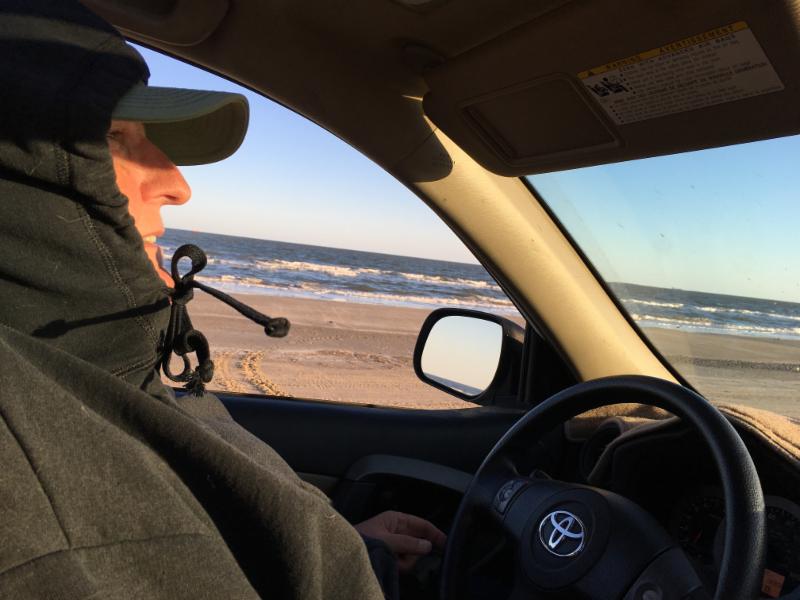
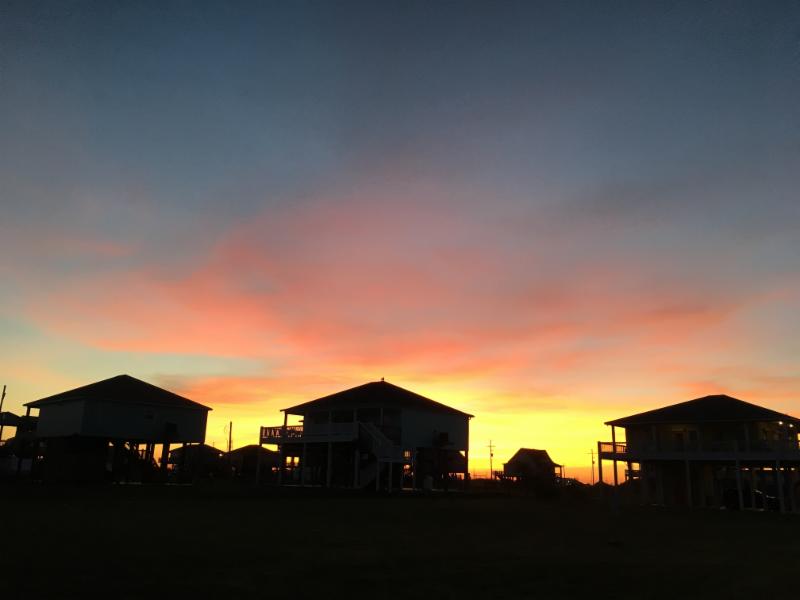
I go to the beach again before sunset, sometimes alone, sometimes all three of us, and every night I delight in the pelicans gliding over the beach houses, and diving into the water for fish. One evening Marika drove the car on the beach all the way to Bolivar Flats, a very popular birding area on the west end of the Peninsula. It was windy as we drove the posted 15 mph, and we had the moon roof open. Marika had to tie up her hoody because I insisted on having the windows open so I could hear the waves.
During the days I have embraced sitting outside in my zero-gravity chair in a pocket of shade along the back fence, and reading. One cloudy day I even took my chair down to the beach to read, and that was pure joy. But without an umbrella or shade tent, there’s too much sun for me to do that most days. So in the afternoon, Cody and I sit under the shade of the palapa watching the egrets and herons in the slough while he gets a brushing.
We are in high bird migration season, which is the reason we came back to the coast for another month, and Marika goes out almost every day to a different spot to bird. She is a true bird lover. She isn’t interested in just seeing a bird to say she saw it. In fact, unless she’s had time to really study the bird, she won’t add it to her list.
She can sit and study a group of birds for an hour. Then she’ll walk a little further and study some more birds for some more hours. I don’t have that kind of an attention span. Even bringing a book or going for a walk while she’s birding doesn’t work for more than three hours. So most days she’ll go alone, or meet up with someone she’s met on one of her outings.
I joined her last Sunday for a drive out to High Island, a mecca for springtime bird migration. Thousands of birds flying up from South America come though the area. When there is a big storm, the birds are exhausted by the time they’ve crossed the Gulf of Mexico, and High Island is the first big land mass with trees and ponds and plants to eat. The birds “drop from the sky” and hundreds of bird watchers and wildlife photographers flock to the area to see the varieties and numbers of birds.
The drive to High Island runs east along the coast, past twenty miles of breaking waves and beach houses on stilts. Once you turn inland, the small town of High Island is just a few miles up the road. There are several wildlife refuge areas in town, with trails and benches for prime bird viewing. There is also has an active rookery for Egrets, Cormorants, and Roseate Spoonbills that I wanted to see.
We parked where we had parked when we came to High island in February, when the trees were bare, the ground was soggy-muddy, and there were very few birds. Since then, spring has colored everything green and the volunteers have installed new boardwalks over the boggy ground.
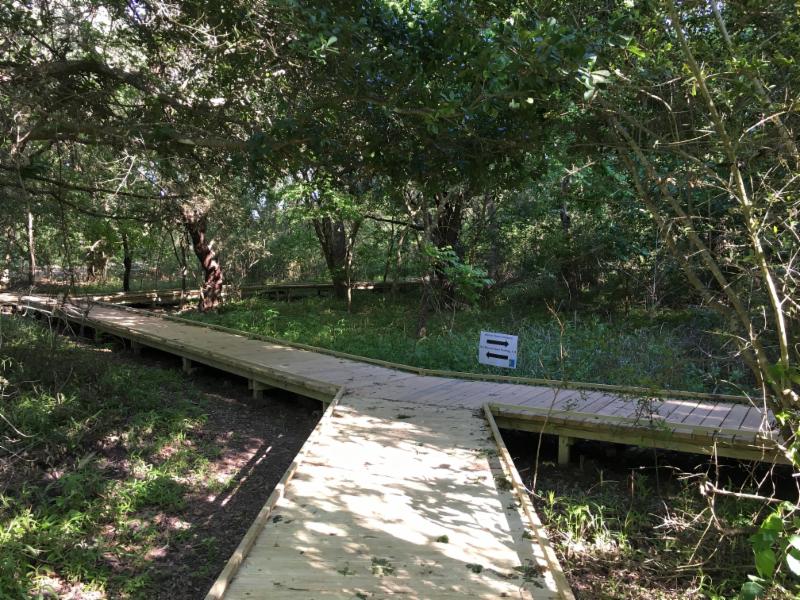
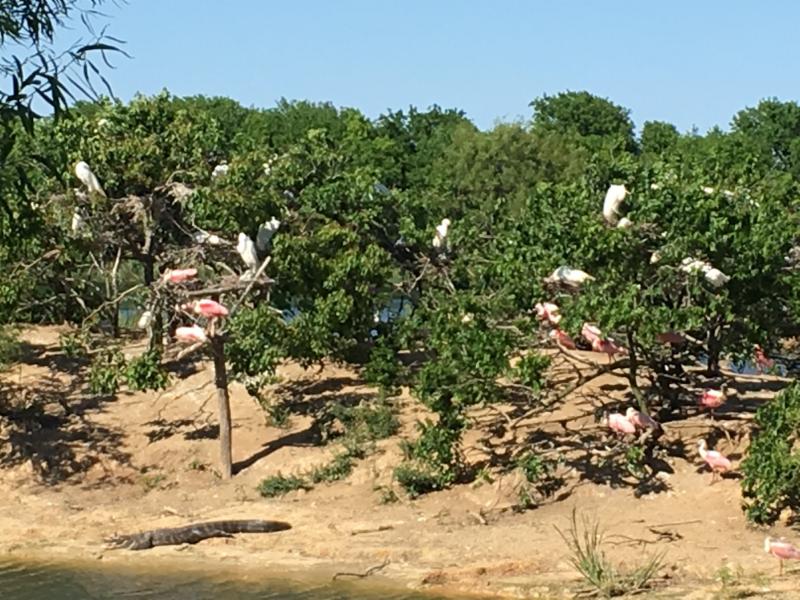
There were several viewing platforms along the trail, giving you a bird’s eye view of the rookery island, about thirty feet feet across a pond. Hundreds of nesting birds dotted the trees, the great egrets and snowy egrets already feeding their fuzzy-headed babies, the roseate spoonbills still gathering twigs for the nest, and the dark cormorants tucked down, sitting on their eggs.
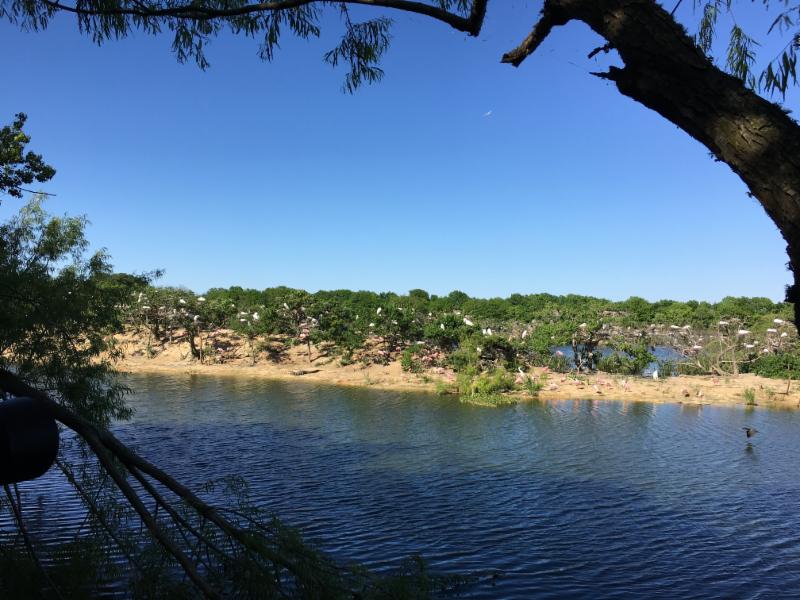
More birds walked along the shoreline within a few feet of a sunning alligator, the spoonbills scooping their bills into the water, then shaking them to strain the water, the egrets poking their slender bills into the water like a spear.
We had a different angle at each viewing platform, so that, with my binoculars, I could really see the stunning orange on the tail feathers of the roseate spoonbill, and that the alligator was missing a few teeth. I watched baby egrets extend their opened beaks, begging for food, and a pair of spoonbills mating on top of their nest. And all around me, people with immense camera lenses were clicking, clicking, clicking, and the rapid shutter sounds reminded me of gunfire.
The next day we went out for fried catfish lunch, then stopped in Rollover Pass, a favorite spot for fishing and birding. We parked at the end of a dirt road to watch shorebirds and barges along the Intracoastal Waterway.
Marika set up her spotting scope and I took a walk along the small beach. I found a plastic five-gallon bucket to sit on, and amused myself watching several dozen avocets poke their long bills along their side feathers to clean themselves.
I carried my bucket back to join Marika, who was sitting on her portable stool, and we named everything we were seeing: pelicans, terns, cormorants, skimmers, great blue herons, willets, sanderlings, black necked stilts, and laughing gulls. On the drive home, we saw cattle egret standing next to cattle along the highway.
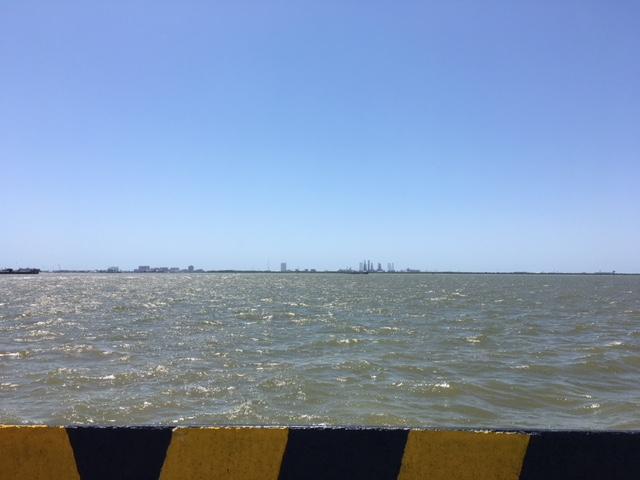
Tomorrow we’re taking the ferry into Galveston for a boat tour of Galveston Bay to see more birds, and dolphins, and learn more about the history of the area. Last week when we took the ferry over to go food shopping, instead of staying in the car, I stood at the bow of the boat, with the wind, and the sea spray, and the wide open view, and it was exhilarating. I can’t wait to do it again tomorrow.
And this weekend we’re going back to Bolivar Flats to bird, with the hope of running into a very famous birder who will be leading a tour there.
And in between all of this vacation fun, I’ve been planning the next chapter of our travels when we leave the coast at the beginning of May. Stay tuned!
On Duty in the Pineywoods
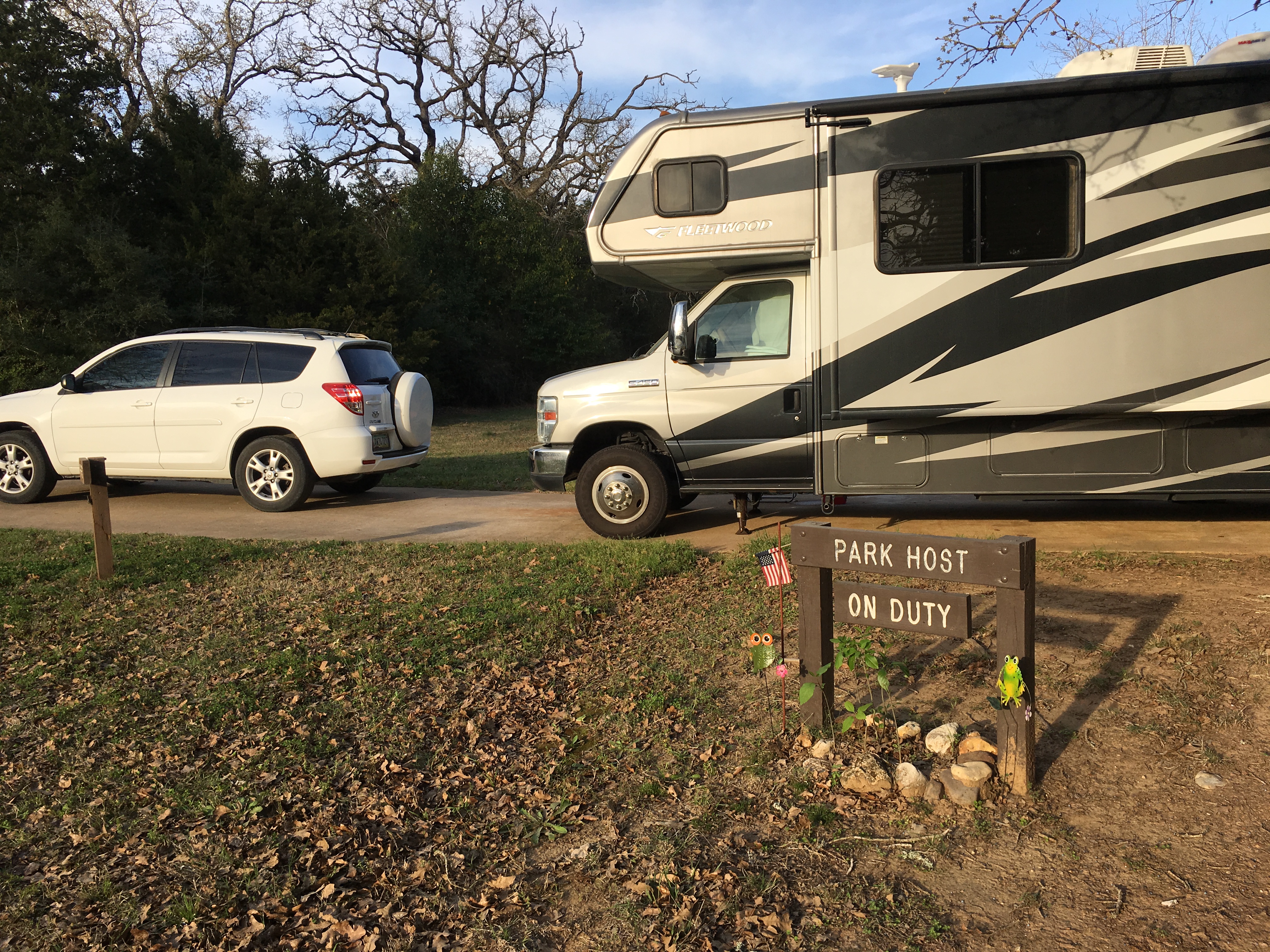
We’re enjoying our time here at the lakeside campground in central Texas. It’s a nice park in the Pineywoods, about 30 miles southeast of Austin. We’re meeting interesting people and enjoying the local museums, art centers and restaurants. We even went to the movies, and there was also a bowling alley, a bar and grill, and an arcade with the world’s largest Pac-Man game in the theater complex.

The weather has been mostly perfect with some very muggy days thrown in, and we like the work. We clean seven bathrooms with showers, and we’re responsible for the outside areas around the ten waterfront cabins. This includes emptying the fire pits, scraping the grills, and picking up litter. A paid maintenance crew cleans inside the cabins and collects all of the trash. They also do our jobs on our days off.

A lot of campers have been leaving hot fires in the fire rings, so we sometimes have to haul buckets of water to the pits to drown and stir the hot ashes, then come back the next day to clear out the cooled ashes.
It’s good, hard, physical labor, and it feels good. My shoulders are a little tight from the mopping and bucket carrying, but I’m feeling strong. And nothing hurts. And I’ve been walking almost three miles on working days. By the end of our shift on Sunday, when we’ve cleaned all ten cabin sites in one day, we are both exhausted, and glad that on Monday and Tuesday the bathrooms have less traffic and we usually only have the few cooled fire pits to clean.

The first week we were here it was spring break, so we had a full campground every day, but we didn’t actually start working until the weekend. There were kids and dogs, dogs and kids, and bicycles, and running races, and smoky campfires and, with our bedroom window open, we could hear our neighbors late into the night.
And then everyone left. And it was gorgeously quiet. We could hear all kinds of birds, and the rustle of raccoons in the brush. And the deer came out.
I took my kayak onto the lake one late afternoon, just me and two men in a small fishing boat moving through the green-brown water. They stopped to cast their lines along the reedy banks, and I paddled further into the narrows. A kingfisher lit from his perch and flew further down the waterway and I followed, stopping to watch him land on a branch hanging over the water.
I paddled past more than two dozen coots, the black-bodied ducks with the white tipped beak, that sound like a dog’s squeaky toy. They floated away from me and then suddenly, they all took flight. I loved the sounds they made running and splashing across the top of the water at the same time, like a giant paddlewheel boat.

I followed the inlet around a turn and further, until the branches were hanging too low and the reeds were thickening. I turned the boat around and sat in the stillness, the only sounds were the kingfisher in the distance, and the reeds rubbing against the vinyl bottom of the boat.
When I returned to the wider channel, a woman in an orange kayak paddled nearby and we exchanged gratitudes for being on the water. I told her about the kingfisher, pointing to where I had just been, and she said she saw a heron near the fishing pier, but it flew off.
I paddled past the pier toward where the lake opened wider, but the wind hit me as soon as I passed the bank of trees. I wasn’t up for a workout, so I turned around, and slowly made my way to back to the muddy beach where I had put in.
I spotted the heron on the shoreline, camouflaged by the tall dried grass. I pulled up to the dock and waited until he flew away before I paddled up the muddy bank and got out.

Marika has been enjoying the bevy of birds at her seed feeders, including cardinals, Carolina wrens, pine siskin, chipping sparrows, red bellied woodpeckers and white throated sparrows. And I was sitting outside with her when two young bald eagles flew overhead. She attended the local Audubon meeting where she met a woman who invited her over to watch a pair of Pileated Woodpeckers that are building a nest in the cavity of one of her trees.
Cody and I have been exploring the trails through the campground, and every weekday evening, the three of us walk down to the grassy park along the lake to play stick and check for birds.

It’s coming up on the weekend again, and all the campsites and cabins are reserved, which makes me very happy. Because people are getting out into nature, with their kids, their friends, their loved ones, and they’re fishing, and riding their bikes, and roaming the trails.
And I’m enjoying driving around the campground in the golf cart, welcoming folks, waving to the kids, and answering questions.

This will be our last weekend here. We’re heading back to the Texas Gulf Coast next week to spend another full month there so that Marika can enjoy the full-on spring migration! And I’ll be so happy to be at the beach again!
A Week of Traveling
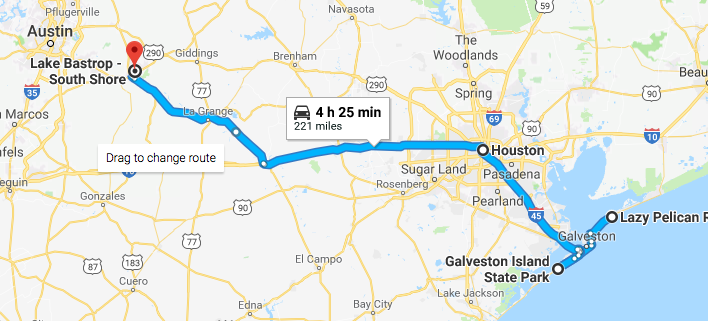
We enjoyed a leisure pace of traveling from the Gulf Coast up to Austin for our new camp hosting gig. We took the ferry from Bolivar Peninsula back to Galveston and stayed at the Galveston Island State Park on the west end of the island. I had camped there two years ago on my solo Heart Sparks Road Tour, and wanted to share the place with Marika.
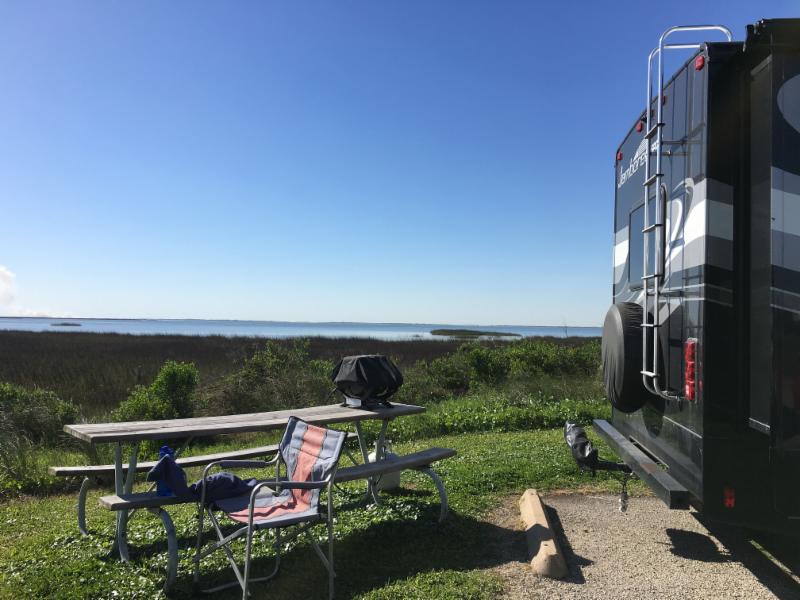
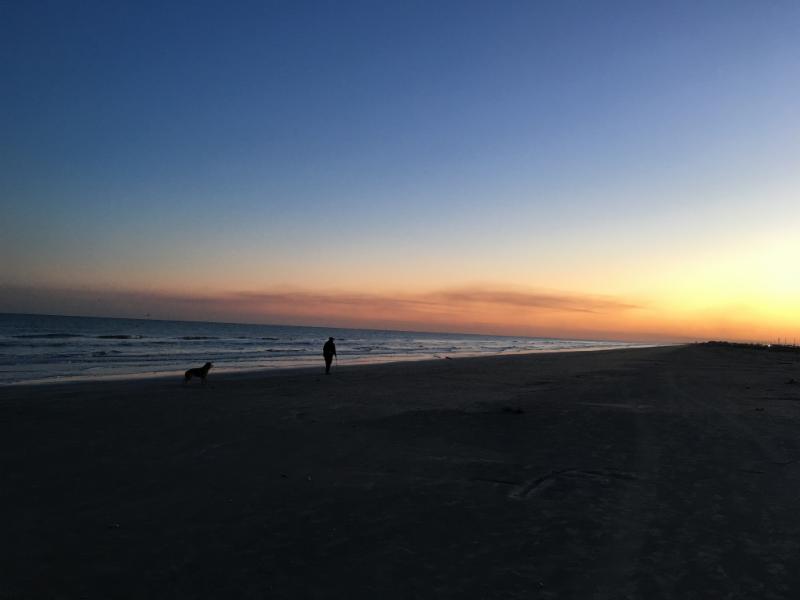
The park has two camping areas, one on the beach side that is popular, but very windy. The other area looks out over the mudflats and the West Bay, and it is stunning. Cody and walked along the sandy mudflats every morning, and Marika explored the birding trails. And every evening we took our beach walk along the Gulf.
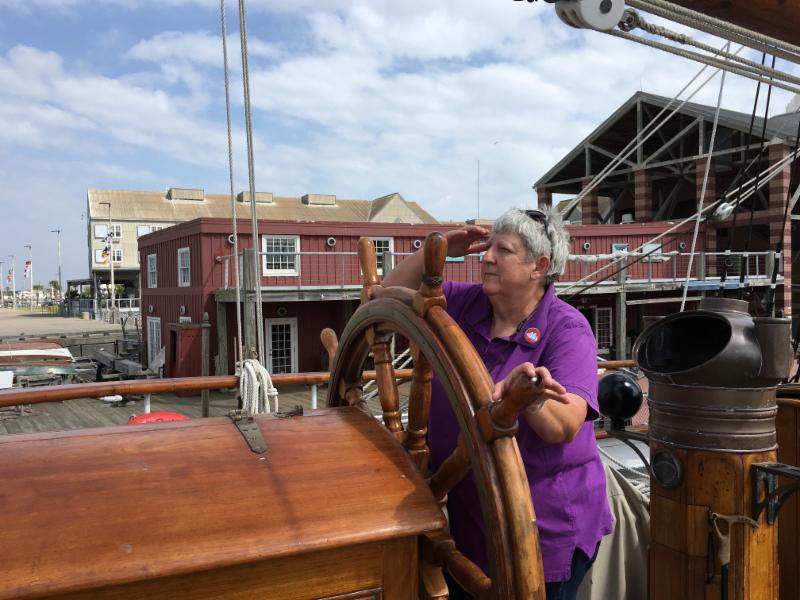
One day we drove into Galveston for lunch and a tour of the Texas Seaport Museum and the fully restored sailing ship, Elissa, from the 1800’s.
After four relaxing nights on the bay, we headed up to Houston for some big city sightseeing. We haven’t been in the throes of serious traffic since we left Phoenix in January and, let me tell you, Houston drivers are crazy! It was so stressful that we asked our friend to do the driving around town.
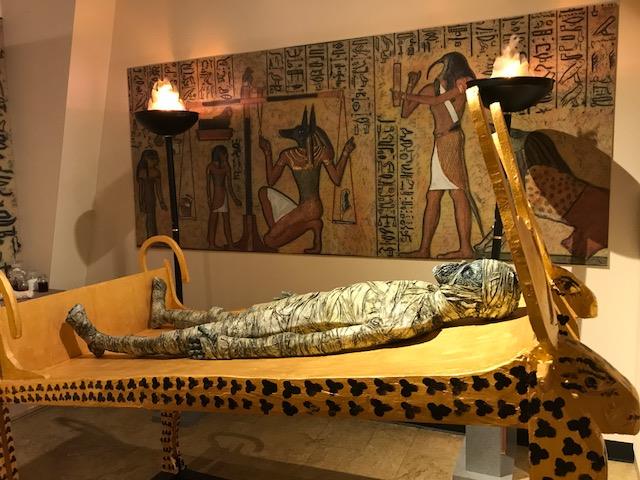
We checked out the National History Museum of Funeral History where we learned about embalming, saw beautiful hearses from the 30’s and 40’s, and replicas of several Presidential caskets.
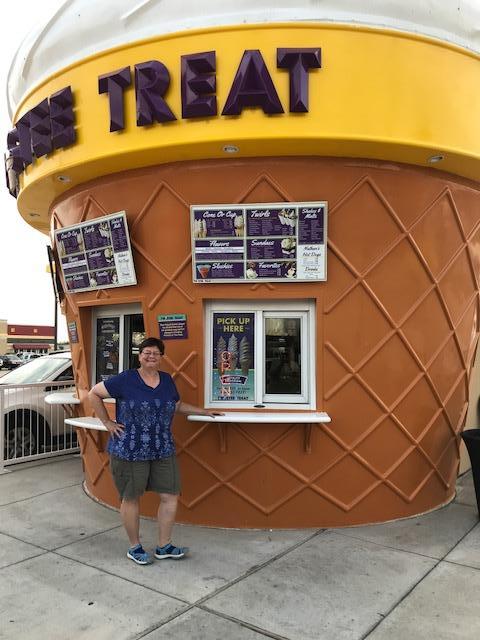
We had the most delicious lunch at a real, flown-in-from-New-York-every-day Jewish deli, with amazing corned beef and hand-sliced belly lox, and found a small and delicious Thai restaurant just a few minutes from our RV park. And we had to stop at the Tastee Treat for dessert.
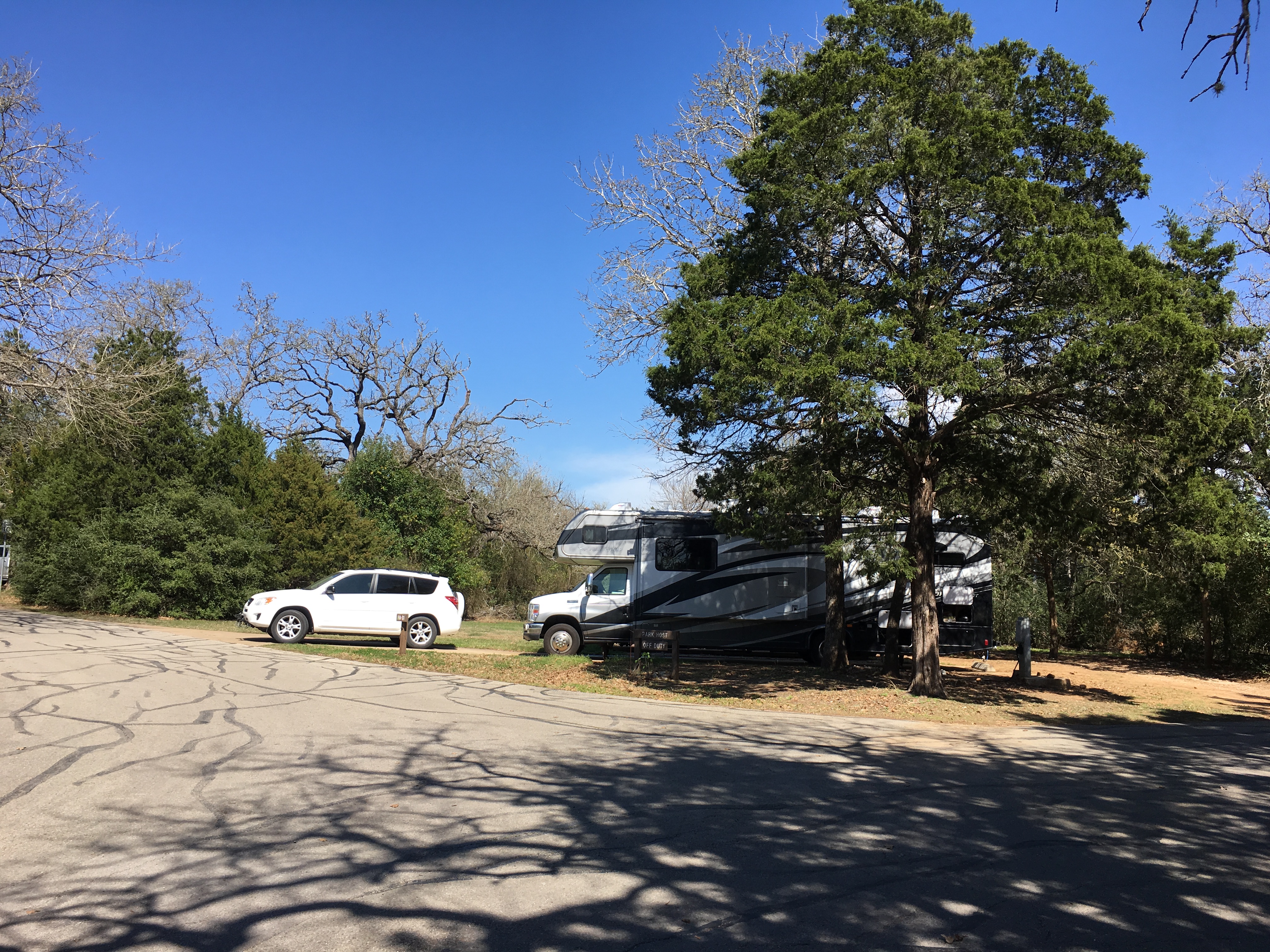
On Saturday we left Houston and headed to Bastrop, Texas, where we are now camped for the next 30 days, working as camp hosts. After a month at the coast, it’s fun to be in the Pineywoods, surrounded by the songs of cardinals, warblers, and jays. The lake is beautiful, and the kayak launch ramp is right around the corner from our spot.
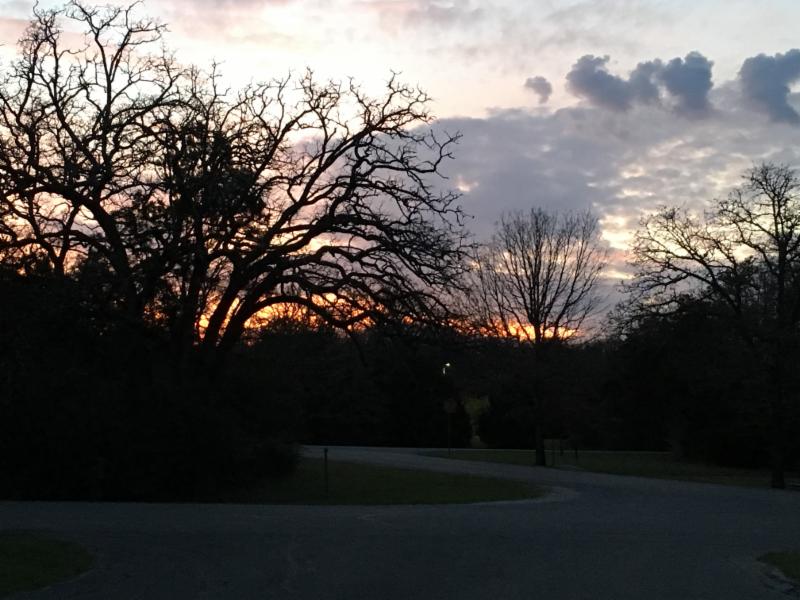
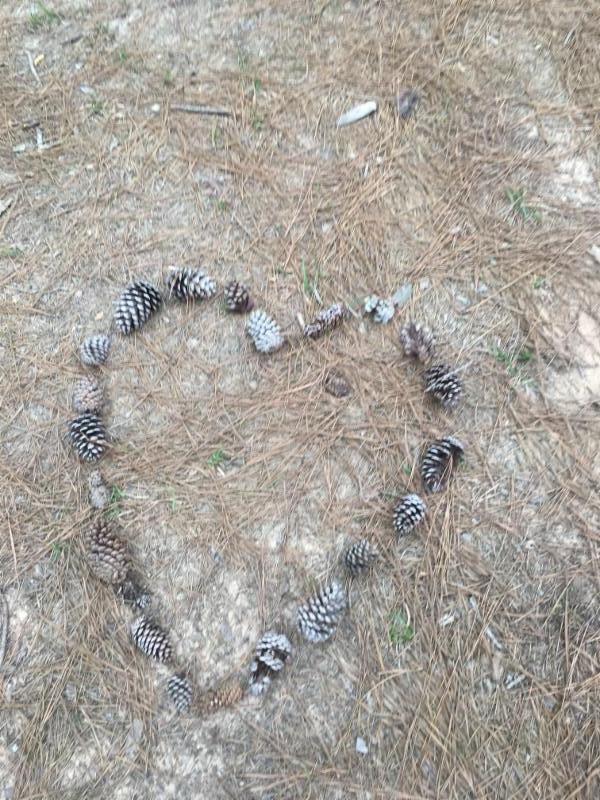
Cody and I followed a trail, first along the lake, then into the woods. I had looked at the map, but didn’t have one with me. It seemed like we were walking further than the signs indicated, but my phone wasn’t registering my steps. When we reached the marker for the second trail, I realized we weren’t on a loop trail, so we turned around. We were both a bit tired and thirsty, but we kept going. The heart of pine cones on the trail helped. By the time we got back to camp, we had walked 3.5 miles, our longest hike ever.
We’re excited to be here for the month, to explore another part of Texas, and spend some time in the woods. And we have some friends in Austin who we can’t wait to see. I’ll be exploring the lake in my kayak and I even got my bike out of the car for some around the park riding. And we’ll be cleaning fire pits and picking up litter, and sharing this beautiful pace with other campers.
Living On Island Time

I’ve been settling into the slow, relaxing Island Time, flowing with the energy of my body and the ever-changing weather. After the first two weeks of rain and cold and wind, these last few days have been cloudy and warm and very humid, with fog every morning and evening. And I am loving it. My skin is moist without daily lotion, and I don’t even mind that my hair falls into bangs.

Marika and I have explored more of the back streets on the Peninsula, and walked the jetties near the fishing boats and ship yards. We had a picnic lunch at the state park on the west end of Galveston Island, and ate our very first pound of boiled crawfish.
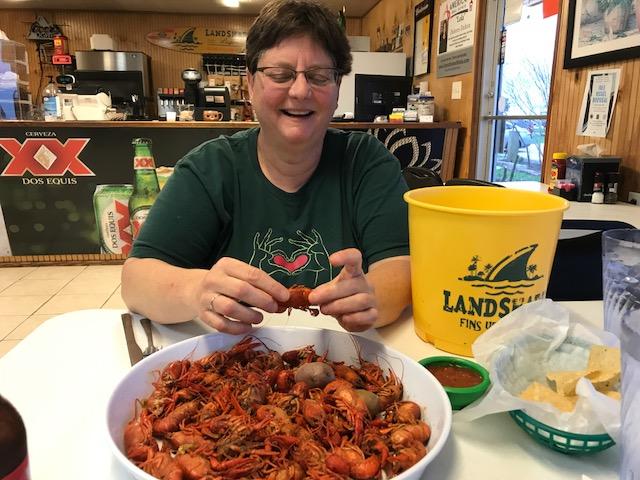
I haven’t been watching as much TV, or even sitting at the computer as often as usual. Instead, Cody and I are loving our every day romps on the beach, playing many rounds of ball in our grassy front yard space, and following the smells of the other dogs in the grassy areas around the RV park.
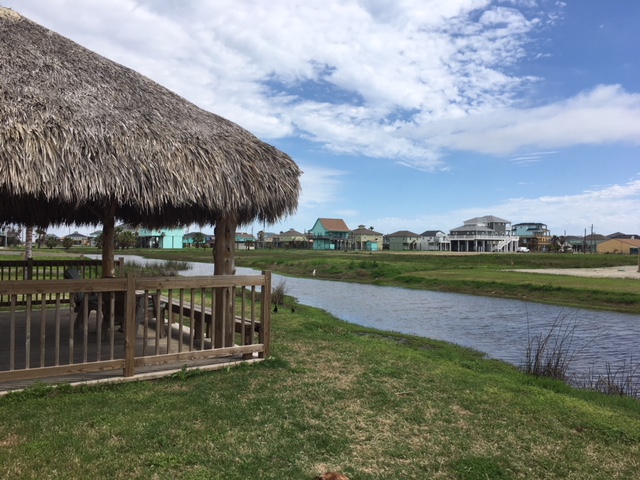
Every day I sit under the cool and breezy palapa and read a chapter or two, and watch for the egrets and roseate spoonbills in the canal. My legs are covered in mosquito bites, but they’re not the itching kind, and I am so grateful. And when it gets too sticky to be outside, I retreat to the cool a/c inside to read, watch TV or make postcards.

And when I hear myself say I’m too tired to go to the beach, or it’s too windy or too sticky, I ask myself, “If I don’t go, will I regret it a few months from now when it is no longer an option?” And usually the answer is yes. And so I go, always glad that I did. And on the few occasions that I opt to stay home, I really enjoy it.

Marika has been birding all over the peninsula, along the breakers at Rollover Pass where the fisherman line the jetty, down to Bolivar Flats, near the ferry, where the world-famous bird tour leader, Victor Emanuel, has a modest beach house on stilts. She’s been to the wildlife refuge about an hour away, and she took me to a great spot along the Intercoastal Waterway to watch the birds and the huge cargo ships and barges.

Last Saturday, we had talked about driving to Winnie, the closest town east of us. Marika really wanted to get the freezer defrosted, and so I figured I’d sit at the computer and get some work done, even though I really didn’t want to. And then she suggested that I go by myself. And I was thrilled at the idea!
So I grabbed my wallet and keys, a bottle of water and a bag of pretzel rods, and headed east on Texas 87, toward Winnie, to take myself out for lunch. Yes, I still had to have a reason, a destination, a focus. But, for the first time in months, I didn’t have the GPS turned on with a specific destination in mind. I was just driving until I got to Winnie.
I rolled down the front windows and opened the moon roof and loved the sticky coastal air softening my face, thickening my hair. I talked, out loud, through some ideas for the upcoming Heart Sparks workshop at the RV Park.
By the time I turned north onto 124 N, I had a plan for the workshop and could turn my full attention to the new landscape of fields and cattle and utility poles. I passed a half dozen short horned steer walking the fence line, and several dead possums on the side of the road.

I was the only car heading north, as I passed trailers and motorhomes and cars heading to the beach. I started singing King of the Road, but I couldn’t remember the lyrics, so I whistled most of the song, belting out the title line, louder, stronger, happier, with each verse.
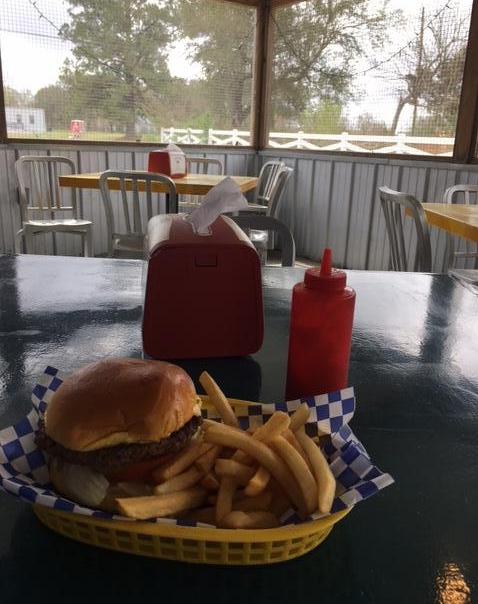
There weren’t too many choices for lunch in Winnie beside the usual fast food places, so I checked Yelp on my phone and chose the Shorthorn Cafe in Hamshire, the next town over. I put the address into the Garmin and found the restaurant, an order-at-the-counter sandwich and burger joint next to a convenience store. The gal was young and friendly and said “everything is good,” so I stayed. I enjoyed my burger and fries outside under the covered patio, watching the trees blow in the breeze. On the drive home I wondered why I hadn’t taken myself on a solo trip sooner.
When we leave the Peninsula this weekend, we’ll spend a few nights camping at the state park on the other end of Galveston Island, then head north to a campground 30 miles outside of Austin where we got a last-minute camp hosting job through the beginning of April. The park is on a lake that is part of the Lower Colorado River Authority. We’ll be cleaning camp sites and cabins, and meeting and greeting campers.
It will be good to have a schedule, a routine, and regular interaction with other people. And then, the plan is to return to the coast in April for the spring migration of all of the birds.
But until then, I’m so loving this time here at the beach, made even sweeter knowing that we’ll be back soon.

Finally! The Beach!
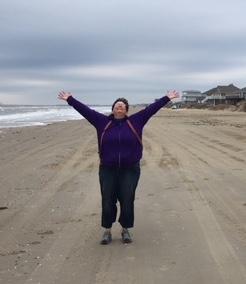
We’re on Bolivar (rhymes with Oliver) Peninsula, a free, five-mile ferry ride east of Galveston. We’re here for the month, staying at a private RV park two short blocks from the beach, with full hookups, fast wifi, and free laundry. Our good friend, Judy, came to visit this past week, so we’ve been exploring the islands, the restaurants, and searching for birds.
In previous years, this part of the Gulf Coast has been sunny and 70’s in February, but, like everywhere else in the country, that is not the case this year. It’s been in the 40’s and 50’s, rainy, foggy, and overcast almost every day since we’ve been here.
There was one day where the sun came out between clouds, and we drove out to High Island, at the east end of the Peninsula. High Island sits on a salt mound nearly 40’ above sea level and it’s the the last land mass for thousands of migrating birds in the spring and fall. Since this is still winter, there were only a few varieties, but Marika and Judy enjoyed them. And I was grateful to be outside, walking a new trail.
One cold but dry day, we took the ferry to Galveston and walked along the uprooted sidewalks of Broadway, admiring the architecture of the ornate mansions and Victorian homes. We went back to Galveston on the windiest day and took a tour of the famous Bishop’s Castle, listed as one of the top 100 architectural masterpieces in America. We learned about the petroleum industry at the Ocean Star Offshore Oil Rig Museum, and found a few of the carved tree sculptures done by artists after Hurricane Ike.
We ate crab balls and king cake, and chalupas that looked like just like tostadas. We brought home garlic bread and Indian foods from the local farmers market, and bought fresh shrimp and red snapper at a fish market on the pier. We were delighted by the pelicans, waiting outside on the docks.
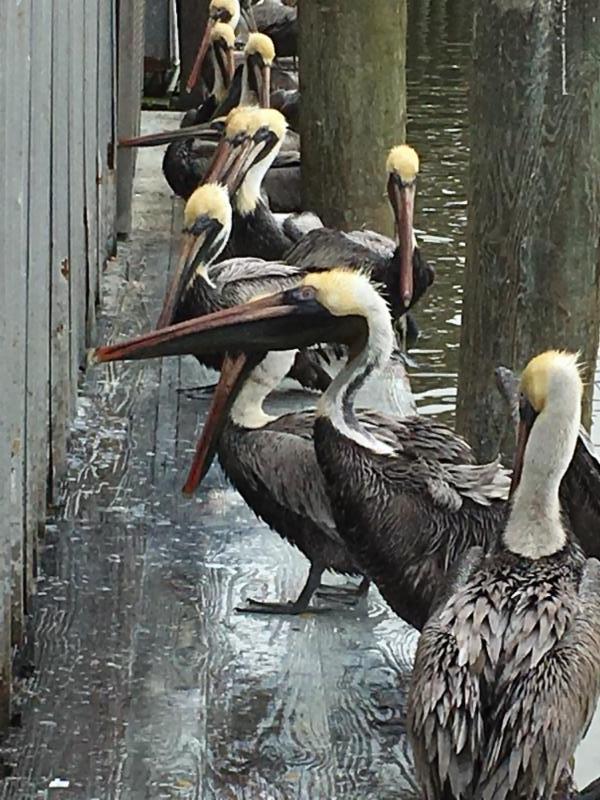
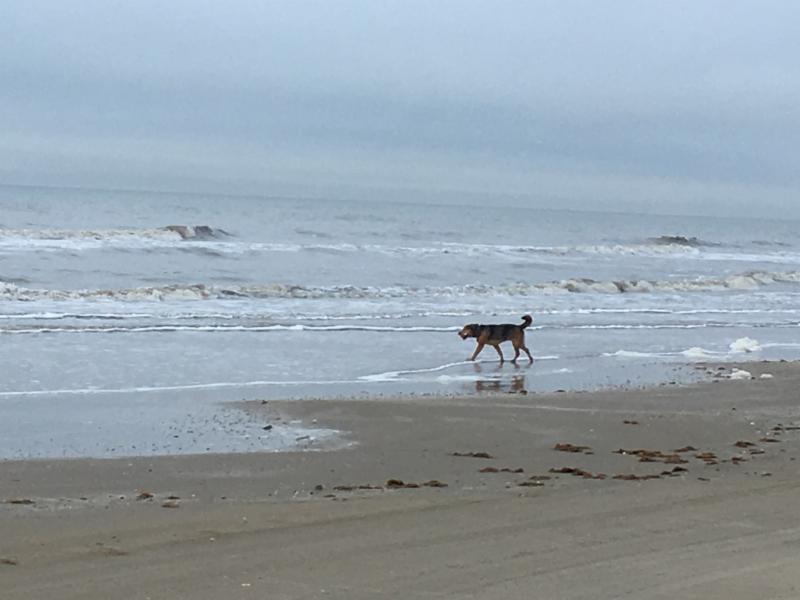
Every morning Judy, Cody, and I went for beach walk. Even in the wind and drizzle, because we could. And wherever we drove, we stopped to watch the shorebirds and cormorants, herons, and egrets wading in the ditch waters along the roads.
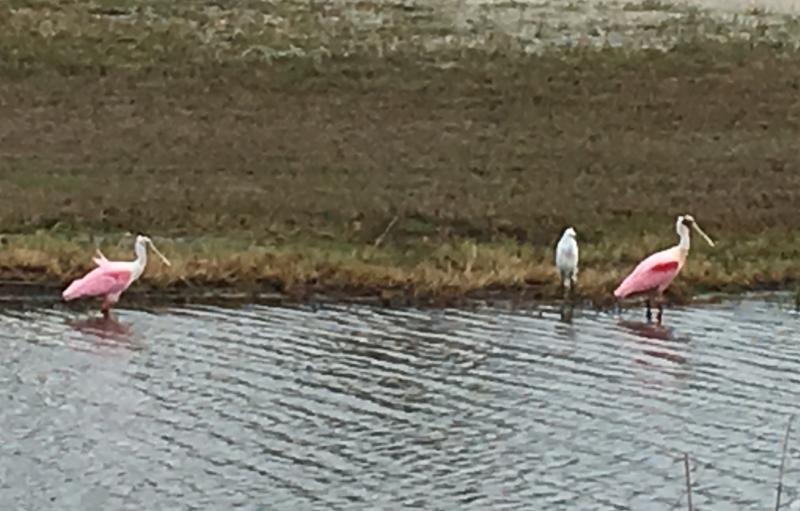
One morning it was dry enough for Marika and Judy to have their morning coffee outside under the palapa at the edge of the RV Park. The covered patio area overlooks a ten-foot-wide slough that attracts herons, various ducks and my new favorite bird, the roseate spoonbill. Their feathers range from pale pink to cotton candy, with a smear of lipstick-red on their wings. I watched from the dinette window as they poked their spoon-shaped bills into the water along the grass, looking for food.
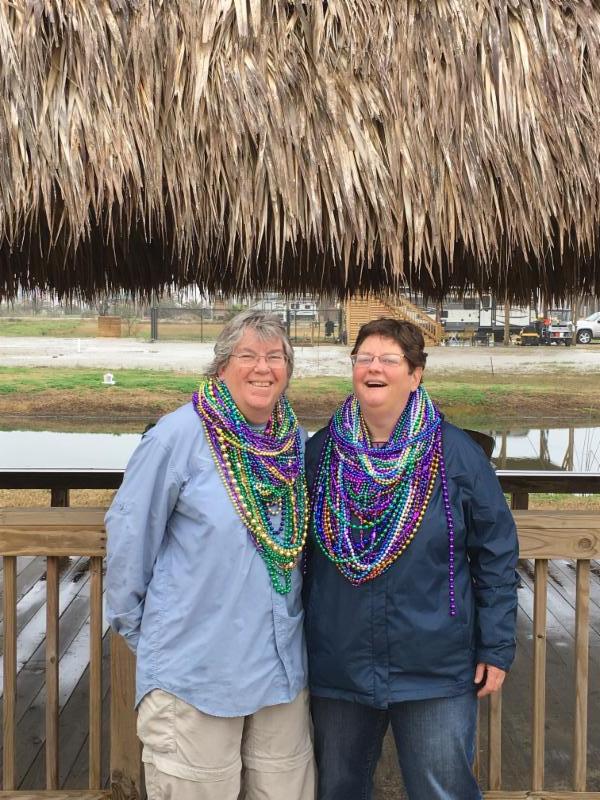
This past weekend was Mardi Gras, and they definitely celebrate here on the Gulf Coast. Judy and I drove the car up to the main highway so we’d have a dry seat for the town’s Mardi Gras parade. I asked her, how many beads do you think we’ll get? She said 5. I said 7. (We donated our loot to the local Humane Society for next year’s parade.)
Judy left yesterday and, now that the whirlwind of getting here, and having company is over, I’m ready to settle in to simply be-ing here for the next three weeks.
It’s been a dream for more than a year, to spend a winter month on the Gulf Coast. While I’m disappointed that there aren’t more birds for Marika, I am so happy to be at the beach, my very favorite place for my body and my soul. I’m excited for the time and space to do some inner exploring, to tap into what I might like to do with my gifts and talents, and how I can best serve.
I know I want to take a class, learn something new. But I’m not sure what yet. I’ve been doing a lot of asking, and opening, and letting go, and reminding myself that I don’t have to rush, or know, or feel comfortable, or make big decisions, or plan lifetime goals.
I just need to show up and lean in to being right here: on the coast, at an affordable, quiet, friendly RV park, with local seafood, a fabulous walking beach, places for Cody to run, and pelicans and roseate spoonbills right out our window.

And when I start to feel anxious and uncomfortable, I smoke a little, put on however many layers of clothes and coats I need, and take Cody for a walk. To get out of my head. To breathe in the moist air. To hear the rolling waves of the Gulf, just two blocks away.
And then some small thing, maybe the sherbet colors of the beach houses, or a heron flying by, brings me back to the moment, and how simply grateful I am to be living this life.
Travelogue to Texas
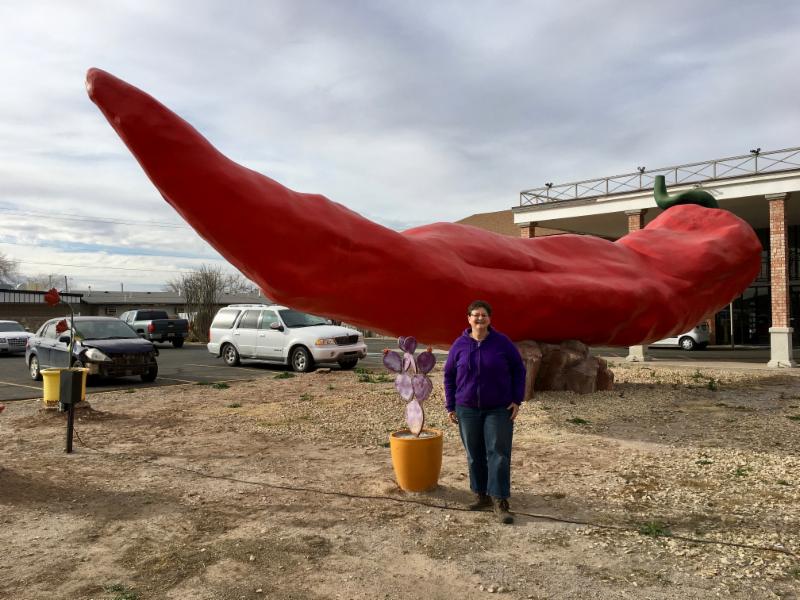
It’s been a great stretch of stories between the monastery in Willcox and the Texas Coast. We started the trip with an RV fill up at the gas station and someone had left $23.00 on the pump for us! We drove a good day from Willcox, into New Mexico, to Las Cruces. We enjoyed delicious middle eastern food near the university, restocked at Walmart, and checked out the largest red chili and the Recycled Roadrunner art. We visited the old settlement of Mesilla, with the oldest documented brick building in New Mexico.
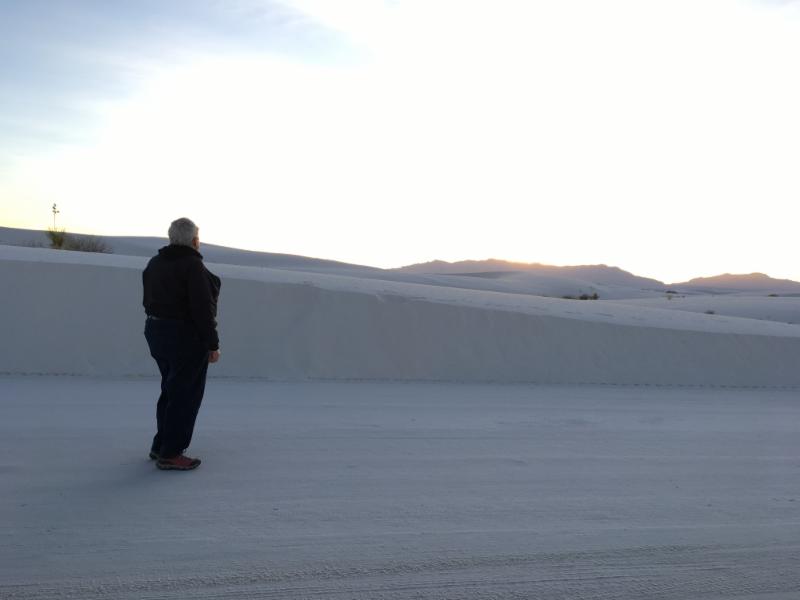
And, even though we were both tired and could have easily stayed home, we drove out to White Sands National Monument, about 30 miles out of town, for a guided sunset hike.
White Sands is like nowhere else I’ve been, and I’ve seen sand dunes. It is so white, it is like snow. But it feels like sand. And you can see it for miles and miles. I imagine it is blinding and very hot in the summer.
After two full days and nights, we pulled out, with empty holding tanks and a full tank of water, and the Garmin set for Marfa, a small artist town, and Big Bend National Park. But before we even got to the highway, the alarm for the car’s transmission pump started squealing. Marika wanted to ignore it. I knew we’d be driving into vast open no man’s land, with no services for miles.
Marika had talked to an RV guy in Albuquerque about the pump in November when we had to replace it, so I suggested we drive 180 miles north to see him. The receptionist said they were all booked up, but Tom, the owner, said to drive on up and he’d take care of us.
So, we reprogrammed the Garmin and Marika and Cody drove in the RV and I followed in the car. It was a long three and a half hours of wide open landscapes. I found an 80’s station, called a friend, and kept saying thank you for the pump acting up BEFORE we got out of town.
We pulled into the RV repair lot and met Tom and his tech, Jeff. We explained the problem then watched as Jeff checked the connections, the wires inside the cable – the umbilical cord – he called it, that connects all of the electric things from the RV to the car-brake lights, turn signals, and the power for the transmission pump in the car.
Marika stayed with Jeff and I went into the RV to pee, then took out my phone to research places to stay for at least one night. I found two that got good ratings, one was west of town, one was south, at the Isleta Casino.
I called both and chose the casino, in case we were going to continue south to Big Bend. The casino was less than a half an hour outside of town, in case we wanted to be tourists. And, the campground wasn’t near the bright lights of the casino. It was across the street, in an arroyo, with a lake!
Tom and Jeff tightened everything and the pump stopped alarming so we headed out. We pulled into the campground and took the space second from the end, with a view of the lake and the mountains and the train. As soon as we finished leveling, a huge bird swooped over the lake. I said, “Marika, Big bird, black wings, white body.” She didn’t think it could be an eagle, but it was. And there was a second one perched in a tree. What a welcome.
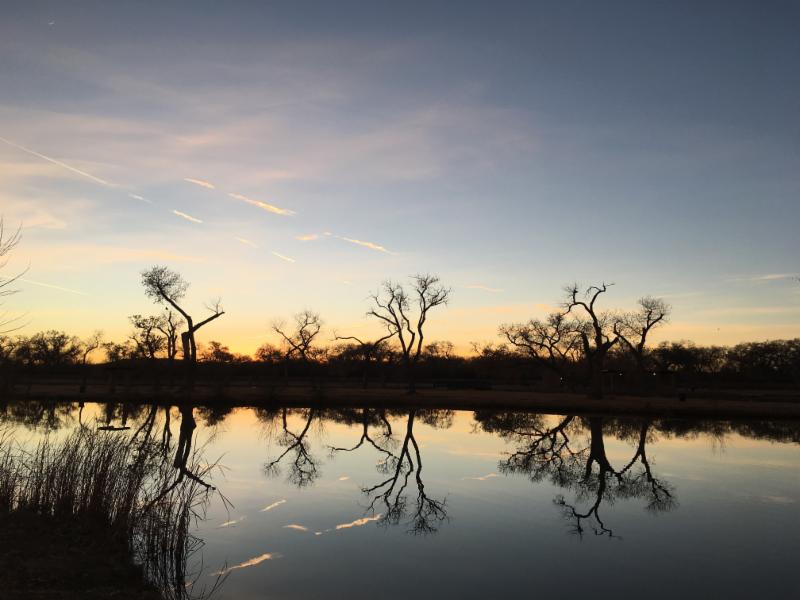
We plugged into the electricity, but stayed unhooked from the water because it was going to be in the 20’s every night, and we didn’t want the hose to freeze. We walked along the edge of the lake, watching the sun go down beyond the trees and the Rio Grande, somewhere beyond them.
I kept thinking over the day, thanking the Universe for bringing us safely to this beautiful place. That Tom was willing and able to help us. And he didn’t even charge us for his time!
The next day I took out the paper map and google maps and started to regroup and re-route. We were scheduled to arrive at Big Bend National Park the following night, so we were at least two days behind getting there. And, there was a chance that the government was going to shut down at midnight, which meant the park would be closed.
We had already cancelled our Marfa reservation and one night at Big Bend, so it was a clear and easy choice to cancel the rest of our reservation and take a more direct route to the coast.
And so, after three relaxing days along the lake outside of Albuquerque, we headed to Roswell, New Mexico, for two nights. Not to see the alien stuff, but because it was an easy three hour drive on the new route.
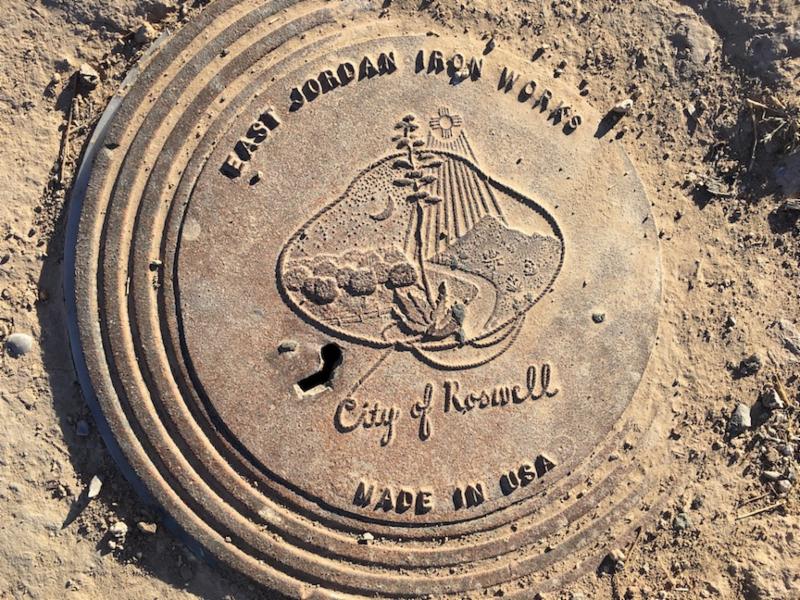
We stayed at a private RV park that butted up against a city park, so Cody had a great place to romp and play ball. The city also has a small zoo of rescue animals, and a lake, so we were happy with the place.
The first night we dry camped, meaning not hooked up to electricity. It was already in the 30’s around 7pm , and we couldn’t run the two electric heaters, and we didn’t want to run the house propane heaters for too long in the evening, in case they drained the batteries. So we went to sleep really early to stay warm. Cody joined us in bed around midnight, and we were all pretty cozy and warm. The batteries held a charge like they were supposed to, and we turned on both house heaters at six in the morning when it was 21 degrees outside. We moved into an electric site the second day so that we could freely run the electric heaters, and it was much warmer.
We went food shopping, Marika got a pair of leggings at JC Penney, and we got the car washed after a very dirty quick rain in Albuquerque. In the afternoon we took a drive to check out the Bottomless Lakes state park, the first state park in New Mexico. We walked the wetlands trail, then went to a nearby refuge for sunset and saw more sandhill cranes flying in. Marika had her scope out, and I watched from the car.
From Las Cruces we drove a long six hours into Texas to a campground in San Angelo, one of the state parks that Cody and I camped at during my solo Heart Sparks road tour in 2015. This time, it was winter and we had the entire campground to ourselves.
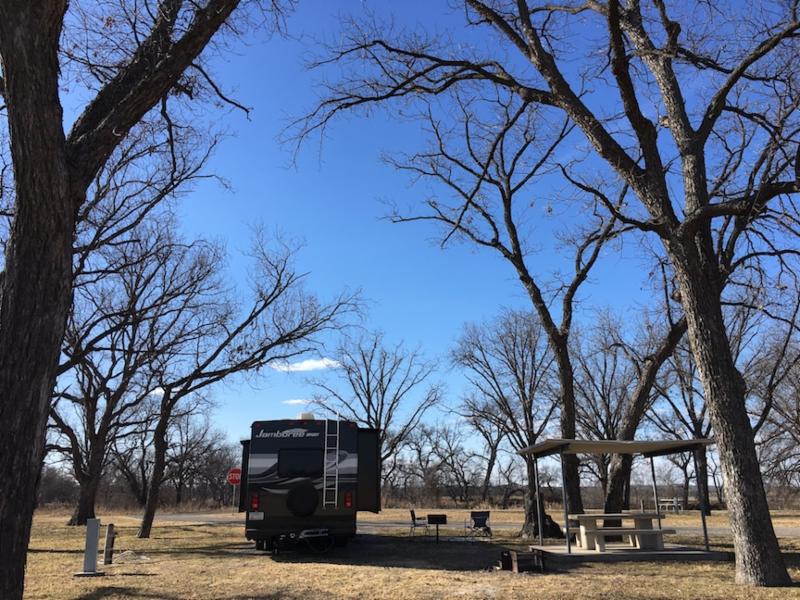
About 45 minutes before sunset, Marika wanted to check out the south camping area eight miles down the road. I wanted to just sit in our campsite and unwind after the long day on the road, watch the sun set, see what birds or deer showed up. But she was insistent, and I wanted to see it too, so we went. We started to drive out of the park, no map, no GPS, just our phones, but the gate was locked. I called the office and the woman apologized profusely and gave me the gate code.
It took four attempts at the rolling combination lock to get it open, then a bit more time to figure out how the gate opened. By the time we were on the road, the sun was behind the trees, but we kept going. When we got to the south camp gatehouse, we picked up our camping tags, and met the woman who gave me the gate code. She apologized again, then told us to enjoy our stay.
We drove down to the lakeside primitive camp area, also empty, and saw hundreds of gulls on the lake. The sky was orange and pink, yellow and gold behind the winter trees.
We drove back toward camp in the dark, not sure exactly where our turnoff would be for the north camp. I said, “It’s just over the river, remember?” We watched for signs and I saw “bridge may be icy” and then the brown sign for the campground, so we turned in. I got out and Marika held the flashlight while I unlocked the gate and we drove in and down the road, and nothing looked familiar. I looked on my Maps app and we had turned off the highway too soon. We were in the Equestrian camp. The road to the campground was a different gated entrance on the other side of the river.
So we drove out, opened and closed the gate again, and turned back onto the highway. We went over the bridge and saw the turnoff sign for the actual campground.
We did the gate again, and drove past the entry booth, total darkness through the campground that has no signs, and thank goodness I left a light on in the RV or we would have never found our site.
We woke up to dozens of wild turkeys and deer in our back yard. We had delicious Pho in town and visited an artists collective, but most of the studios were closed.
Marika returned to the south park to bird along the lakes while Cody and I played ball. Then I took a walk around the campground and found a body of water surrounded by cottonwoods and tall grasses. I heard so many birds, in the trees, in the grasses, but I saw none. I sat for a long time, listening with my eyes closed, wishing that more people could find a spot in nature to sit and relax.
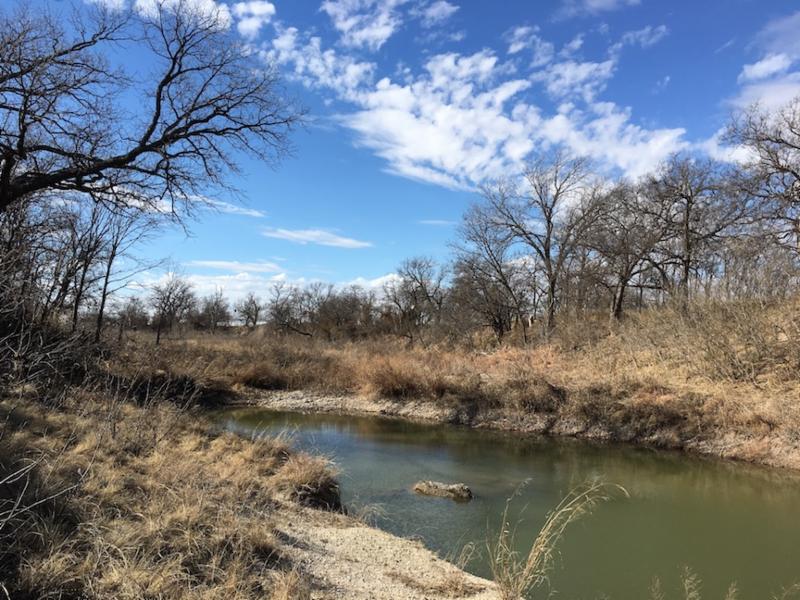
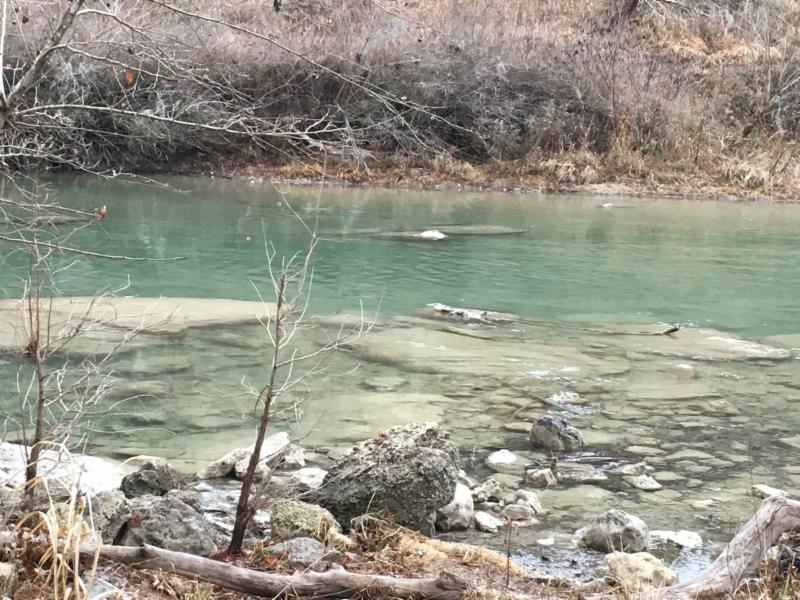
We left early the next morning and continued east toward San Antonio. It was a longer traveling day than expected with a lot of wind and misty rain, but easy driving besides that. We passed Eden, the center of Texas, and camped for one night about 30 miles northwest of San Antonio at a state park along the Guadalupe River. The water was so calm and clear you could see the rocks under the surface. And it was moist in the air, from the rain, and the river and my body was so happy.
We drove over to the trailheads and Marika found a bird blind while Cody and I took the river trail and we saw armadillos eating in the grasses. I’ve only seen them dead along the road. They are something! They have a black and white striped tail and a grayish shell of armor. I said it looks like he is wearing striped pajamas, and that he put on a gray robe to go out. Marika said I was using too many words. A few minutes later, when we were talking about their defense system, Marika said, “They go into their robe for protection.”
If we had known how beautiful it was, we would have stayed two nights, but we had both agreed we wanted to make it a quick stop so we could get to the coast. So we didn’t follow our 2-2-2 rule: Drive only 2 hours each person, arrive by 2 o’clock and stay 2 nights. But we were both ok with it. And so, in the morning, we set the GPS to take us to the beach.
The Garmin directed us out of town to Hwy 181 south. I had looked on Google maps the night before and asked Marika is she wanted a bigger highway or smaller for the day’s drive, and she said bigger. So I re-programmed the Garmin to take us on the 35S.
Except we were already headed to the 181, and I kept overriding the directions, until the GPS had us going all the way around and then through San Antonio. We passed Texas-sized stone mansions, strip malls and chain restaurants, then through an industrial part of town, past some old, shabby homes where the people on their porches looked like they’d never seen a motor home towing a car drive through their neighborhood. The streets got narrower as we passed through the funky arts district, then right into downtown, (thank goodness it was a Saturday), past the Riverwalk and finally, to the signs to 35S.
Once we were on the highway I looked at the map to see where we’d been, and I couldn’t believe that we had driven an hour out of the way, and that, yes, the 181 WAS a better route. And so after 15 minutes of the 35S, we cut across on a numbered Texas road for 20 miles to pick up the 181 after all.
By the time we pulled into the RV park, it was after four and pouring rain. But I grabbed Marika’s rain jacket and guided her into our spot, did the leveling jacks and plugged in the electric. I changed into dry clothes and finally, we were settled in.
The park is not much, but we picked it because it is across the street from the water. It was a bit hard to see much with the rain, but we have a view of the bay and the remnants of a pier, so we are tickled! And we are here for a week!
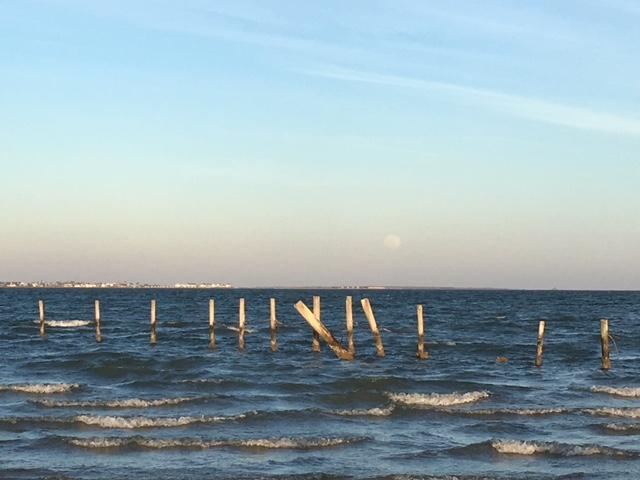
The town of Rockport is still in recovery from Hurricane Harvey. Many stores and restaurants and motels are gone. On our way into town we passed towering piles of house things along the highway – furniture, kid’s yard toys, wood, roof materials. The park manager said that’s the end of what’s left, that it was much bigger before.
So many homes are still in need of repair, the temporary plastic roof tarps are tattered, many building lost their walls, and folks continue to pile dead tree limbs and trash along the roads for pickup. Our neighbor has been coming here for three years and he said it’s terrible. So much gone.
But the birds are still here. Today we saw white and brown pelicans, cormorants, ruddy turnstones, black vultures and turkey vultures, black crested titmouse, cardinals, laughing gulls, red head ducks, coots, and rock doves.
And our first whooping cranes. There are only 600 in the world, 400 of them migrate from Canada to the Texas coast. And we saw five of them, less than 20 yards away, feeding on the grasses along the bay. And they are huge birds, FIVE FEET TALL!! And they were feeding with some sandhill cranes, which, at 3 feet tall, seemed huge birds, but they are small compared to the whoopers.
Ever since I came to this part of Texas in 2015, I’ve dreamed of bringing Marika here for the birds for a whole month. And now this dream is real. Which is thrilling and joyous. And also leaves me with a new emptiness, because, now what’s the next dream between here and our volunteer job in New Jersey in August?
But, if I shift from feeling empty to feeling open, then it becomes a delightful kind of exciting, to NOT know, and be OK with that, to focus on enjoying all that this dream is, right here, right now.
And I realize that I need time to shift from planning, planning, planning to arriving and being here. After weeks of hopping and skipping across three states, my body and my being need to slow down and settle into here and now. And what a great place to be.
Peacocks and Pecans
We pulled out of Phoenix on Friday and enjoyed the wide open desert drive south to Patagonia Lake State Park. Finally, we were back on the road. The campground was full, but quiet, and there were birds and trails, and we even went on an avian boating tour. And at the east end of the campground there was a bench overlooking the lake, with a half dozen seed and hummingbird feeders hanging from trees, and suet cakes and loose seed spread on a tray. Marika was in heaven.
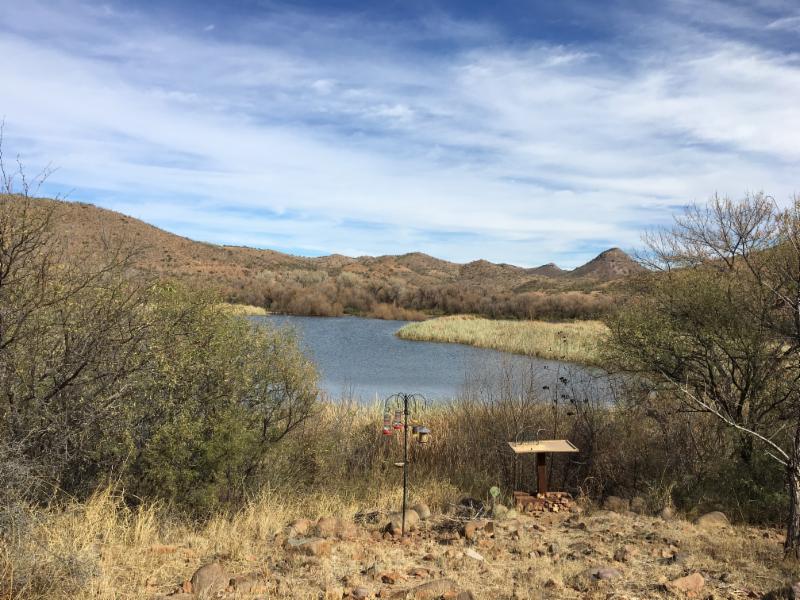
We stayed for three nights, sleeping late, reading, and relaxing. On Monday, the morning of our traveling day, instead of rushing to get on the road, Marika went birding at a nearby riparian area, and Cody and I took a walk to the birding bench. I talked with a camper about re-learning the joys of reading, and how she’ll be retiring in three years, and she wrote down the name of my book to download on her Kindle.
Instead of our usual nine o’clock departure, we didn’t pull out until almost noon. And it was an easy new choice to make, since we were only driving an hour to our next stop, the Holy Trinity Monastery in St David, a small town in southeastern Arizona, about an hour east of Tucson and about 50 miles north of the Mexico border. The monastery is situated on the San Pedro River, and is a popular stop for birders.
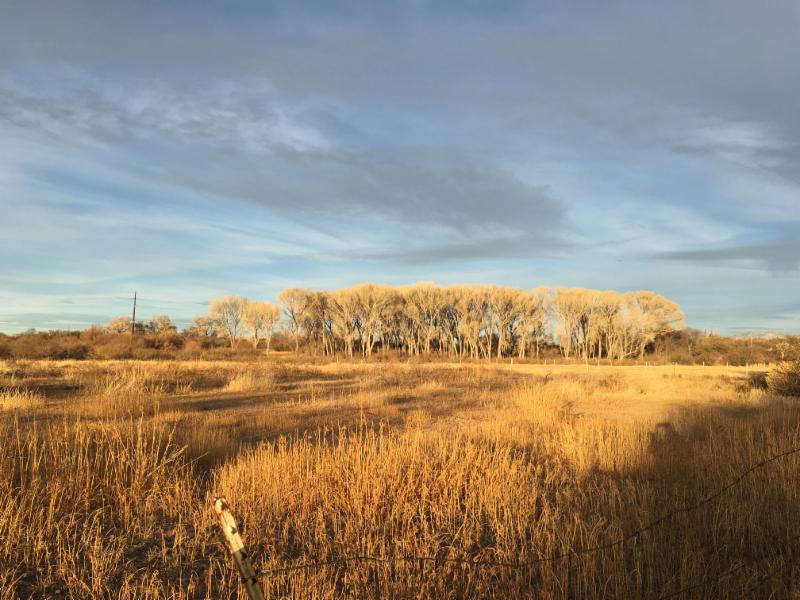
From 1974 until early 2017 Holy Trinity was an active Benedictine monastery with a retreat program. The monastery has recently undergone some major changes, with most of the monks now relocated elsewhere. But the place is still maintained by the Benedictine Olivetan Congregation and many volunteers. Some are local, others are wintering RVers of all religions who have been coming to the monastery for as many as twenty two years. They offer retreats and also have a small RV Park.
We pulled into the gates and spoke with Ann, a seventy nine year old retired nurse who lives in town and volunteers a few days a week in the gift shop. She said we needed to talk to Jan, who should be back soon. So we browsed the books and statues of saints, and learned that Ann had been a single mother with four kids, and her second husband had one child, and they lived in Iowa at the time, and he proposed to her in one sentence: “How would you like to marry me and move out to Arizona and open an RV Park?” And how could she say no to that.
We didn’t get to hear the rest of the story because Jan, the woman we’d been waiting for, finally arrived. But she wasn’t the person we needed to talk to. She told us to drive to the RV Park area and find Thelma, the RV park host. If she wasn’t in the Community Room cleaning pecans, she’d be in her trailer.
So we unhitched the car and drove the dirt road through the monastery grounds, past several modular buildings to the RV area, which consisted of three rows of campsites in the dirt, with several fifth wheels and trailers, and several empty spaces.
I walked down to the trailer marked RV HOST, and Thelma, a gray haired woman in her seventies, told me to pull in wherever, and fill out the registration information and she’d come and find us and collect the money, twenty dollars a night with full hookups.
We pulled into a middle row spot and, while I unpacked things inside, Marika talked with the woman in the golf cart across from us. She was a retired nun who had a post-stroke droop on the left side of her face. She worked at the monastery’s library, and we were welcome to come by. She explained that there was also a laundry and bathrooms, and she pointed to the fence where the bird trail was. And she said there is a meal at on o’clock every day if we were interested.
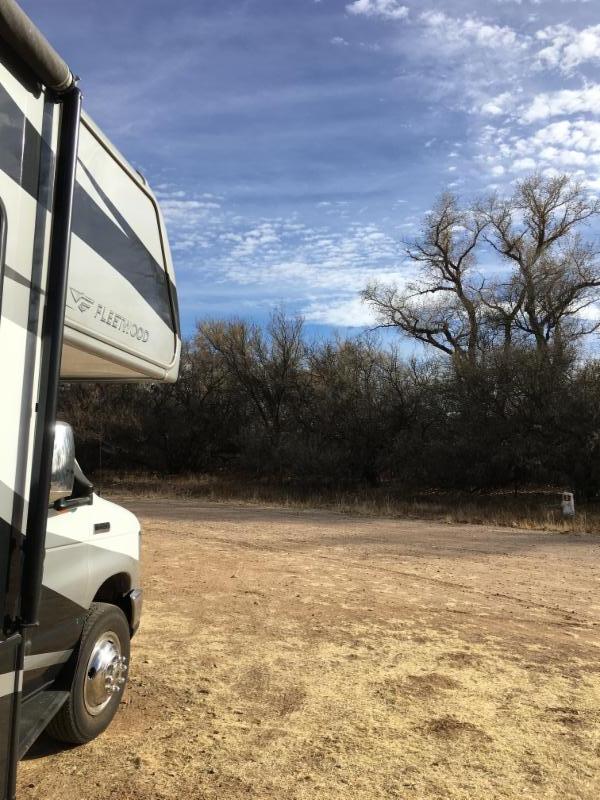
We had planned to just use the place as a hub for two days, and spend the following day in Bisbee, a place I’ve never been, and go on the tour of the mine. But after a gorgeous sunset walk along the bird trail, Marika and I both realized that we’d rather stay at the monastery, join the group for lunch, and do some volunteering and connecting with the people here. And so ,the next morning when Marika and Cody saw Thelma, she put us on the list for lunch and invited us to clean pecans at ten.
It was just the two of us, sitting at a round table in the Community Room, a forty by twenty foot room furnished with donated sofas and artwork and a piano that, according to Thelma, was beyond a good tuning.
Thelma poured five pounds of unshelled pecans on the table and explained that this was the end of last year’s crop. There were pecan pieces of all sizes mixed in with some good halves still clinging to their shell. She said we just needed to separate the shells from the edible pieces of pecans so they could use the nuts in the bakery. And not to worry about getting the bits of meat out of the shells – she’d feed them to the peacocks and javalinas.
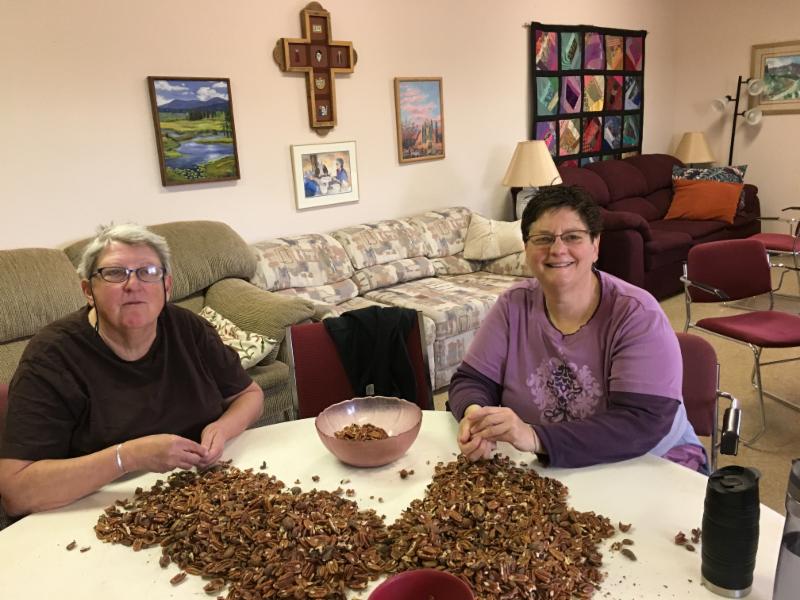
Marika and I each had a bowl to fill and, after an hour, my bowl was full and I was ready to stretch my body, refill my water bottle, go home to the bathroom and walk with Cody. Marika chose to stay and keep shelling.
Cody and I walked around the edge of the RV section, and along the back of the work shed. The grounds are surrounded with some of the oldest cottonwoods in the country, thick and tall, with silver dollar leaves that sound like they are whispering in a breeze.
It was so nice to be moving my body under the overcast sky that, even after Cody had pooped and peed and played, we kept going. We walked past the Community Center and I thought about stopping to tell Marika I wasn’t coming back, but then I realized that she’d figure it out. And that she’d be fine with it. That’s the beauty of our relationship. A lot of the time she does her thing, and I do mine, and it’s all good.
Cody and I followed the dirt road through the courtyard to the dining hall, near where the pastor lived, where his dog was barking barking barking as we walked by.
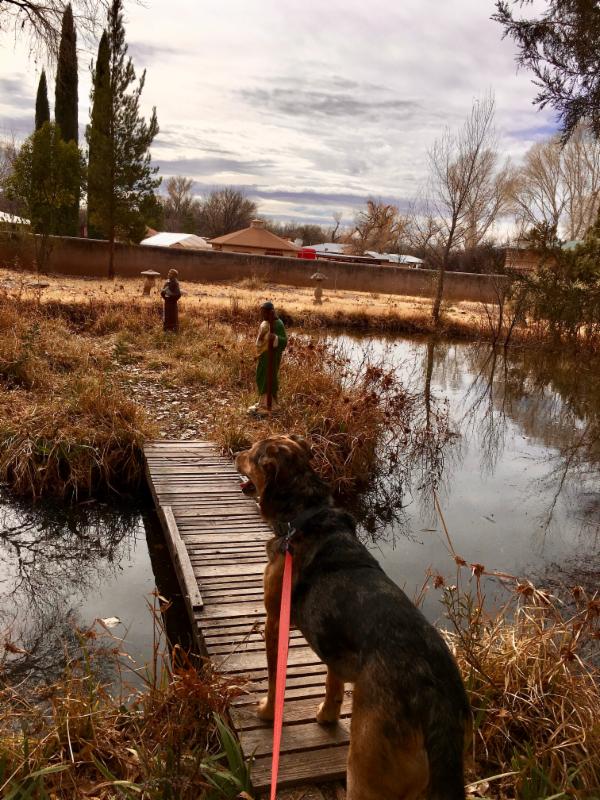
We found the 70-foot tall Celtic cross, a gift from some locals who wanted to put it on their own property, but their neighbors complained. And we discovered the meditation garden, for adults only. The sign didn’t say No Dogs, so we went through the metal gate and followed the path around the koi pond, over the narrow wooden bridges, Cody first, so I could make sure he didn’t get distracted by the water. He sniffed the dried grasses under the trees where the resident peacocks and hens wander, and I took pictures of the statues, the Japanese lanterns, the metalwork on the bridge.
We left through the opposite gate and continued along the dirt roads, from St. Mary’s Way to St. Bernard Place, passing all different shaped buildings in various stages of newness. There were round wooden huts, barely big enough for a bed and a chair, and modest residence buildings with three or four units, each with a garden patio. I peeked into the windows of the large modern building and saw wooden floors and folding chairs, the space big enough to seat at least 200 people.
We stopped at the Benedict Peacock Thrift Store, but it is closed until January 31, when more volunteers are here. We went into the Quonset hut shaped Used Books building, with a sign that said Always Open, and we were greeted by the sweet smell of old musty books. I kept the door open and looked around at the shelves along the angled walls, each section identified with handwritten signs: Theology, Psychology, Scripture, Spiritual Life. The fiction books were unsorted in boxes underneath the only table in the room.
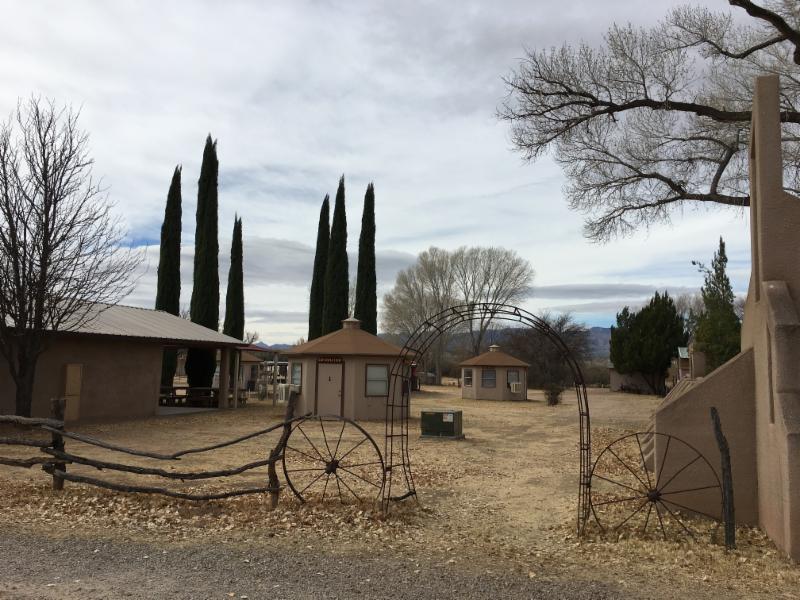
We followed the dirt road to the building with a Museum sign and rusty farm equipment on either side of the doorway. The door was locked and I could only see blackness through the windows. The Monastery Library was next door, and one of the double doors was unlocked, but the lights weren’t on, so we didn’t go in.
We turned onto St. Anselm’s Place and stopped at an area called La Fonda, with picnic tables under a wooden ramada, and a bright red utility trailer outfitted as a food truck. Another round building with an order window facing the picnic area had a taped sign on the window advertising bottled water and soda for sale. But everything was closed. I’m guessing it’s all open for their annual Art Fair the first week in November.
And as we walked, Cody sniffed the dried grass and piles of leaves where the resident peacocks and peahens had gathered. They watched us from behind the cottonwood trees, pecking the air, their big chicken-like feet kicking up the dust as they walked toward us, then away.
By the time we got home, Marika was there and we walked up to Benedict Hall to have lunch with some of the volunteers. After a simple blessing, we enjoyed a chicken and mushroom casserole, a full salad bar, and wonderful conversations.
Mary Ann, a dark haired woman in her fifties, has been at the monastery for two years. She came for a ten-day retreat, then applied for the three-month Oblates apprenticeship. She loved it, applied for full time status and was voted in. She sold everything, and feels that being here is a true blessing.
One of the men, Joe, used to lead RV tours and was an avid birder. We asked him about birding in Big Bend, and Thelma told us how she was camping in a trailer there with her nine kids, and there were no markets for miles and she only had one pound of ground beef to feed everybody. So she added some beans and onions, and made chili, and fed ten people with one pound of meat.
We talked about the pecans, and Annie, a retired nurse from Colorado, and her husband Charlie, invited us to work on the belt after lunch. So, after a walk with Cody, we met them at the Nut Hustler machine, where the pecan processing really begins.
There are more than a hundred pecan trees on the monastery property. To harvest the nuts, the monks lay tarps on the ground, then wrap a band around the tree and a machine vibrates the tree at the trunk. The pecans drop to the ground, onto the tarps.
The tarps are brought to the Nut Hustler machine and one person shovels the pecans into the machine. The machine immediately separates branches, leaves and broken pods and spits them in a pile on the side of the machine. The remainder drops down a chute onto a moving screened conveyor belt where four people, two on each side, pick out the perfect pecans, out of their pods but still in their shells.
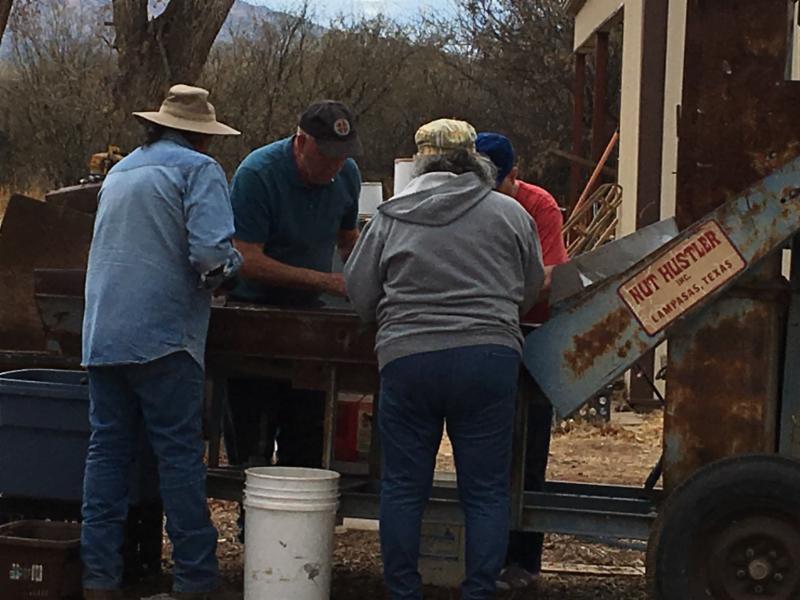
Marika and I stood on opposite sides of the conveyor belt next to Annie and a quiet woman named Rachel. Annie turned the motor on and a load of brown stuff dumped onto the belt. There were remnants of pecan pods, some sticks, several pods that hadn’t opened, a few pecans with cracked shells, and many beautiful pecans, pristine in their shell. Our job was to pick out the perfect pecans and put them in a white bucket, and toss any sticks and unopened pods over our shoulder. Juan, Rachel’s husband, stood at the end of the belt, facing the machine, the last person to pick out any good pecans that had slipped by us, before dropping into the compost chute.
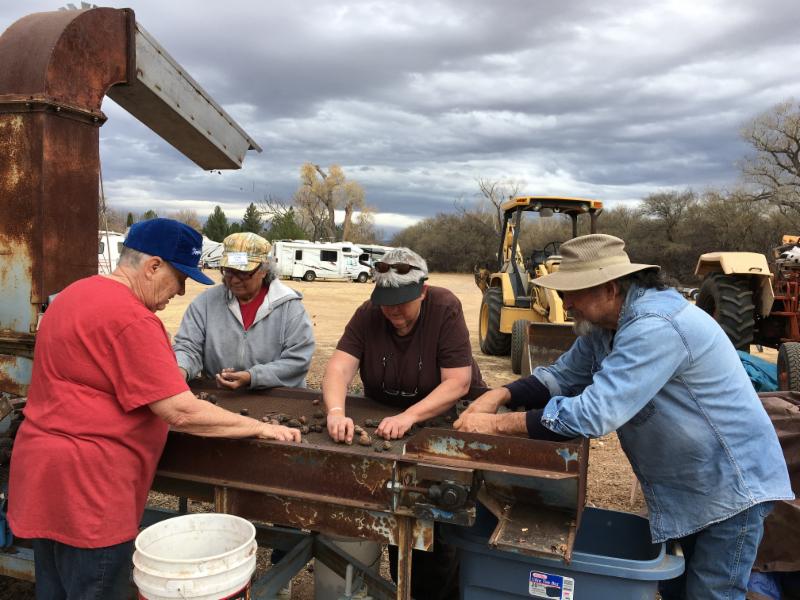
Marika and I grabbed for the perfect pecans, picking them up, first, one at a time, then by the handful, as the machine seemed to get faster. Yes, there were jokes about Lucy and Ethel and the chocolate factory, and it was easy to miss a few pecans. When there were too many nuts on the belt to sort through, Annie would stop the conveyor belt and we’d pick out the good ones, toss the trash over our shoulders, and then Juan would sweep the rest to the compost chute.
After a few minutes of working at the fast moving belt, the sideways motion of the screen and the belt below it made me dizzy. So Juan and I switched places and I was now in charge of quality control.
Above us the sky shifted from silver gray to steel, and a breeze kicked up the discarded pods that the machine had spit out. And then it started to drizzle. Annie stopped the machine and we quickly picked through what was on the conveyor belt. Charlie, who had been shoveling the nuts into the machine, wrapped a tarp over the nuts and the machinery to keep everything dry.
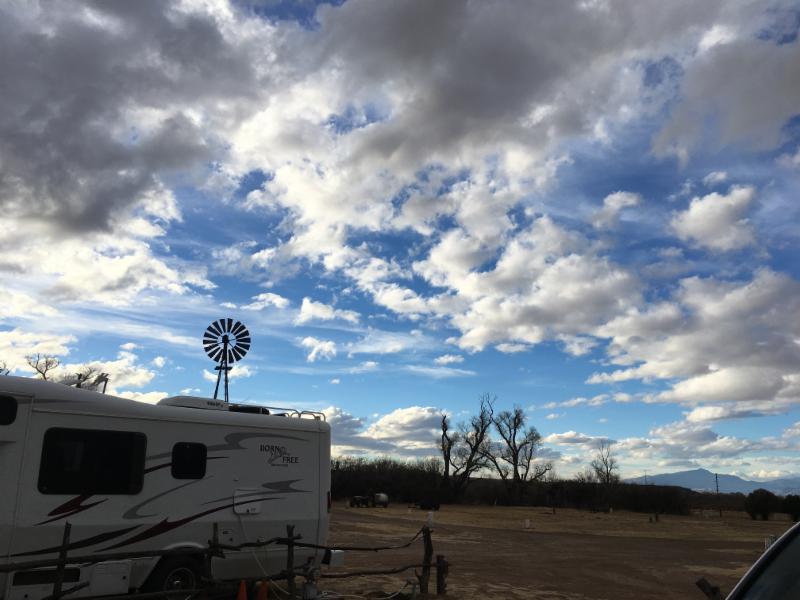
Annie took us into a small building and showed us the nut cracking machines. She explained that they’d dump each of our buckets of pecans into the cracker. They’d go through a second machine to shake the pecan meat from the cracked shells, then they’d soak the shelled nuts overnight to further loosen the nut meat from the shells. The nuts would be dried on a screen in the sun, then taken up to the community room to be shelled. It was cool that we had been a part of the first and last steps of the pecan process.
We walked home in a light drizzle and watched some TV and then, even though a previous me would have been peopled out by now, I said yes to meeting with Thelma and Annie for happy hour at five. Marika brought a beer, I had my bottle of water, and we sat outside, wrapped in jackets, sharing stories, and feeding pretzels to the peacocks and hens.
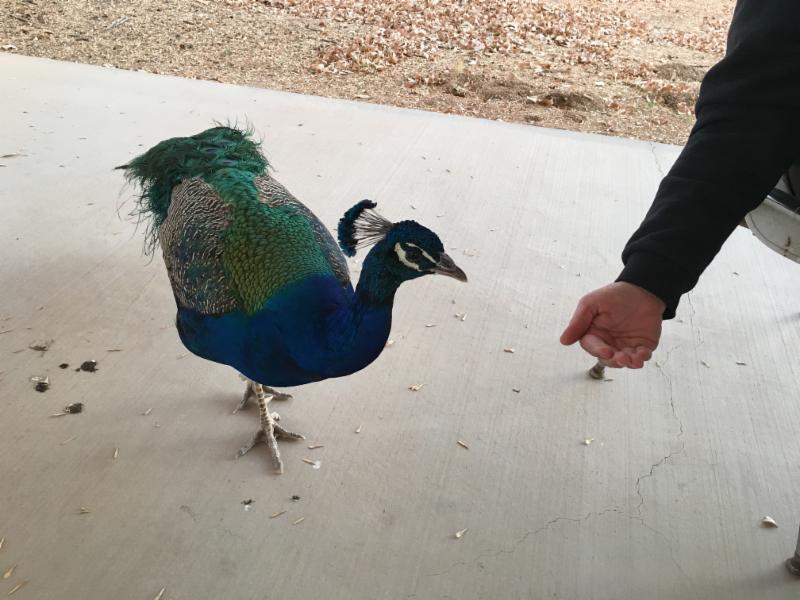
We watched the peacocks hop into highest branches of the giant cottonwood tree near the chapel to roost for the night. The distant storm skies darkened and the sun went down, and it was quickly too cold to stay outside. We said goodnight and there were hugs all around.
In the morning, I gave Thelma a copy of my book to share with everyone, and we stopped at the gift shop to buy a loaf of the famous monastery bread and, of course, a three-pound bag of pecans for the road.
Readying

It’s our last Wednesday in the Big City. We were originally going to leave today, but after a great day at the river with friends, I got the head cold crud last week, and Marika got it on Saturday. So we’ve been laying low and resting, versus getting out and taking care of everything we need to do to get ready.
On New Year’s Day we lounged in our pajamas, watched the Rose Bowl parade, then we walked a new labyrinth. I made some veggie soup in the Instant Pot and we relaxed the rest of the day.

I was still getting tired after the smallest efforts, and I started to freak out about everything that needed to happen for us to leave. And so we changed our Wednesday departure to Thursday and cancelled plans to meet up with a friend.
But I still felt anxious. I realized that I needed another extra day, so we cancelled our Thursday night reservation in Patagonia and even got a refund for that night. And suddenly, I felt that three days would give us enough time to feel better and still get everything done.
And so finally, this morning, my head is clearing, I am hardly coughing, and I have most of my energy back. And so does Marika.
This readying is different. We’re not moving from one stationary location to another. We’re heading out for some camping and road living. Away from big city conveniences like Costco for dog food, and an abundance of supermarkets and fresh produce.
So we need to do a bit more stocking up on favorite foods and supplies, and make sure everything is in prime working order before we head out for this next adventure.
Last week we had a new RV guy come out to replace the water pump. We also have a new transmission pump in the car for towing, the tires and batteries and fluids have been checked, and we are ready to be on the road.
We’re heading south to Patagonia Lake State Park, just a few miles from the Mexican border. The birds are plentiful there this time of year. We’ll be at the Wings Over Willcox birding festival January 10-14, and meeting up with a friend who is on her own road trip back from the east coast. From there, we have a direction and a destination: the Texas Coast by February 5, but no firm plans or reservations to get there. And I like how that feels.
I want to ease into being on the road again. I want to be open to what we see and discover. And I want to connect with people as we travel. So let me know if you’re on our route and we’ll make a plan!

I posted on Facebook that my word this year is Passage. It’s actually a word I used in 2014, when I was setting out on my first ever solo RV Heart Sparks Road Tour across the country.
It is still a gorgeous guide for me, but I’ve also chosen the word ENGAGE. Because it challenges me, and will move me to a bigger, better version of myself. Because sometimes it is easier for me to just stay in my perfect little world, in my own thoughts, in my own habits and routines, than to reach out.
But that’s not my best way to grow. I realize that I need connections with other people, big, small, in a grocery store, in a coaching circle, to truly “spark my heart and ignite my life.”
And engage also means “to put into gear, take action,” and I like that too.
And so, yes, as part of that gentle nudge to the edge of my solitary comfort, I am facilitating a virtual women’s coaching group, the Heart Sparks Circle. We’ll meet once a week, beginning in February, via a private video chat, to explore what we each need and crave and also no longer want in our lives.
We’ll use my book Heart Sparks: 7 Practices For Loving Your Life as our weekly guide. If you’re curious, or interested, you can read all about it here. Or email me and we’ll set up a time to chat.
